Guides / Design for Manufacture
Tonearm Component Machining: Bearing Housings and Headshells
October 25, 2026
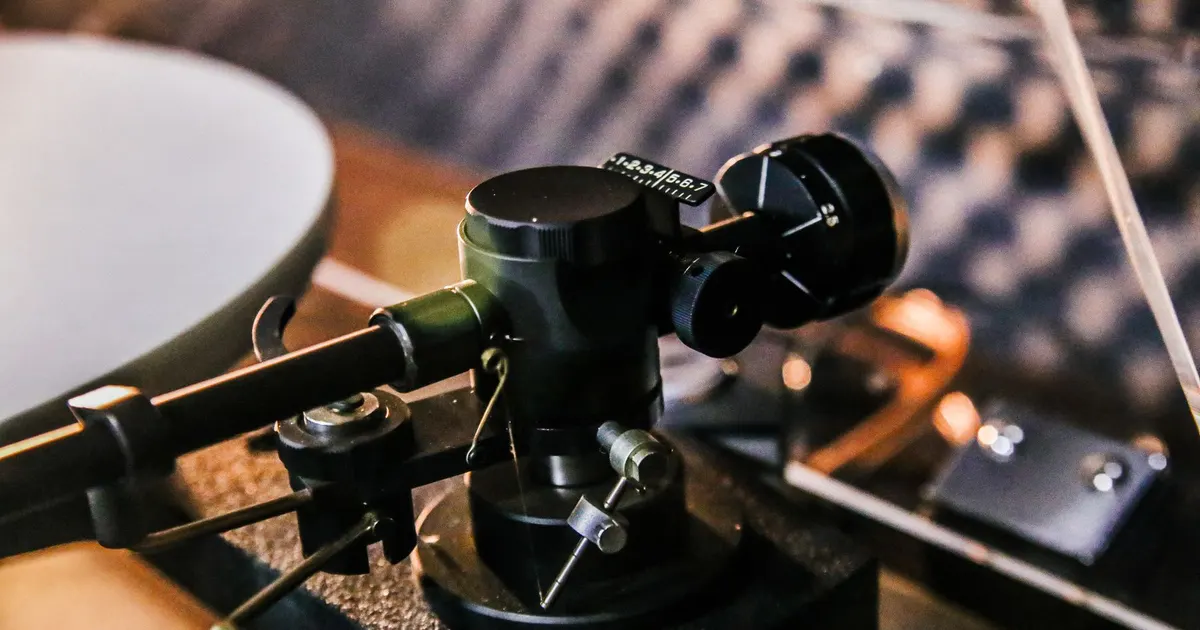
A tonearm is a precision instrument disguised as a piece of furniture. Its parts move on bearings that must have almost no play and almost no friction, and carry a cartridge that reads a groove a few hundredths of a millimetre wide. The machining reflects that. Most dimensions that look generous on an amplifier chassis are tight here.
The parts of an arm
A typical arm has six machined parts.
- Base or pillar, which mounts to the turntable plinth and carries the vertical pivot.
- Bearing housing, which holds the horizontal and vertical bearings.
- Arm tube, covered separately in carbon fibre vs aluminium tonearm tubes.
- Headshell or headshell collar, which holds the cartridge.
- Counterweight, which balances the arm and sets the tracking force.
- Fittings: height adjustment collar, anti-skate parts, lift mechanism and the cable outlet.
Each has a different mix of precision and cosmetic needs.
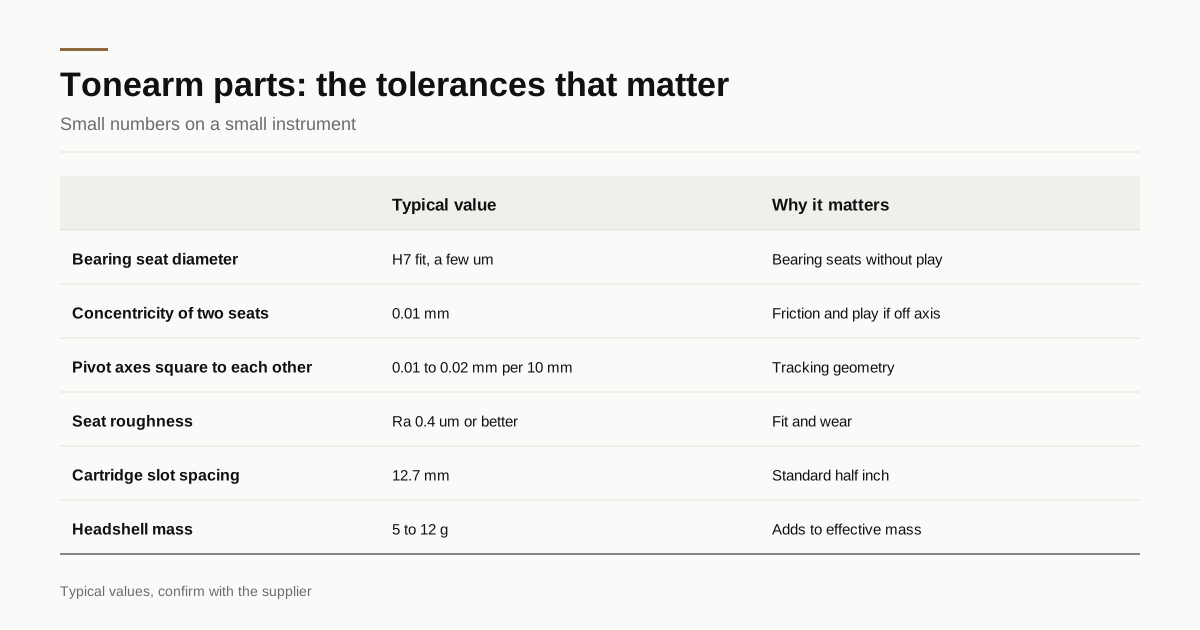
Typical figures
These are typical values, not promises. Confirm with the shop quoting your part.
| Feature | Typical value | Why it matters |
|---|---|---|
| Bearing seat diameter | H7 fit, a few µm | Bearing must seat without play |
| Concentricity of two seats | 0.01 mm | Misalignment causes friction and play |
| Perpendicularity of pivot axes | 0.01 to 0.02 mm per 10 mm | Affects tracking geometry |
| Seat surface roughness | Ra 0.4 µm or better | Bearing seat wear and fit |
| Cartridge mounting slot spacing | 12.7 mm (half inch) | Standard cartridge hole spacing |
| Headshell mass | 5 to 12 g | Counts toward effective mass |
| Counterweight tolerance | ±0.1 g on mass | Sets tracking force range |
| Pivot to spindle distance, a common 9 inch arm | About 222 mm | Fixed by the geometry of the arm |
Bearing housings
The bearing housing is the heart of the arm. It holds the bearings that let the arm swing sideways and up and down.
Two common designs use ball bearings or point-type pivots. A gimbal design uses two pairs of small ball bearings, one for each axis. A unipivot design uses a single point resting in a cup. Housings for both need very accurate bores.
Bore tolerance. A ball bearing seat is bored to a fit such as H7, which on a 10 mm bore means a window of about 15 µm. The bearing is pressed or glued in, so the seat must not be oval or tapered.
Concentricity. The two bearings on one axis must share the same centre line, within about 0.01 mm. If the two seats are cut in separate setups, errors add. The reliable method is to machine both in one clamping on a rigid lathe or a precision mill, or to bore through from one side in a single pass.
Perpendicularity. The horizontal and vertical axes must be square to each other. Errors cause the arm to behave differently at different angles. The housing is machined on a machine that can hold square faces to a few hundredths of a millimetre.
Surface finish. A fine boring or reaming pass gives a smooth seat. A rough seat wears and loosens a glued bearing.
Tolerance control on a small precision part follows the same principles as on large panels, though with smaller numbers. The reasoning for how errors add up is in tolerance stack basics for audio enclosures.
Anodizing and precision seats
Anodize and bearing seats are a tricky mix. The coating grows into the seat, reducing the bore, and the thickness varies slightly by position. A seat that was within a few micrometres can end up outside the fit.
Three approaches are used.
- Mask the seat during anodizing so it stays bare, then finish it.
- Machine the seat after anodizing, leaving a little extra stock in the bore and finishing it after the coating.
- Compensate for the growth, by cutting the bore larger by the known coating growth and checking on a sample.
Which approach to use depends on the maker’s process and on the coating type. Plan it early and write it on the drawing. The growth numbers are in hard anodizing vs Type II.
Headshells
The headshell carries the cartridge, and it is both a mechanical part and a visible one.
Mounting slots. Two slots, 12.7 mm apart, take the cartridge screws. The slots allow the cartridge to slide for alignment, and their width and finish matter. A burr or a rough wall scratches the cartridge or makes alignment gritty.
Connector. The headshell connects to the arm by a bayonet, a four-pin plug or a fixed collar. The connector section must be round and concentric with the arm axis, since it forms part of the alignment.
Mass. A headshell weighs a few grams and adds to the effective mass of the arm, so makers shave weight from non-structural areas. Thin walls and pockets are common, which brings flatness and chatter issues similar to those in machining thick front panels, at smaller scale.
Materials. Aluminum is the usual choice, with titanium or magnesium for low mass. Brass and stainless add mass and are used where damping or style calls for it. Titanium issues are covered in titanium audio parts for headphones and tonearms.
Finish. Anodize, bead blast or brushed finish work well. Edges must be smooth where fingers touch. Colour match with the arm tube needs a sample, as with any anodized pair.
Counterweights
The counterweight is a heavy ring on a rear stub that balances the arm and sets the tracking force. It is made from stainless steel, brass or a denser alloy such as tungsten for compact designs.
The critical features are the bore, which must slide smoothly on the stub with a tiny, even clearance, and the mass, which sets the range of tracking force. A fine thread or a friction fit locks it in place. The ring is often knurled or engraved with a scale for the tracking force.
Because mass matters, the shop weighs the parts and reports the weight. Specify a mass tolerance. Bore and thread issues follow the same logic as for any precision turned part, as in CNC volume knob manufacturing, where knurl and bore are controlled in one lathe operation.
The mass budget
Every gram on the moving side of the arm counts toward effective mass, which for typical arms falls somewhere between about 8 and 25 g. The tube, the headshell, the cartridge and a share of the counterweight all add to it. The designer sets a target and each part gets a share of it.
For the machinist this turns into a weight tolerance. A headshell drawn at 7.0 g that arrives at 7.8 g shifts the whole arm, and the counterweight needs to move to compensate. Ask the shop to weigh finished parts, including coating, since anodize and plating add a little mass. Record the weights on the first article report, so the designer can check the sum against the target before production.
Materials and finishes
| Part | Common materials | Finish |
|---|---|---|
| Bearing housing | Aluminum, stainless, brass | Anodize with masked seats, or plain |
| Base and pillar | Aluminum, stainless | Anodize or blast |
| Headshell | Aluminum, titanium, magnesium | Anodize or blast |
| Counterweight | Stainless, brass, tungsten alloy | Brushed or blasted |
| Fittings | Aluminum, brass | Anodize or plating |
Magnetic materials near the cartridge can affect the signal. Austenitic stainless is mostly non-magnetic but can become slightly magnetic when worked, as described in 303 vs 304 stainless for audio knobs, feet and spikes.
How a shop approaches the work
A shop suited to this work shows several habits. It machines bearing seats in one setup. It measures bores with air gauges or bore gauges, not just calipers. It cleans parts well, since chips in a bearing seat ruin a fit. It keeps the parts at a stable temperature before measuring, since a bore changes with a degree or two. And it can show a record of measured values on a first article.
Ask how the shop checks concentricity and what equipment it uses. A shop that answers clearly is a better fit than one that quotes a tolerance without a method.
Cost
Tonearm parts are small, so material cost is low and machining time dominates. Precision bores, multiple setups and inspection raise the price per part. At low volume, expect the cost to be driven by setup and checking time. At higher volume, dedicated fixtures and programs bring it down. The general cost structure is in what an amplifier chassis costs to manufacture.
What to put on the drawing and in the RFQ
- Bore sizes with fit class and concentricity between seats
- Perpendicularity between pivot axes
- Surface roughness for bearing seats
- Material, anodize type and which surfaces are masked or machined after coating
- Headshell slot spacing, width and finish
- Counterweight mass and bore tolerance
- Inspection method and the first article measurement report
- Quantity and yearly volume
Send the drawings through the RFQ form and we match them with up to 3 shops used to small precision parts, with a reply within 24 business hours.
See also: turntable components and the callout each part is judged on.
Frequently asked questions
How tight are the tolerances on a tonearm bearing housing?
Bearing seats usually need diameters held to a few micrometres, often an H7 type fit, and the two bearing seats on one axis need to be concentric to about 0.01 mm. The housing is machined in one setup where possible so both bores share the same axis.
Can a tonearm part be anodized after machining the bearing seat?
Only if the seat is masked or the size allows for the coating. Anodize grows into and out of the surface, so a precision bore can close or shrink out of fit. Many makers machine or ream the seat after anodizing, or leave it bare.
What material is best for a headshell?
It depends on the arm's design goals. Aluminum is light and common. Titanium and magnesium are used where a very low mass or particular damping is wanted. The material matters less than the stiffness of the design and the quality of the mounting slots and connector.
Need a quote for this part?
Send the drawing. We match you with up to 3 shops and reply within 24 business hours.
Get matched with an audio parts shop