Guides / Cost
Titanium Audio Parts: Headphone Yokes, Tonearms and Cost
October 24, 2026
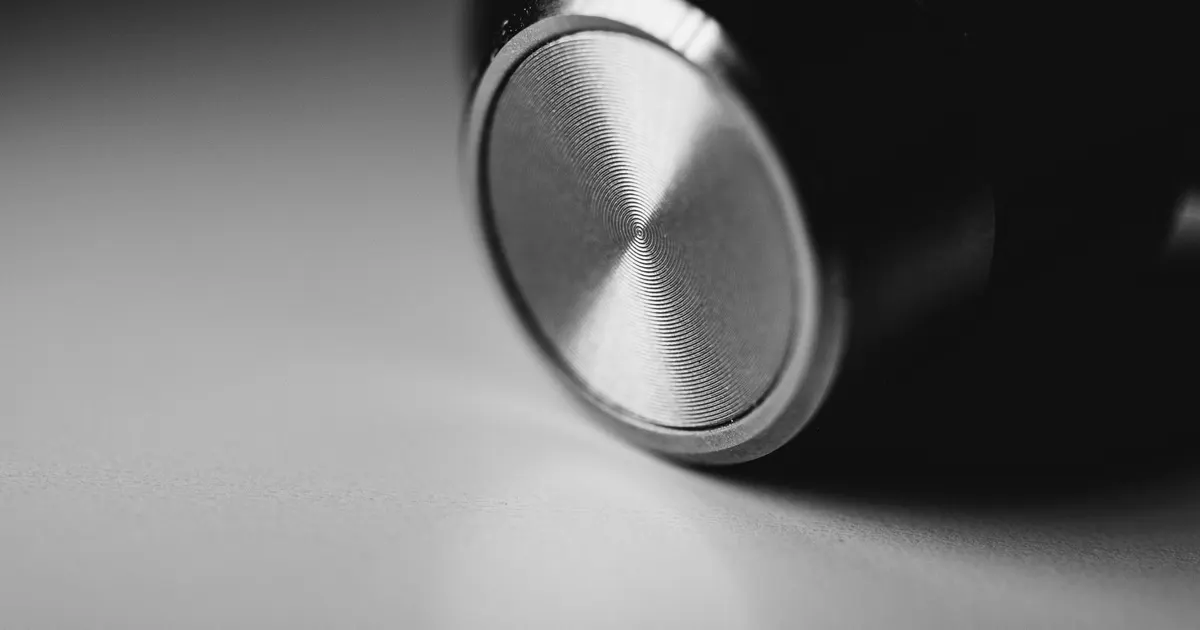
Titanium sits at the top of the material ladder for audio hardware. It is light for its strength, it does not corrode, it feels cool and substantial in the hand and it takes striking anodized colours. It is also slow and expensive to make into parts. The sensible approach is to use it where its properties do real work and to use plain metals everywhere else.
Two grades cover most audio work
Commercially pure titanium, Grade 2, is soft, formable and very corrosion resistant. It is easier to machine than the alloy grade and takes colour anodizing evenly. It suits cosmetic parts, small housings and parts that bend.
Ti-6Al-4V, Grade 5, is the alloy workhorse, with about 6 percent aluminum and 4 percent vanadium. It is roughly twice as strong as Grade 2, harder to machine and the usual choice for yokes, sliders, fasteners and structural parts.
A third family, such as beta alloys, is used for springs and sports products, and it rarely appears in audio.
Typical figures
These are typical values, not promises. Confirm with the shop quoting your part.
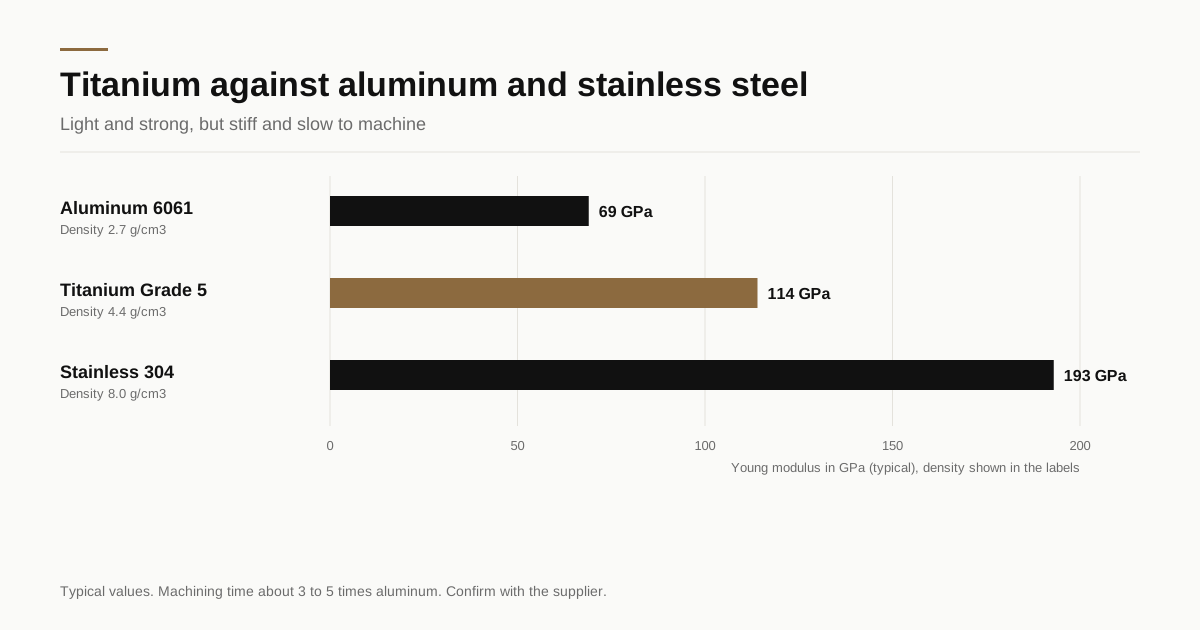
| Property | Aluminum 6061 | Titanium Gr 5 | Stainless 304 |
|---|---|---|---|
| Density | 2.7 g/cm³ | 4.4 g/cm³ | 8.0 g/cm³ |
| Tensile strength, typical | 290 to 310 MPa | 900 to 1000 MPa | 500 to 700 MPa |
| Stiffness, Young’s modulus | 69 GPa | 114 GPa | 193 GPa |
| Thermal conductivity | About 167 W/m·K | About 7 W/m·K | About 16 W/m·K |
| Machining time, relative to aluminum | 1x | 3 to 5x | 2 to 3x |
| Bar cost per kg, rough multiple of aluminum | 1x | 8 to 15x | 3 to 4x |
The thermal conductivity row explains the machining problem. Aluminum carries heat away with the chips. Titanium keeps it at the cutting edge.
Where titanium actually helps
Headphone yokes and sliders. A yoke carries the weight of the cups and takes thousands of flex cycles when the headband is adjusted. Titanium has high strength and good fatigue life, so a thin, light yoke stays straight and does not crack. This is the clearest case for the material. The cup side of headphone manufacturing is described in headphone cup manufacturing.
Tonearm tubes and headshells. Here titanium is chosen for stiffness against weight and for its damping behaviour. Its modulus is higher than aluminum, so a tube of the same diameter bends less, and its density is lower than steel. Titanium’s internal damping is modest, so the benefit is real but not dramatic, and other materials compete. The comparison with carbon fibre is explored in tonearm tubes in carbon fibre and aluminium, and bearing and headshell geometry in tonearm component machining.
Fasteners and small hardware. Titanium screws are light and do not rust. They are a visible upgrade in a premium product and a small share of its weight.
Skin contact parts. Titanium is inert and rarely causes skin reactions, which suits ear-contact and hand-contact parts for people with metal sensitivity.
Pure style. A titanium knob or a titanium cup cap is a decision about feel and price positioning. It is valid, but it should be a conscious choice, since the performance benefit is small.
Designing a yoke in titanium
A yoke is a good test of whether a design uses titanium well. Three points decide it.
Section. Because titanium is strong, a yoke can be thin, and a thin section is where machining gets harder. A wall under about 1 mm in Grade 5 chatters and springs away from the tool. If the design needs a very thin arm, ask the shop whether it can be made from sheet or formed, instead of machined from a block.
Radii. Sharp inside corners are where fatigue cracks start. Give every inside corner a radius, and make it as large as the styling allows. A 1 mm radius is a minimum in a flexing part, and 2 mm is better.
Surface. A fatigue crack begins at a scratch or a tool mark. A part that flexes in use should have a smooth finish in the stressed area, and light blasting or polishing there helps.
Keep the weight in view too. A titanium yoke saves grams, but the saving is only useful if the rest of the headphone is light as well. Check the whole mass budget before specifying the material.
Sourcing and traceability
Titanium bar and plate come from mills with a certificate that lists chemistry and mechanical properties for each heat. For a premium audio product, ask the shop to supply that mill certificate with the order and to keep parts from one heat together. That is a record of the stock, not a claim about the shop, and it settles questions about grade if a problem appears later.
Lead times for titanium bar can run longer than for aluminum, especially in unusual sizes. Tell the shop your yearly volume early, since many buy stock in advance for planned jobs. The timing logic is covered in MOQ and lead time for audio parts.
Why machining is hard
Four properties combine to make titanium difficult.
Low thermal conductivity. Heat from cutting stays at the tool tip, instead of leaving with the chip. Tool wear is rapid.
Chemical reactivity. At cutting temperature, titanium tends to weld to the tool and wears it by diffusion. Carbide tools with suitable coatings are standard.
Work hardening and springback. The surface hardens if the tool rubs. Thin walls spring back from the tool, which leads to chatter and size errors.
Low modulus. The part flexes under cutting force, so long thin features need support.
Shops respond with slow speeds, sharp tools, generous flood coolant and rigid fixtures. They avoid dwelling, since stopping a cut with the tool still in contact leaves a work-hardened mark. Fine titanium chips and dust can ignite, so shops keep the area clean and avoid dry cutting of fine swarf. The result is cycle times three to five times those of aluminum, and a scrap risk that makes first articles important.
Colour by anodizing
Titanium anodizing is a different process from aluminum. The part is made the anode in a mild electrolyte, and the voltage controls the thickness of a very thin oxide, tens to a few hundred nanometres. The oxide reflects light with an interference effect, so the colour depends on thickness and not on a dye.
Colours step up with voltage: bronze and gold at low voltage, then purple, blue, light blue, then a series of greens, pinks and others at higher voltage. The finish looks vivid and metallic and has no dye to fade. It also has limits.
- Colour depends on the surface. A bead-blasted part, a brushed part and a polished part all look different at the same voltage.
- Colour varies with alloy and lot. Grade 2 gives clean even colour. Grade 5 can show slight differences between areas.
- The oxide is thin, so it is not a wear coating. Abrasion exposes the metal and the colour wears at edges.
- Matching two parts needs a physical reference, just as it does for aluminum. See the approach in anodize colour matching for hi-fi.
If a part needs hardness as well as colour, it may need a different treatment. Ask the shop what is available.
Surface finishes
Titanium looks best with one of four finishes.
- Bead blast gives a soft grey matte, even and forgiving. It is the most common cosmetic finish and the cheapest. See bead blasting audio enclosures for the look and the process, which works the same on titanium with different media.
- Brushed gives a directional grain. It works on flat parts, and the brushing is slower than on aluminum.
- Polished is possible, though titanium polishes to a warm grey sheen, not a mirror like stainless or aluminum.
- Anodized colour over a bead-blasted surface gives the soft, saturated look seen on premium products.
Cost: a realistic picture
Titanium cost has three layers.
Material. Bar and plate cost many times the aluminum price per kilogram. The multiple varies with grade, form and quantity, and small lots buy at a premium.
Machining. Cycle time is several times longer, tools wear faster and scrap risk is higher.
Finishing. Anodizing and blasting add cost, though titanium finishing is cheaper than polishing aluminum to a mirror.
A rule of thumb is that a titanium part costs five to ten times the same part in aluminum, with wide variation by geometry. Small parts with little machining sit at the lower end. Large parts with deep pockets sit at the higher end. For the general cost structure, see what an amplifier chassis costs to manufacture.
Three decisions lower the bill. Use titanium only on the parts where it works, for example a yoke and a headshell, and aluminum elsewhere. Simplify geometry so fewer setups are needed. And choose Grade 2 where strength is not critical, since it machines faster.
What to put on the drawing and in the RFQ
- Grade and form, for example Ti Grade 5 bar, with mill certificate for the stock if traceability matters
- Critical dimensions and the stiffness or strength requirement
- Finish: bead blast, brushed or polished, then anodize colour with a reference sample
- Which dimensions apply after finishing
- Quantity and yearly volume
- First article before the full run, since scrap is costly
Send the drawing through the RFQ form and we match it with up to 3 shops that machine titanium, with a reply within 24 business hours.
Frequently asked questions
Is titanium worth it for headphone parts?
For yokes, sliders and springs, often yes. Titanium combines low weight with high strength and good fatigue behaviour, so a thin yoke stays light and does not fatigue. For a part that is only looked at and not stressed, the price premium buys a story more than a performance gain.
Why is titanium so much more expensive to machine?
It cuts slowly, wears tools quickly and conducts heat poorly, so the heat stays in the tool and the cut. Cycle times are several times longer than aluminum, tools are replaced more often and scrap risk is higher. The bar itself also costs a good deal more.
Can titanium be coloured like aluminum?
Yes, but by a different process. Anodizing titanium grows a thin oxide whose thickness produces colours by light interference, from gold through purple and blue. There is no dye, so the colour is set by voltage and depends on the surface condition.
Need a quote for this part?
Send the drawing. We match you with up to 3 shops and reply within 24 business hours.
Get matched with an audio parts shop