Guides / Cost
Billet Aluminium Speaker Cabinets: Machining and Assembly
October 12, 2026
A billet aluminum speaker cabinet starts as a slab and ends as a sculpted shell. It is the most expensive way to make a speaker box, and for a small group of brands it is the point of the product. The machining is long, the parts are heavy and the finishing is awkward. Knowing where the cost sits helps decide whether the design is right for the volume.
Three ways to build an aluminum cabinet
| Route | How it is made | Typical use | Relative cost |
|---|---|---|---|
| Fabricated plates | Cut plates joined by screws, dowels or welds | Compact cabinets, bookshelf size | Medium |
| Extruded tube with caps | A profile for the body, machined plates close the ends | Slim towers, cylinder shapes | Medium to low |
| Billet shell | Walls and baffle milled out of thick plate or blocks | Statement products, curved forms | High |
True billet cabinets often combine pieces: a front baffle from a thick plate, side walls from plate and a rear panel that carries the terminals. Each piece is machined from a block, and the pieces are bolted with a gasket. A single block milled into a complete box is possible only for small cabinets, because the machine and the block have to be large.
Where the material goes
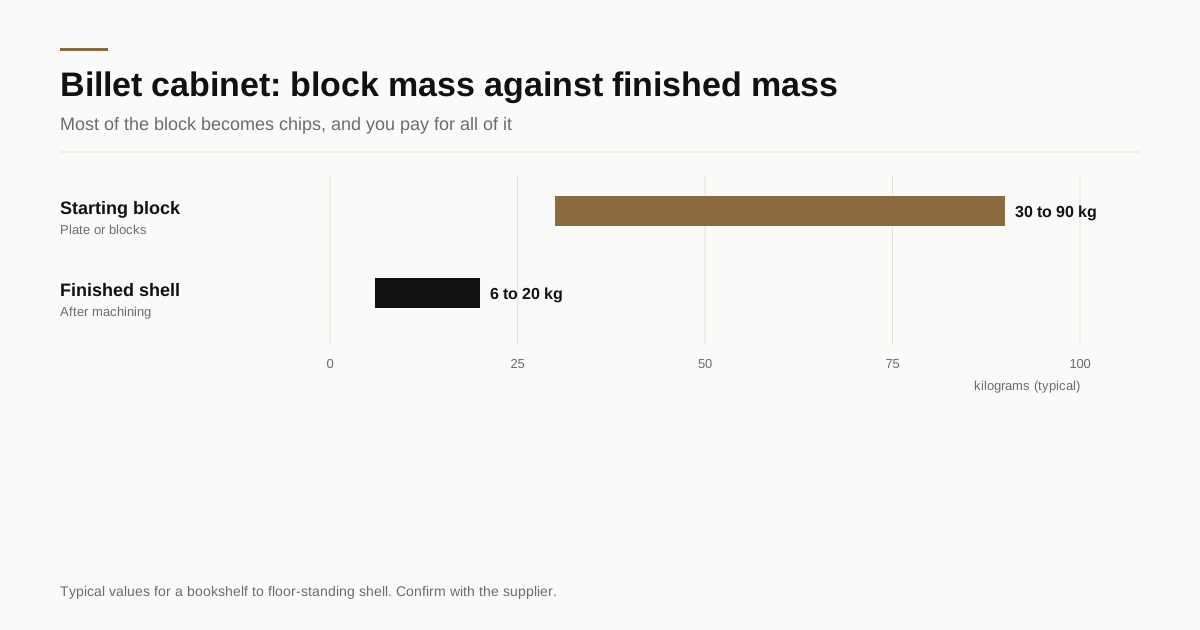
Billet machining removes most of the block. A cabinet shell with 15 mm walls and a clear internal volume of 15 litres might start from 50 to 70 kg of plate and finish at 8 to 12 kg. The rest becomes chips, which are recycled at low value.
That ratio drives two costs.
Material. You pay for the starting weight at plate prices, not for the finished weight. A thick plate costs more per kilogram than thin stock, because of the rolling and the stress relief.
Machine time. Removing 40 or 50 kg of aluminum takes hours of roughing on a large machine. Modern machines remove aluminum quickly, but cabinets are big and the work adds up.
Designers reduce both by choosing a thinner plate, by using fabricated parts where a billet shape is not visible, and by keeping internal cavities simple.
Typical figures
These are typical values, not promises. Confirm with the shop quoting your part.
| Item | Typical range | Notes |
|---|---|---|
| Wall thickness | 8 to 25 mm | Thicker walls resist ringing and cost more |
| Front baffle thickness | 15 to 40 mm | Deep driver rebates need thickness |
| Starting block mass | 30 to 90 kg | Depends on size |
| Finished cabinet mass | 6 to 20 kg | Shell only |
| Driver cutout tolerance | ±0.1 mm | Flange must seat |
| Flatness of joint faces | 0.1 mm | Gasket compression and seal |
| Machine bed length needed | 1000 to 2000 mm | Many shops cannot take parts this size |
Machining the baffle
The front baffle is the visible part, and it carries the most detail: driver cutouts, rebates for the driver flanges, a bright chamfer and mounting holes.
Driver cutouts and rebates. A round hole for the driver with a stepped rebate for the flange. The rebate depth lets the flange sit flush with the face. Diameters need ±0.1 mm so the driver fits without a visible gap.
Mounting holes. Threaded holes for driver screws. Because the baffle is thick, the threads can be cut directly in aluminum with enough engagement, or inserts can be used where the driver is changed often. See threads in anodized chassis for how coating and threads interact.
Chamfer and edge. A bright chamfer around the baffle is common. See diamond cut chamfers on audio panels.
Flatness. A thick plate with big cutouts can move as stress releases. The sequence of rough, rest and finish applies exactly as described in machining thick front panels, at a larger scale.
Walls, bracing and the ringing problem
An aluminum box rings when struck, as aluminum has low internal damping. In a speaker, panel resonances can colour the sound. Designers use four tools.
- Thick walls. Stiffness rises with the cube of thickness, so doubling a wall thickness makes it eight times stiffer in bending and pushes panel resonances higher.
- Internal bracing. Ribs or cross members divide a large panel into smaller, stiffer areas.
- Damping layers. A bitumen-type sheet, a constrained layer or a foam lining absorbs vibration energy.
- Mass. A heavy box moves less for a given driver force.
Machined ribs are part of the billet advantage, since they come out of the same block. The principles are discussed in chassis resonance and damping.
Joints, seals and assembly
A cabinet made of several machined parts needs reliable joints.
- Gaskets. A flat gasket or an O-ring in a groove seals the joint between baffle and shell, and damps rattle. The groove depth and width must be machined to the gasket’s specification.
- Fasteners. A ring of screws holds the joint. Spacing is typically 30 to 60 mm to keep clamp pressure even.
- Inserts. Steel inserts in aluminum threads give a strong, reusable fixing for service access.
- Terminal and port holes. The rear panel carries binding posts and a port tube if the design is ported. Binding post geometry is in speaker terminals and binding posts.
Seal quality matters. An air leak in a sealed cabinet changes the bass response. Tell the shop how the joints are to be checked, for example by a pressure test.
Finishing large parts
Finishing is where large billet cabinets often struggle.
Anodizing tanks. Many anodizing shops have tanks 1 to 2 metres long, and a cabinet part must fit with room for racking. Ask for the maximum part size before choosing the design.
Colour uniformity. A large flat face shows variation across its area. Racking points and the position in the tank affect the result. The control steps are in anodize colour matching for hi-fi.
Rack marks. On a big visible face, a rack contact point leaves a bare spot. Mark where it may go on the drawing, such as inside a rear port.
Surface finish. Bead blast hides machining marks on large faces. Brushed finishes show variations along long runs. The comparison is in bead blasting audio enclosures.
Handling. Large parts are heavy and scratch easily. Soft supports, lifting straps and protective film are part of the process.
When billet is the wrong call
Billet suits a product whose cabinet is the brand. It is a poor fit when the volume is high, when the shape is a plain box or when the price has to match wooden competitors. A rectangular box with flat walls gains little from being milled out of a block, and fabricated plates or an extruded tube give the same look for far less.
A fair test is to ask what the customer sees that a fabricated version could not show: a continuous curve, a seamless corner, an integrated heatsink-style rib. If the answer is nothing, quote both routes and compare. The difference is often large enough to decide the project.
Shipping, weight and handling
A pair of billet cabinets can weigh 25 to 40 kg before drivers and packing. That weight changes freight class, crate design and the labour needed to move parts through the shop. A cabinet shell scratches far more easily than it dents, so packing is built around surface protection: protective film on finished faces, foam blocks cut to the part shape and a crate that holds the shell without pressing on the baffle.
Tell the shop how the parts will travel. A shell that ships alone to an assembly site needs different packing from one that ships complete with drivers. The packing principles for finished parts are in packing finished audio parts, and weight is a good reason to ask for a packing quote with the part quote.
Cost: a realistic picture
Billet speaker cabinets cost many times their wooden equivalents. The cost splits into material, machine time, finishing and handling, with machine time and material taking the largest shares. A pair of cabinets is two or four large parts, each with long cycles, so even small volumes need a significant order value.
Three decisions change the price a lot.
- Choose where billet shows. Use billet for the baffle and visible shell, and fabricated plates for the rest.
- Reduce the removed volume. Hollow only what is needed, use thinner stock where stiffness is not critical.
- Allow for stock sizes. Design to a standard plate thickness, to avoid paying for a thicker plate than needed.
The general cost logic is in what an amplifier chassis costs to manufacture, and the routes compared in billet, extrusion and sheet chassis.
What to put on the drawing and in the RFQ
- Cabinet construction: single shell, joined plates or extrusion with caps
- Wall thickness, rib layout and driver cutout details with rebate depth
- Flatness of joint faces and gasket groove dimensions
- Alloy and plate thickness, with stress-relieved temper
- Finish: blast or brushed, then anodize type and colour, with maximum part size noted
- Rack and handling points
- Pressure test or leak check requirement
- Quantity and yearly volume
Send the drawings through the RFQ form and we match them with up to 3 shops with large machines, with a reply within 24 business hours.
See also: loudspeaker machined parts from cabinet to spikes.
Frequently asked questions
Why are billet aluminum speaker cabinets so expensive?
Because most of the block becomes chips. A cabinet can start as 40 to 80 kg of plate and finish at 8 to 15 kg, so you pay for the material, the long machine time to remove it and the large-part handling and finishing. A wooden cabinet of the same volume costs a small fraction of that.
Does an aluminum cabinet ring?
Aluminum is stiff and light on damping, so a bare thin-walled box can ring at its panel resonances. Billet designs use thick walls, internal ribs and damping layers to control it. Whether the result sounds better than a damped wooden box depends on the design.
Can a large billet cabinet be anodized?
Yes, if the part fits the shop's tanks and racks. Large parts need a big tank, careful rack points and even colour across big faces. Some shops can do it. Many cannot, so ask early about the maximum part size.
Need a quote for this part?
Send the drawing. We match you with up to 3 shops and reply within 24 business hours.
Get matched with an audio parts shop