Guides / Design for Manufacture
Carbon Fibre vs Aluminium Tonearm Tubes: Stiffness and Cost
October 26, 2026
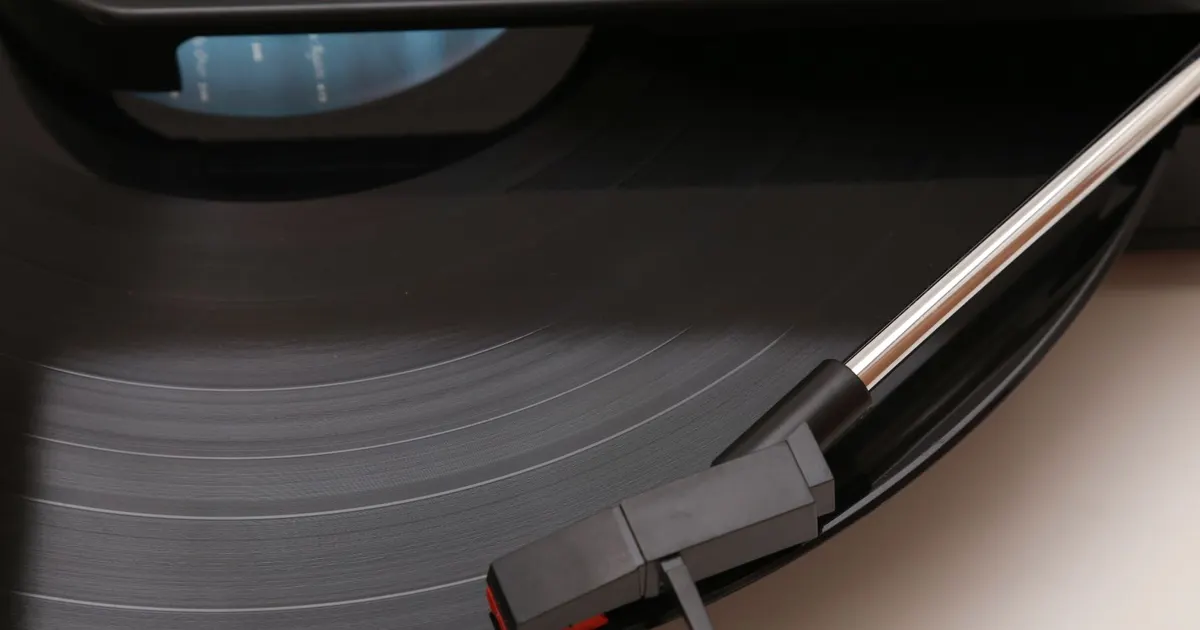
The tube is the longest and most visible part of a tonearm, and the one that gets the most talk. It carries the cartridge at one end and the bearing and counterweight at the other, and it has to be stiff enough not to flex or ring under the forces that a groove puts on a stylus. Two materials dominate: aluminum and carbon fibre. Each has a clear logic, and the manufacturing side differs more than the marketing suggests.
What the tube has to do
A tonearm tube has three jobs.
Hold the headshell and cartridge in a rigid line against the bearing. Any bend between the two moves the stylus in ways that a record groove did not ask for.
Keep its own resonances out of the way. Every tube rings at some frequencies. A good design pushes the main resonances above or below the range that matters and damps what remains.
Keep effective mass in range. Effective mass is the mass the cartridge sees at the stylus, including the tube, headshell and part of the counterweight. It must match the compliance of the cartridge, and a lighter tube makes this easier.
Stiffness, mass and damping are therefore the numbers to compare. Cosmetics matters too, since a tube is an obvious design element.
Typical figures
These are typical values, not promises. Confirm with the shop quoting your part.
| Property | Aluminum 6061 / 7075 tube | Woven carbon tube | Unidirectional carbon tube |
|---|---|---|---|
| Density | 2.7 to 2.8 g/cm³ | 1.5 to 1.6 g/cm³ | 1.5 to 1.6 g/cm³ |
| Modulus along the tube | 69 to 72 GPa | 40 to 70 GPa | 100 to 150 GPa |
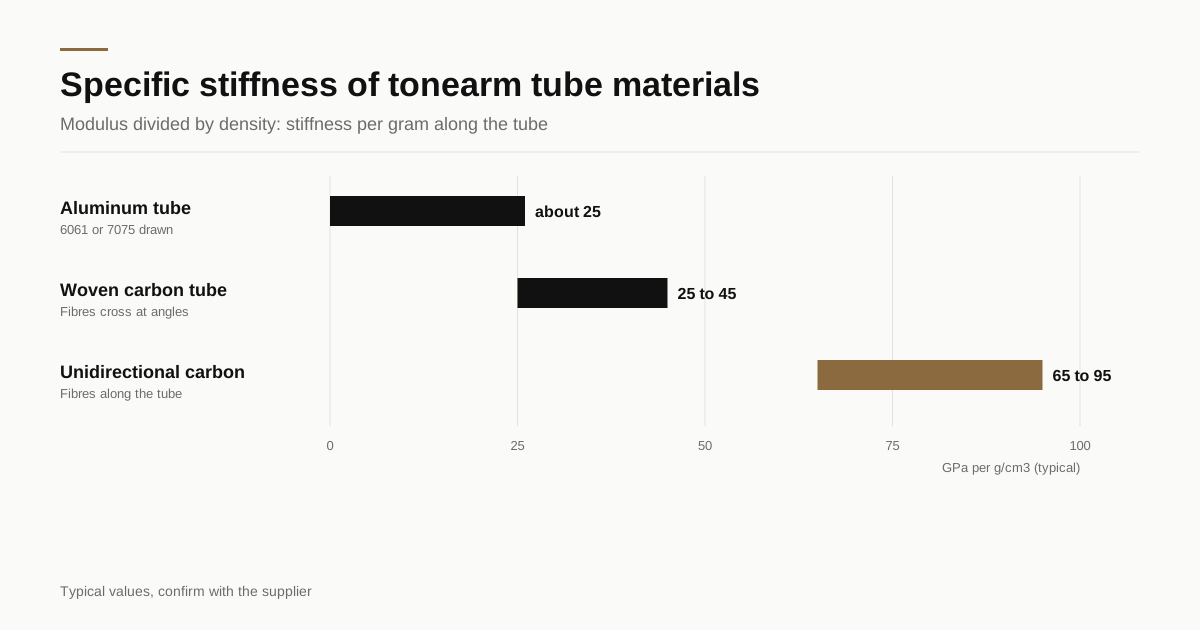
| Specific stiffness, modulus over density | About 25 | About 25 to 45 | About 65 to 95 |
| Internal damping | Low | Higher | Higher |
| Thermal expansion along the tube | 23 µm/m/K | Near zero to small | Near zero |
| Typical wall thickness | 0.8 to 1.5 mm | 0.5 to 1.5 mm | 0.5 to 1.5 mm |
| How it is made | Drawn tube, cut and machined | Rolled prepreg or braided | Pultruded or rolled prepreg |
The specific stiffness row is the headline. Weave and fibre direction matter: a woven tube has fibres crossing at angles, which gives balanced strength but lower stiffness along the length than a tube with fibres lined up. Unidirectional or mostly axial layups give the highest stiffness per gram, with less hoop strength.
Aluminum: the practical choice
An aluminum tube starts as drawn stock, cut to length and machined at the ends. It is easy to buy, consistent, easy to anodize and easy to join to other metal parts.
Advantages: low cost, tight dimensional control, screws or presses straight into fittings, anodized colours that match the rest of the product, and no special handling.
Limits: lower stiffness per gram than carbon, more tendency to ring because aluminum damps itself poorly, and weight that rises quickly if the walls are thickened for stiffness.
Designers compensate with tapered or conical tubes, with internal damping material such as foam or a filling, and with a thicker wall near the bearing. A tapered aluminum tube is more work to make than a straight one. Ask the shop how it forms a taper, as spinning and drawing are different processes with different tolerances.
Carbon fibre: lighter and stiffer per gram
A carbon tube is built from layers of fibre in resin, rolled on a mandrel and cured, or pulled through a die. The maker controls fibre angle and wall thickness to tune stiffness and damping.
Advantages: high stiffness per gram, which allows a lighter arm for the same rigidity, and higher internal damping than aluminum because the resin absorbs vibration. Thermal expansion along the tube is very small.
Limits: higher unit cost, more variation between suppliers, a more demanding joint to metal fittings and handling issues. Cut dust is an irritant and the cut edge can fray.
The tube is normally bought as stock from a composite maker. The shop supplies the cut length, trimmed ends and bonded fittings, and the metal parts around it.
Joining the tube to the fittings
The joint is the weak link in both designs, and it often matters more than the tube material.
Aluminum tube joints. A fitting can be pressed in, bonded, screwed or locked with a grub screw. A press fit with adhesive is common. The joint must not flex under load, so look for a deep socket and a tight fit.
Carbon tube joints. A metal sleeve is bonded over or inside the tube with structural epoxy. The bonded area must be large, since carbon is hard to hold by a screw. Surface preparation, clean abraded surfaces and correct bond-line thickness decide how well the joint lasts. A shop that cannot describe its bonding process is a risk.
Differences in thermal expansion matter: aluminum fittings expand at 23 µm per metre per K, and the carbon tube hardly moves. A rigid bond over a wide temperature range loads the joint, so epoxy with a little flexibility and a modest bond length work better than a hard long bond.
Joint geometry also sets the bearing alignment. Bearing housings and their bore tolerances are described in tonearm component machining.
Machining the ends
For both materials, the tube ends need preparation.
- Cutting to length. A fine saw or a diamond wheel gives a square cut. Aluminum burrs are removed by deburring. Carbon needs a sharp cut to avoid fraying and needs dust control.
- Facing. A light facing cut gives a flat end for bonding or sleeves.
- Holes and slots. Drilling aluminum is routine. Drilling carbon needs a sharp, carbide or diamond-coated bit, backing material to avoid breakout and a slow feed.
- Surface finish. Aluminum tubes are brushed or blasted and anodized. Carbon tubes are gloss clear-coated or left matte, depending on the design.
Because carbon tubes are not machined like metal, the work is closer to composite fabrication than to turning.
Damping fills and internal treatment
Many designers do not rely on the tube alone to control ringing. A tube can be filled or lined to absorb vibration: a plug of foam, a thin layer of damping compound on the inner wall or a rod of a different material inside. This is cheap compared with changing the tube, and it works with both aluminum and carbon.
For manufacturing, a fill adds an operation and a check. The shop needs to know where the damping material goes, what it is and how it is held in place so it cannot rattle loose. A loose plug inside a tonearm tube is a quality fault that a customer notices as a rattle after shipping. The principles of damping in a metal structure are discussed in chassis resonance and damping.
Cosmetics and finish
Aluminum tubes take any anodize colour and match the arm base. A matching process for colour is covered in anodize colour matching for hi-fi. The tube can also be bead blasted or brushed. See brushed finish on audio panels for the principles, which apply to a round tube as well.
Carbon tubes show the weave. A twill or plain weave under gloss lacquer is a recognisable design element. Weave alignment and pattern can vary from one tube to the next, so decide how much variation is acceptable and mark it on the drawing. Clear coat needs care at the ends where the metal fitting meets the carbon, since a visible gap or a bond line shows.
Cost
Aluminum tube stock is cheap and widely available, and machining the ends is quick. Tapered or formed tubes cost more.
Carbon tube stock costs several times more than aluminum tube, depending on layup and supplier, and bonding adds labour. Setup for cure and finish adds more. At low volume the price of a carbon tube is mostly material and handling. At higher volume, supplier pricing drops, though the bonding step stays manual.
A fair comparison includes the whole arm. If a lighter carbon tube lets the designer use a smaller counterweight and a lighter headshell, some of the cost comes back. The general cost logic for audio parts is in what an amplifier chassis costs to manufacture.
How to decide
- If the design relies on lowest mass and highest stiffness per gram, choose unidirectional or axial-heavy carbon.
- If the design values a consistent, machinable, colour-matched part at moderate cost, choose aluminum.
- If you want carbon’s look with fewer risks, specify woven carbon with a clear coat and accept a stiffness closer to aluminum.
- If the joint cannot be bonded well, choose aluminum.
What to put on the drawing and in the RFQ
- Tube material, outer diameter, wall thickness and length with tolerance
- Layup, fibre direction and weave, if carbon
- Fitting material, bore sizes and the joint method
- Bonding adhesive and the bond length
- End finish and cosmetic requirements
- Target effective mass and the other parts it combines with
- Quantity and a sample for first article
Send the drawing and the mass target through the RFQ form and we match it with up to 3 shops that make tonearm fittings and tubes, with a reply within 24 business hours.
Frequently asked questions
Is a carbon fibre tonearm tube always stiffer than aluminum?
Per gram, usually yes, because carbon fibre is stiff and light along the fibres. A woven tube is less stiff along its length than a unidirectional one, and a poorly bonded joint can waste the benefit. A well-made aluminum tube beats a poorly made carbon one.
Does carbon fibre sound better?
That depends on the whole arm, not the tube alone. Tube material changes stiffness, mass and damping, and all three interact with the bearing, headshell, cartridge and counterweight. Treat claims of one material being better with caution, and judge a design as a system.
Can a shop machine carbon fibre tubes?
Cutting to length and trimming the ends is routine with the right tools and dust control. The metal end fittings are usually machined separately in aluminum, brass or stainless and bonded to the tube. Drilling or turning carbon fibre needs sharp or diamond-coated tools to avoid splintering.
Need a quote for this part?
Send the drawing. We match you with up to 3 shops and reply within 24 business hours.
Get matched with an audio parts shop