Guides / Design for Manufacture
Tonearm Counterweight Material: Brass, Stainless or Tungsten Alloy
November 4, 2026
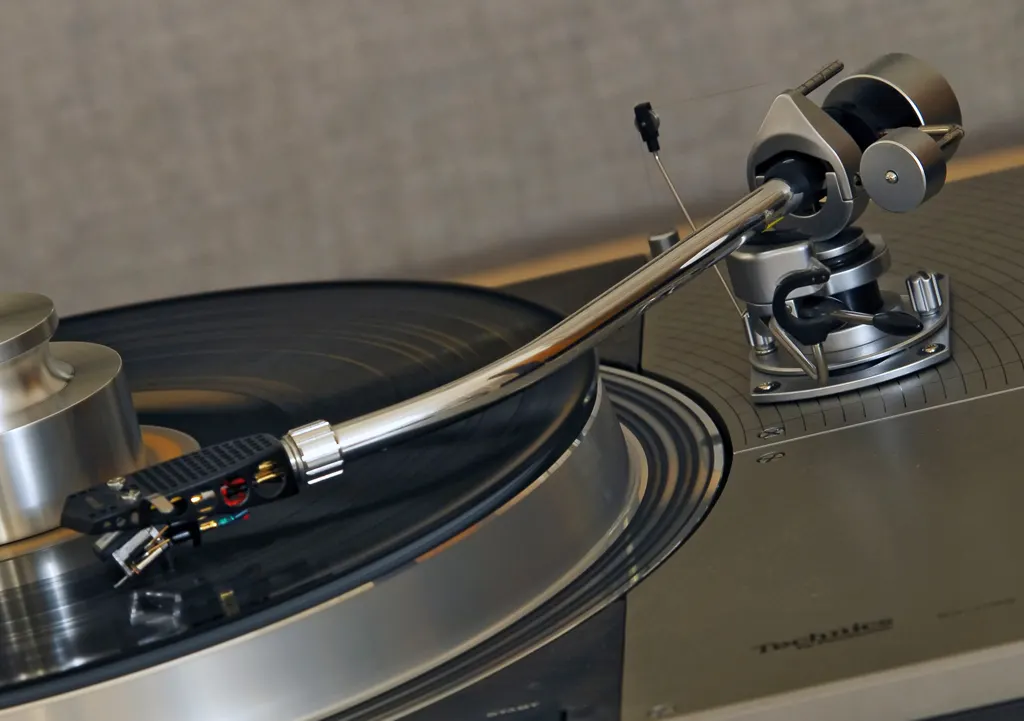
For a tonearm counterweight the choice comes down to density. Brass is the usual economical pick, stainless steel gives a harder surface and a non-magnetic body, and tungsten alloy packs the same balance into a ring about half as long. All three are turned on a lathe, so the real differences are mass control, tool wear and cost.
This guide compares them with the same ring size, shows what the density difference does to stub length and lists what to put in an RFQ. Where the counterweight sits in the arm is covered in tonearm component machining.
What the counterweight does
Reference sources say quality arms use an adjustable counterweight to offset the mass of the arm and the various cartridges and headshells. After the arm is balanced, the tracking force is set by moving the counterweight toward the pivot or by turning a dial. The balance follows the lever rule: each side balances when mass times distance from the pivot is equal, as in the principle of moments. A heavy counterweight close to the pivot balances the same front end as a lighter one placed further out.
That matters for a second reason. For a point mass the moment of inertia is the mass times the square of its distance from the axis. For a fixed balance, a denser counterweight sits nearer the pivot and adds less rotational inertia to the arm. Arm makers define effective mass differently, and some exclude the counterweight, so the designer fixes the definition. Trade sources put low-mass arms at 7 to 11 g and medium-mass at 11 to 20 g (directional figures from a trade explainer).
The materials side by side
| Brass | Stainless steel | Tungsten heavy alloy | |
|---|---|---|---|
| Density | 8.4 to 8.73 g/cm³ | 7.5 to 8.0 g/cm³ | 16.85 to 18.85 g/cm³ (ASTM B777 classes 1 to 4) |
| 30 mm OD, 8 mm bore, 20 mm long ring | 110 to 115 g | 98 to 105 g | 225 to 234 g (class 2), 233 to 241 g (class 3) |
| Length of ring for 100 g | about 17.8 mm | about 19.3 mm | about 8.7 mm (class 2) |
| Magnetic | No | Austenitic grades usually not | Grade dependent, nonmagnetic grades exist |
| Machining | High machinability for free-cutting grades | Harder on tools | Hard, sintered stock, Rockwell C 32 to 35 maximum by class |
| Finish | Polish, lacquer or plate | Brush, blast or polish | Bare or coated |
Figures come from the brass, stainless steel and tungsten reference pages and from a supplier’s reproduction of ASTM B777 classes. The ring masses and lengths are density times the volume of a 30 mm outside diameter, 8 mm bore ring, so they are arithmetic for comparison, not a real counterweight. Stainless steel in the table is the range for the family. See 303 and 304 stainless for audio parts for grade choice.
What the density does to the design
Take a balance moment of 6,000 g·mm, for example 100 g at 60 mm, and the same 30 mm ring in each material:
| Material | Ring mass | Distance from pivot for the balance |
|---|---|---|
| Brass (8.57 g/cm³) | about 113 g | about 53 mm |
| Stainless (7.9 g/cm³) | about 104 g | about 58 mm |
| Tungsten alloy, class 2 (17.5 g/cm³) | about 230 g | about 26 mm |
The tungsten ring is twice as heavy, so it sits about half as far from the pivot. Because the inertia of a point mass goes with mass times distance squared, and mass times distance is fixed by the balance, the inertia is proportional to the distance. In this example the tungsten ring adds about half the rotational inertia of the brass one. It also needs a shorter rear stub. The designer who wants a short, stiff rear end or a low effective mass is the buyer for tungsten. A designer with a long stub and no mass pressure does not need it.
Machining and quality points
- Brass. The reference page lists free machining brass C360 with high machinability. It also lists 2.5 to 3.7% lead for that grade, and notes that California cut its limit for lead in brass from 4.0 to 0.25% on 1 January 2010. If the buyer sells in regulated markets, ask about a lead-free brass early, because it machines differently. Finish and tarnish are covered in brass and copper audio parts.
- Stainless. Choose a free-machining or standard grade by finish and magnetism needs. Austenitic grades are usually non-magnetic, though work hardening can make them slightly magnetic. Stainless is harder on cutting tools than brass, so expect longer cycle time.
- Tungsten alloy. ASTM B777 covers four classes of machinable, high-density tungsten base metal made by consolidating metal powder, and names weights or counter-balances as an intended use. The supplier table lists maximum hardness of Rockwell C 32 to 35 by class, and notes that worked or aged material can reach Rc 46. Higher tungsten content raises density but lowers ductility. The standard sets a machinability check by number of drilled holes (8 for class 1, 6 for class 2, 4 for class 3, 2 for class 4), so say on the order if you need it. Nonmagnetic grades exist for classes 1 to 3 and Class 4 is magnetic only. There is no public price list, so compare quotes on the same drawing and ask for the material certificate.
- Bore and thread. The bore slides on the arm stub with a small even clearance, and a fine thread or friction fit locks it. Hold the bore and the outside diameter in one setup, as for a knob in CNC volume knob manufacturing.
Mass is not controlled by the drawing alone
Density varies inside every grade. Brass is 8.4 to 8.73 g/cm³, about plus and minus 2% around the middle, and tungsten alloy class 2 is 17.15 to 17.85 g/cm³, also about plus and minus 2%. On a 230 g ring that is plus and minus 4.6 g from material alone. Dimensions cannot fix that. Put a target mass and tolerance on the drawing, with a nominated place where the shop may remove material to trim, such as a blind balancing hole on the rear face, or sort and bin the parts by weight. Record the weight on the first article report, with the finish on, as in first article inspection. Plating and anodize add a little mass.
What to put in the RFQ
- STEP model and 2D drawing with the bore, outside diameter, thread and any scale marks
- Material and grade, or the class and magnetic or nonmagnetic requirement for tungsten alloy
- Target mass with tolerance, where trimming is allowed and whether mass is measured before or after finish
- Finish and surface requirements on the visible rim, see surface roughness for cosmetic faces
- Lead or restricted substance requirements for the target market
- Material certificate request and quantity per run
Send the drawing through the RFQ form and we match it with up to 3 shops that turn small dense parts, with a reply within 24 business hours.
Sources
- Tonearm, Wikipedia
- Moment (physics), Wikipedia
- Moment of inertia, Wikipedia
- Brass, Wikipedia
- Stainless steel, Wikipedia
- Tungsten, Wikipedia
- ASTM B777 scope, ASTM
- ASTM B777 class table, supplier reproduction
- What is tonearm effective mass, hifihub
Frequently asked questions
What is the best material for a tonearm counterweight?
There is no single best. Brass is dense, easy to turn and cheap to finish. Stainless steel is slightly lighter and gives a harder, non-magnetic surface. Tungsten alloy is about twice as dense as brass, so it fits the same balance in a ring half the length, at higher cost and with harder machining. The arm designer picks from the stub length available.
How dense is tungsten alloy compared with brass?
Brass is 8.4 to 8.73 g/cm³. Machinable tungsten heavy alloys under ASTM B777 run from 16.85 to 18.85 g/cm³ across the four classes, and pure tungsten is 19.25 g/cm³. So a tungsten alloy ring weighs a little over twice the same ring in brass.
Why do counterweights need a mass tolerance?
The counterweight sets the tracking force range and the balance. Material density varies within a grade, about plus and minus 2% for brass and for tungsten alloy class 2, so the same drawing gives parts that differ by several grams. Specify a target mass and a weighing step, not only dimensions.
Is tungsten alloy magnetic?
It depends on the grade. ASTM B777 lists nonmagnetic grades for classes 1 to 3 and magnetic grades for all four classes. If the counterweight sits near a moving-magnet cartridge or a sensor, ask for the nonmagnetic grade and a certificate.
Need a quote for this part?
Send the drawing. We match you with up to 3 shops and reply within 24 business hours.
Get matched with an audio parts shop