Guides / Design for Manufacture
303 vs 304 Stainless for Audio Knobs, Feet and Spikes
October 5, 2026
Stainless steel in an audio product usually means one of two grades: 303 or 304. They look the same on the bar and the drawing, they are priced close together and they behave very differently on the machine and under a polishing wheel. Choosing between them takes two questions: how will the part be finished, and how many will you buy.
What separates the two grades
Both are austenitic stainless steels, built on about 18 percent chromium and 8 percent nickel. Grade 304 is the general-purpose standard. Grade 303 is the same family with added sulfur, usually 0.15 percent or more, and sometimes a little selenium or phosphorus.
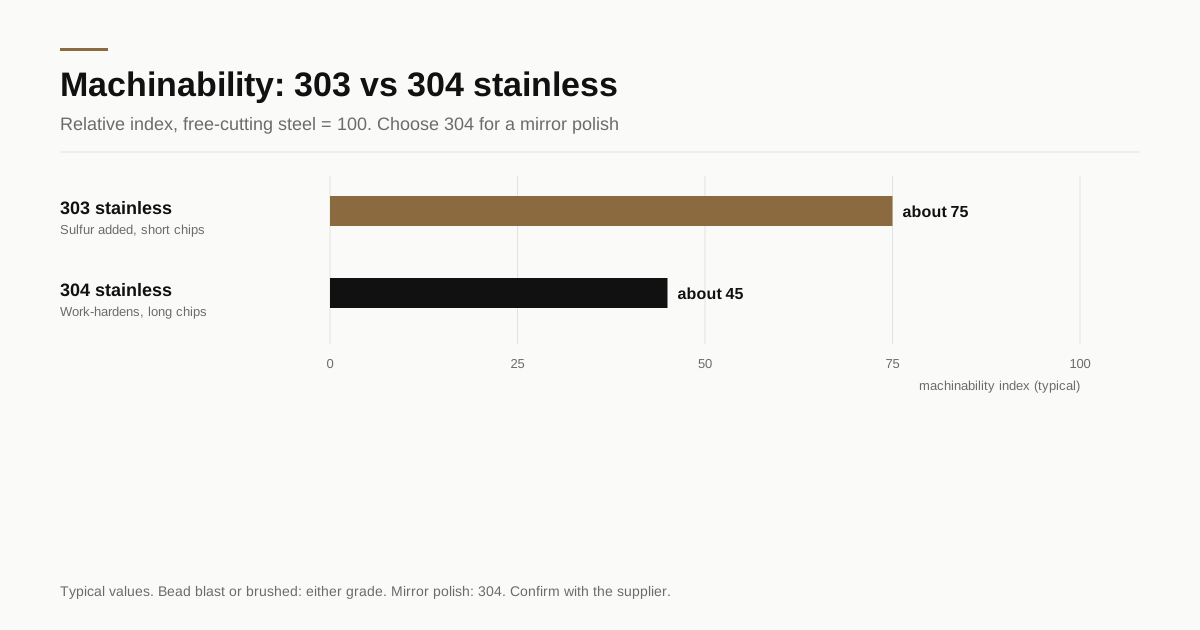
The sulfur forms tiny manganese sulfide particles in the steel. During cutting, these particles act as chip breakers. Instead of a long stringy ribbon that wraps around the tool, 303 breaks into short curls. The tool runs cooler, the surface is cleaner and the machine runs faster.
The same particles are weak points. They lower corrosion resistance a little and they can show as pits or streaks on a highly polished surface.
Typical figures
These are typical values, not promises. Confirm with the shop quoting your part.
| Property | 303 | 304 |
|---|---|---|
| Machinability (relative to a free-cutting steel at 100) | About 75 | About 45 |
| Chip behaviour | Short, broken chips | Long, stringy, work-hardens |
| Corrosion resistance | Good, slightly below 304 | Good, general standard |
| Mirror polish | Poor, sulfide streaks | Good |
| Bead blast or brushed finish | Very good | Very good |
| Weldability | Poor | Good |
| Strength, annealed | About the same | About the same |
| Cost per kg of bar | Similar or slightly higher | Baseline |
| Cost per machined part | Often lower | Often higher |
The last two rows explain most decisions. Bar price differs little. Machining time differs a lot.
Machining: why 303 usually wins on cost
Stainless is hard on tools. Grade 304 work-hardens, meaning the metal gets harder where the tool has just cut it. A tool that rubs instead of cutting hardens the surface and then fights it on the next pass. Operators respond with slower speeds, sharp tools and heavy feeds.
Grade 303 cuts more easily. The chips break clean and the tool lasts longer. A turned knob or foot in 303 may run in half the cycle time of the same part in 304, and the shop can hold a better surface off the tool.
On a run of 500 knobs, that difference is large. On a run of 20 it is small, because setup time dominates. If the order is small and the part needs a mirror polish, 304 may be the sensible choice despite the slower cut.
Finish: where 304 earns its place
Finish should drive the grade choice.
- Bead blast. Both grades give an even matte surface. Choose 303 for cost. The blast finish hides the sulfides completely. The visual side of this finish is covered in bead blasting audio enclosures.
- Brushed or satin. Both work well. Choose 303 unless corrosion in a salty environment is a concern.
- Mirror polish. Choose 304. A deep mirror on 303 can show fine dark streaks or pits where sulfide inclusions sit. They appear along the grain direction of the bar. Process details for high polish are in mirror polishing aluminium and brass audio parts, and the same steps apply to stainless with harder abrasives.
- Electropolish. Works on both, but 303 gives a less uniform result, since sulfides dissolve faster than the surrounding metal. Choose 304 for a bright electropolished part.
If the knob is the visible hero of the product and you want a flawless polish, specify 304 and accept the extra machining cost. If it is bead blasted or brushed, 303 is the economical grade.
Corrosion and passivation
Both grades resist corrosion well in living rooms. Neither is a marine grade. Where a product faces coastal air, sweat or cleaning chemicals every day, a more corrosion-resistant grade such as 316 is the usual step up, and the shop can quote it.
Machining leaves tiny particles of free iron on the surface from the tools. If they stay, they rust and leave brown specks. A passivation treatment in nitric or citric acid, run to a standard such as ASTM A967, removes the iron and restores the protective chromium oxide layer. Specify passivation on the drawing for any stainless part that will be seen or touched. The sulfides in 303 make passivation more important, since they are the starting point of most rust spots.
Magnetism and the pickup question
Annealed 303 and 304 are non-magnetic. Cold work changes this. Turning, drilling and bending convert part of the structure to a magnetic phase, so a finished part can attract a small magnet slightly. The effect is stronger in 304 than in 303 and stronger in thin, heavily worked sections.
For most knobs, feet and spikes this is irrelevant. For a part near a moving-coil cartridge, a magnetic sensor or a transformer, it can matter. Ask for a simple magnet check on a sample if the part sits close to magnetic components. The effect of nearby metal parts on tonearm and cartridge areas is covered in tonearm component machining.
Threads, set screws and galling
Stainless threads have a habit that surprises people: they seize. When a stainless screw turns in a stainless thread, the surfaces can cold-weld and tear, a fault called galling. The screw then jams halfway in and snaps on the next turn.
A knob held by a stainless set screw on a stainless shaft is a classic case. The risk is highest in 304, which work-hardens and drags, and lower in 303, where the sulfides act as a lubricant. Three habits reduce it:
- Use different grades or a different material for the screw and the part, for example a 303 knob with a hardened alloy set screw
- Apply a small amount of anti-seize or thread lubricant at assembly
- Tighten slowly, since heat from fast tightening speeds up galling
On parts that will be assembled and disassembled in service, state the screw material on the drawing. A thread problem found at the customer is much more expensive than one found in the shop. Thread handling on finished parts is covered more fully in threads in anodized chassis.
Weight and feel
Stainless is dense, about 8.0 g/cm³, nearly three times the density of aluminum. A stainless knob of the same shape as an aluminum one weighs nearly three times as much, and users feel that as quality. A turned stainless knob has a cold, solid touch that aluminum cannot match, which is why premium products often choose it for the controls even when the chassis is aluminum.
The same weight changes the shipping bill and the load on the shaft and bearing. A heavy knob on a light potentiometer shaft needs a collar and a set screw, not a push fit. Check the weight of the knob against the rating of the part it sits on before you commit to stainless.
Choosing by part
Knobs. Use 303 if the finish is bead blast, brushed or satin, which covers most designs. Use 304 for a mirror-polished knob. The geometry and knurl questions are in CNC volume knob manufacturing.
Feet and spikes. Use 303 for turned feet, and consider 304 where a polished foot is visible. For spikes the point matters more than the grade. Annealed austenitic grades are fairly soft, around 70 to 90 on the Rockwell B scale, so a sharp point can blunt or bend under a heavy speaker. A hardenable grade such as 440C or 17-4 PH is the usual step up for high-load spikes, and the shop can advise. The load logic is in isolation feet and spikes.
Spacers and standoffs. Use 303. They are hidden, cheap and made in volume.
Binding post parts. Use 303 for collars and 304 where plating or welding is involved. See speaker terminals and binding posts.
Parts to be welded. Use 304. The sulfur in 303 causes hot cracking in welds.
Quantity and the real cost
Quantity decides whether the machining saving matters. The pattern is simple:
- Under about 50 pieces: setup dominates, grade difference is small, choose by finish.
- 50 to 500 pieces: the cycle-time saving of 303 shows up in the quote.
- Over 500 pieces: 303 usually saves a visible share of the part price, if the finish allows it.
Ask the shop to quote both grades when the finish allows either. The difference is the price of the polish, and sometimes it is smaller than expected. The overall cost structure for audio hardware is in what an amplifier chassis costs to manufacture.
What to put on the drawing and in the RFQ
- Material with the standard and form, for example “303 stainless, annealed bar” or “304, annealed bar”
- Finish: bead blast, brushed, satin, mirror or electropolish
- Passivation requirement and standard
- Magnetism limit, if the part is near a pickup
- Hardness requirement for spikes, with the material that meets it
- Quantity and yearly volume, so the shop can price tooling
- Request for a first article in the real finish
Send the drawing through the RFQ form and we match it with up to 3 shops that turn and finish stainless audio hardware, with a reply within 24 business hours.
Frequently asked questions
Is 303 stainless weaker than 304?
Not in strength. Both are annealed austenitic grades with similar tensile and yield values. The difference is chemistry: 303 has added sulfur so chips break cleanly, and that same sulfur slightly lowers corrosion resistance and makes mirror polishing harder.
Which grade polishes better?
304. The sulfur in 303 forms tiny inclusions that can open as pits or streaks under a mirror polish. For bead blast, brushed or satin finishes the inclusions are hidden, and 303 is a good choice.
Are 303 and 304 magnetic?
Both are essentially non-magnetic when annealed, but cold working such as heavy machining or bending can create a slight magnetic response, more so in 304. If a part sits near a pickup or a sensor, ask for a magnetism check on a sample.
Need a quote for this part?
Send the drawing. We match you with up to 3 shops and reply within 24 business hours.
Get matched with an audio parts shop