Guides / Finishing
PVD Coating for Audio Knobs and Trim: Colours, Substrates and What It Costs
November 6, 2026
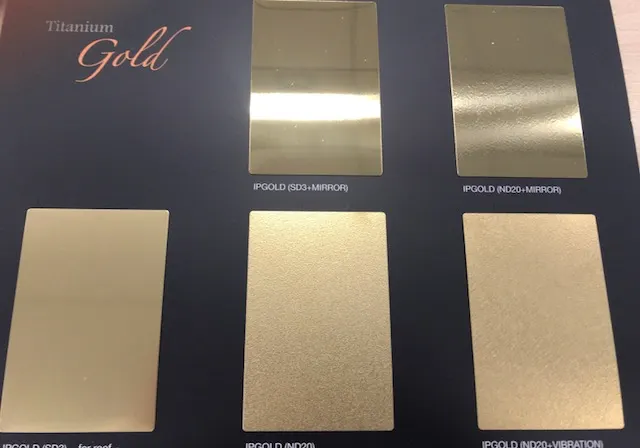
PVD coating is a vacuum process that puts a film of metal nitride, carbonitride or carbon on a finished part. For decorative work the film is thin, 0.2 to 2.0 microns in one coater’s decorative range, and it gives knobs and trim a gold, rose, grey or black colour as a hard film rather than a lacquer. Stainless steel and titanium take it directly. Aluminum, brass and zinc die cast need a nickel or chrome plating layer first, which adds a process step and a place for defects.
No public price list exists for decorative PVD on small parts, so this guide covers what you can specify and what moves the quote. For the knob itself see CNC volume knob manufacturing. PVD sits beside anodize and powder coat in our guide to audio panel finishes.
What PVD is, in terms a knob designer needs
Physical vapor deposition covers several ways of turning a solid source into vapor and condensing it on the part. Sputtering and evaporation are the most common, and cathodic arc is another. The same reference notes that PVD can run at lower temperatures than chemical vapor deposition, which suits temperature-sensitive substrates, and that line-of-sight transfer is typical of most PVD techniques. One decorative coater gives a coating temperature of 20 to 200 °C for its range.
Two consequences matter for audio parts:
- The film follows the surface. At 0.2 to 2.0 microns it cannot hide a scratch, a tool mark or a weld line. Whatever is under it is what the user sees.
- It reaches only what it can see. A deep bore, an undercut or a tight knurl valley is coated less than the outer face, so the colour can differ inside the part.
Colours and the compounds behind them
The colour comes from the coating material and the process, not from a dye. Suppliers describe it this way:
| Look | Typical coating | Note |
|---|---|---|
| Gold | Titanium nitride (TiN) | Hardness 1,800 to 2,100 HV, mostly under 5 microns thick |
| Rose gold | Titanium carbonitride (TiCN) | Titanium with a small amount of carbon |
| Black | Diamond-like carbon (DLC) | A supplier recommends matte for hiding wear |
| Purple | TiAlN | Listed by one supplier |
| Silver or gray | Unreacted titanium | Listed by one supplier |
One decorative range (Ionbond Decobond) names these standard colours: stainless steel, nickel, smoked grey, anthracite, black, copper rose, chrome, dark black, French gold, gold 18K, gold 24K and brass. It describes the materials as ZrN, TiN, DLC or similar, and offers custom colour matching.
Two points before you pick:
- Name a physical sample, not a colour word. “Gold 18K” from one coater and “champagne gold” from another are different things. Approve a coated sample under your inspection light, as in cosmetic inspection: lighting and viewing distance.
- Ask whether the colour depends on thickness. Some colours vary with film thickness across a 3D part. Ask the coater which of its colours are stable on a knob that has a face, a skirt and a knurl.
Which base metals take PVD directly
This is the decision that sets the route and the price. In Ionbond’s decorative portfolio, stainless steel and titanium can be coated directly. Aluminium, brass, zinc die cast and ABS carry a footnote that they need nickel or chrome electroplating first.
| Knob material | Route to a PVD colour | What it adds |
|---|---|---|
| 303 or 304 stainless | Coat directly | Cheapest route, but stainless is heavy and harder to machine, see 303 vs 304 stainless |
| Titanium | Coat directly | Light, expensive, see titanium audio parts |
| Aluminum | Nickel or chrome plate, then PVD | Two processes after machining and a plated layer on a soft metal |
| Brass | Nickel or chrome plate, then PVD | Same, and free-cutting brass carries lead, see lead in brass audio parts |
The practical effect: a PVD aluminum knob is aluminum, then a plated layer, then the colour film. Each step is another place for a defect, another rack and another lot to schedule. A PVD stainless knob has one step. The PVD reference also notes that workpieces need high hardness to keep the coating dimensionally stable, which is one reason a soft metal such as aluminum or brass gets a hard plated layer under the film.
If the knob must stay aluminum for weight, compare PVD against anodizing colour matched to a sample. Anodize is made on the aluminum itself and needs no plating step. PVD is the route when you want a metallic gold or rose colour. Ask a coater and an anodizer to show samples of the same colour on the same pre-finish and compare them under your inspection light.
The base finish is the finish
Because the film is under 2 microns, the surface you coat is the surface you ship. A supplier notes that the surface finish, brushed, polished or matte, changes how the coating looks while the underlying hue stays the same. The sample card in the photo shows the same titanium gold on mirror and on textured stainless: bright and reflective on one, soft and grainy on the other.
On a knob this means you specify two things, not one:
- The pre-finish, for example “brushed, Ra 0.4” or “bead blast, glass bead 120 grit”. See brushed aluminum panels, bead blasting audio enclosures and surface roughness on cosmetic faces.
- The coating colour.
A mirror pre-finish shows every machining and polishing flaw through the gold. If a mirror look is the aim, see mirror polishing aluminum and brass and expect to pay for the polish before the coating.
Fit, thread and bore
Coating thickness is small enough that PVD rarely breaks a knob fit, but check it:
- Bore. A PVD film adds up to 2 microns on a surface. Anodizing, by comparison, grows half its coating thickness inward, so a 10 micron anodize shrinks a bore by 10 microns. A 6 mm bore is hardly changed by PVD. You still say whether the bore is coated or masked, since a coated bore on a set screw knob can be marked by the screw. See audio knob to shaft fit.
- Threads. Coat, then check with the gauge. Mask a thread if it must mate with a bare screw without drag.
- Rack marks. The part hangs on a fixture, and the contact point is uncoated or marked. Tell the coater which surface may carry the mark, usually the underside of the skirt.
What drives the cost
No published tariff exists, and the figure for one coater does not transfer to another. The drivers are clear:
- Number of process steps. Plated aluminum or brass costs more than direct stainless.
- Batch fill. A chamber coats many parts per cycle, so a full rack is cheaper per part than a quarter-full one. The same logic applies to low volume anodizing minimums.
- Racking. Small knobs hang on pins or fixtures, and fixtures can be custom.
- Colour tolerance and inspection. A tight match to a master sample means more rejects.
- Pre-finish. Polishing before coating is its own line.
Ask the shop to quote the knob three ways on the same drawing: bare stainless with PVD, plated aluminum with PVD and anodized aluminum. That gives you a real number for your part instead of a range.
What to put in the RFQ
- Knob drawing with base material and grade
- Pre-finish named with a roughness value or a master sample
- PVD colour named by sample, plus the coating type if you know it
- Which faces are cosmetic and where the fixture may touch
- Bore, thread and set screw areas: coated, masked or reamed after coating
- Adhesion and wear checks you want, such as a scratch test, since scratch testing is a standard way to measure PVD adhesion
- Quantity per run and annual volume, see MOQ and lead time for audio parts
- A coated first article, see first article inspection for cosmetic parts
Send the drawing through the RFQ form and we match it with up to 3 shops that can machine and arrange the finish, with a reply within 24 business hours.
Sources
- Physical vapor deposition, Wikipedia
- Titanium nitride, Wikipedia
- Decobond decorative PVD coatings, Ionbond
- PVD coating colors, sputtertargets.net (supplier content, directional)
- Anodizing, Wikipedia
Frequently asked questions
What is PVD coating on an audio knob?
PVD, physical vapor deposition, is a vacuum process that deposits a very thin metal or ceramic film on a finished part. For decorative work one coater lists a thickness of 0.2 to 2.0 microns. On a knob it gives colours such as gold, rose, smoked grey or black without adding visible thickness.
Can an anodized aluminum knob be PVD coated?
Ask the coater, because a published decorative coating guide only covers bare metals. That guide says stainless steel and titanium are coated directly and aluminium, brass and zinc die cast need nickel or chrome electroplating first. Whether a given coater accepts an anodized surface is a question for that coater, tested on a sample.
How thick is a decorative PVD coating?
Thin. One supplier says most decorative films are under 0.5 microns, and another lists 0.2 to 2.0 microns for its decorative range. Wear coatings for cutting tools are thicker, with titanium nitride mostly under 5 microns. Because the film is so thin, the base finish shows through.
Is PVD more durable than anodizing for knobs?
Hardness figures are high, 1,500 to 2,800 HV for one decorative range, and titanium nitride is 1,800 to 2,100 HV. But the film is under 2 microns, so durability depends on the base metal and any plating under it. Compare finishes by testing samples for scratch adhesion and wear, not by hardness numbers alone.
Need a quote for this part?
Send the drawing. We match you with up to 3 shops and reply within 24 business hours.
Get matched with an audio parts shop