Guides / Design for Manufacture
Microphone Body and Grille Machining for Pro Audio Brands
October 20, 2026

A microphone is handled, stood on a stage, dropped in a case and photographed under bright light. The body and the grille are what the customer sees and touches. Inside is a delicate capsule, and the metalwork around it holds the position of everything with tight tolerances. The job looks like turning a tube and wrapping some mesh. It is harder than that.
The parts
A typical studio or stage microphone has five metal parts.
- Body tube, a turned cylinder that houses the electronics.
- Grille or basket, the cage around the capsule.
- Capsule mount, a precision ring or cup that locates the capsule inside the grille.
- Base or connector end, which holds the XLR connector and often the mount thread.
- Fittings, such as a clip, a ring, a switch cap or a stand adaptor.
The body and the base are turned. The grille is formed from perforated sheet or mesh, or machined. The capsule mount is a small precision part.
Typical figures
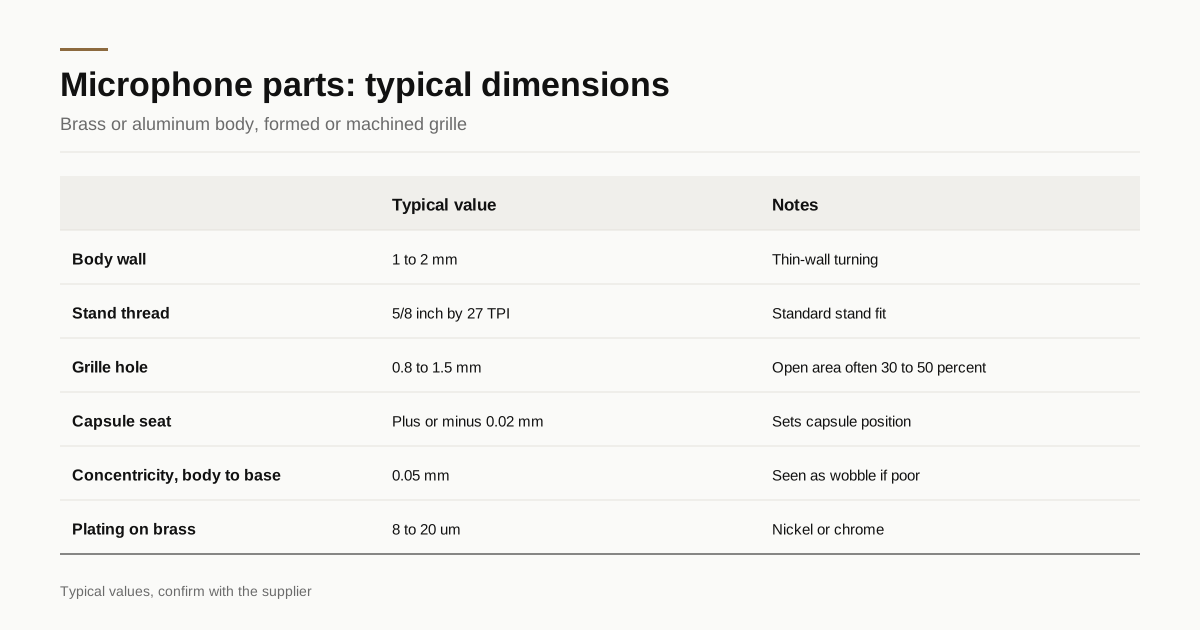
These are typical values, not promises. Confirm with the shop quoting your part.
| Feature | Typical value | Notes |
|---|---|---|
| Body diameter | 20 to 50 mm | Small-diaphragm to large-diaphragm designs |
| Body wall | 1 to 2 mm | Thin-wall turning |
| Body length | 100 to 200 mm | Depends on style |
| Stand thread | 5/8 inch by 27 TPI | Standard for microphone stands |
| Grille perforation hole | 0.8 to 1.5 mm | Open area often 30 to 50 percent |
| Capsule seat tolerance | ±0.02 mm | Sets capsule position |
| Concentricity, body to base | 0.05 mm | Shows as a visible wobble if poor |
| Plating, nickel or chrome | 8 to 20 µm | Brass bodies |
The thread is a standard dimension, so the base must follow it, along with the common threaded adapter to 3/8 inch where the design uses one. Check the thread form against a gauge on the first article.
Bodies: brass or aluminum
Brass bodies are turned from tube or bar. Brass machines cleanly with a good surface finish, and it plates well. It gives weight, a quiet solid feel and a premium impression. It is denser than aluminum, so the microphone is heavier, which affects stand and boom loads. The alloy choices are described in brass and copper audio parts.
Aluminum bodies are lighter and cheaper, and they take anodize in many colours. They suit portable and stage microphones where weight and cost matter. Aluminum is softer, so the body dents more easily.
Both are turned on a lathe, with thin walls that need care. A 1 mm wall on a 30 mm tube flexes under tool pressure, so shops use sharp tools, light finishing cuts and sometimes a support mandrel inside the tube. Walls may be left thicker at the ends, where threads and seats are cut.
Grilles: three ways to make them
| Method | How it works | Look | Notes |
|---|---|---|---|
| Wire mesh | Woven wire formed into a dome and soldered or crimped into a ring | Fine, traditional | Hand assembly, variation between units |
| Perforated sheet | Sheet punched with round holes, rolled or deep drawn into a cap | Clean, uniform | Tooling cost for the punch pattern |
| Machined grille | Holes or slots drilled or cut in a turned shell | Sharp, modern | Slow per unit, high precision |
Many grilles use two layers, an outer protective mesh and an inner finer mesh or foam that acts as a pop screen. The layers are placed for acoustic effect and for protection.
Wire mesh. Woven stainless or brass mesh is formed into a dome, a process that stretches the weave and changes the hole size across the dome. A consistent forming tool and consistent mesh matter. Mesh edges are trimmed and soldered or crimped.
Perforated sheet. A flat sheet with a regular pattern of holes is formed into a cup. The hole pattern stretches during forming, so designers allow for the change.
Machined grilles. Holes or slots are drilled or milled in a turned part. This allows complete control of pattern and gives crisp edges. It is slow, and a small burr in a hole shows under light, so deburring is a major step.
What the grille does besides look good
A grille protects the capsule from knocks, blocks plosive blasts and holds a foam or mesh layer that breaks up wind. It also forms a small acoustic volume around the capsule. The designer chooses open area, hole size and internal volume for the sound, so the shop makes the geometry exactly as drawn and keeps it the same on every unit.
For manufacture, the consequence is repeatability. Two grilles with a slightly different open area or a different internal gap can change the response a little, which a quality-minded brand notices in batch comparison. Ask the shop to report hole diameter and mesh specification on a first article, and to keep the same stock lot for a production run. Changing mesh supplier mid-run is a risk, and it should be a documented decision.
Inside the grille, foam or felt sits between the capsule and the mesh. It should be cut to size and held in place without adhesive that outgasses onto the capsule. Specify the retention method with the grille, since a loose foam piece is a common return.
Forming limits for sheet and mesh
Forming a flat sheet or a woven mesh into a dome stretches the material, and the stretch has limits.
- Depth of draw. A cap that is deeper than about half its diameter starts to thin and split at the top, and perforation holes distort into ovals.
- Hole pattern. Round holes in a flat sheet become slightly elongated on a curved dome. Designers pre-compensate the pattern, or accept the small change.
- Mesh weave. Woven wire distorts at the crown of a dome, where the weave opens. A tight weave holds up better, and a coarse weave shows the distortion.
- Springback. Formed sheet springs back a little after release, so the forming tool is cut slightly past the final shape.
Test a sample of the actual material before committing to a tool. The forming step also hardens the metal, so a formed brass or stainless cap is stiffer than the flat sheet it came from.
Capsule seat and alignment
The capsule sits in a mount that fixes its height and centre in the grille. Small errors change the acoustic behaviour and the look. A capsule that sits off centre shows as a visibly uneven gap inside the mesh.
The mount is a small turned part with a seat and a thread or a press fit. Tolerance on the seat is tight, often ±0.02 mm, and the mount should be concentric with the body thread. The tolerance logic for small precision parts is the same as for tonearm parts, discussed in tonearm component machining.
Finishing the body and grille
Finish matters because the microphone is photographed close up.
Plating on brass. Nickel plating gives a soft, silvery look and chrome plating gives a brighter, harder surface. Gold or black plating are used in some designs. Plating thickness adds to dimensions, so threads and seats need an allowance or masking. Plating also hides tool marks poorly, so the machined surface must be smooth before plating, which links to the polishing steps in mirror polishing aluminium and brass audio parts.
Anodize on aluminum. Type II in black or colour is standard. Parts that rub against stands and clips benefit from hard anodize, as described in hard anodizing vs Type II.
Powder coat and lacquer. Used on some stage microphones. Powder coat is thick and insulating, and it fills fine detail, so threads and grilles need masking.
Grille finish. The grille is often plated or coated separately. A different finish on the grille and the body is a design choice. Colour matching between plated and anodized parts needs a sample.
Electrical continuity and shielding
A microphone body and grille act as a shield around the capsule and electronics. The shield connects to the XLR ground pin, so electrical continuity along the metal path matters.
Anodize and paint insulate. Contact surfaces between the body, the grille ring and the base need bare metal, or a plated surface, or a conductive spring. Specify masked areas on the drawing. The shielding rules from larger enclosures apply here too, as covered in EMI shielding for audio enclosures.
Inspection
The visible faces of a microphone are inspected closely. Check for scratches on the body, uniform plating, a clean grille with no stray mesh strands, an even gap around the capsule and a smooth thread. Agree viewing conditions in advance, using the method in cosmetic inspection lighting and viewing distance. Handling matters too: parts should be wrapped individually and handled with gloves, since fingerprints on bright plating are hard to remove.
Cost and quantity
Microphone parts are small, and machine time is modest. Cost comes from precision, plating and hand assembly of grilles. At 100 to 500 units, setup and tooling for a perforated grille or a forming die are a large fixed share. Machined grilles have no tooling but higher time per unit. Plating batches work best with full racks. The cost structure is described in what an amplifier chassis costs to manufacture, with smaller numbers, and planning information is in MOQ and lead time for audio parts.
What to put on the drawing and in the RFQ
- Body and base material, wall thickness and critical lengths
- Thread form and size, with the gauge to check it
- Capsule seat dimensions, tolerance and concentricity
- Grille method, mesh or perforation details, layer order and forming limits
- Finish: plating type and thickness, or anodize type and colour, with masked contact areas
- Electrical continuity points
- Inspection rule and viewing conditions
- Quantity, yearly volume and packing for individual parts
Send the drawings through the RFQ form and we match them with up to 3 shops that turn and finish microphone parts, with a reply within 24 business hours.
Frequently asked questions
Brass or aluminum for a microphone body?
Brass gives a heavy, solid feel, a quiet body and a good base for nickel or chrome plating. Aluminum is lighter and cheaper and takes anodize well. Weight is a design choice, so decide the feel first, and then choose the material.
Does the grille affect the sound?
It can. Grille open area, mesh density and the volume inside it change how sound reaches the capsule and how the capsule is damped. The shape and material matter less than keeping the grille consistent from unit to unit. Acoustic design belongs to the maker, and the shop's job is to make parts to the same specification every time.
Should the body be anodized or plated?
Aluminum bodies are anodized or powder coated. Brass bodies are plated with nickel or chrome, or lacquered. Anodize insulates, so contact points for grounding or shielding must be masked. Plating conducts, which helps continuity along the body.
Need a quote for this part?
Send the drawing. We match you with up to 3 shops and reply within 24 business hours.
Get matched with an audio parts shop