Guides / Design for Manufacture
DAC and Streamer Enclosures: Small Chassis, High Finish Demands
October 15, 2026
A DAC or streamer is a small box with a large cosmetic burden. It sits on a desk or a shelf at eye level, close to the user, and it is judged on its surface from a short distance. The circuit inside draws a few watts, which is low-stress for the enclosure. The finish is what makes the job demanding.
What makes a DAC enclosure different
Three features set it apart from a power amplifier chassis.
Size. A typical DAC or streamer is a half-width or compact box, often 200 to 250 mm wide, 40 to 70 mm high and 150 to 250 mm deep. A small part has tight proportions, so a 0.2 mm error in a gap is a large fraction of the chamfer width.
Low heat. The electronics produce little heat, so no heatsink is needed. The enclosure can be sealed and the walls thin. This frees the designer to choose the shape by style.
Radio. A streamer has a Wi-Fi or Bluetooth antenna. Aluminum blocks radio, so the antenna design affects the enclosure design. A DAC without wireless has no such limit.
Everything else is about surface and fit: the front plate, the rear connector panel, the cover and the way they meet.
Typical figures
These are typical values, not promises. Confirm with the shop quoting your part.
| Item | Typical range | Notes |
|---|---|---|
| Overall width | 200 to 250 mm | Half-width boxes dominate |
| Front plate thickness | 6 to 12 mm | Allows bright chamfer and engraving |
| Extrusion or cover wall | 2 to 3 mm | Thin walls cut cost |
| Gap between plate and sleeve | 0.1 to 0.3 mm | Visible, so consistency matters |
| Hole position, knob and button | ±0.1 mm | Seen against engraved rings |
| Rear cutout tolerance | ±0.1 to ±0.15 mm | Connectors must seat |
| Chamfer width | 0.5 to 1.0 mm | Narrow on small boxes |
| Mass | 1 to 3 kg | Mostly from plates and transformer |
Three ways to build the body
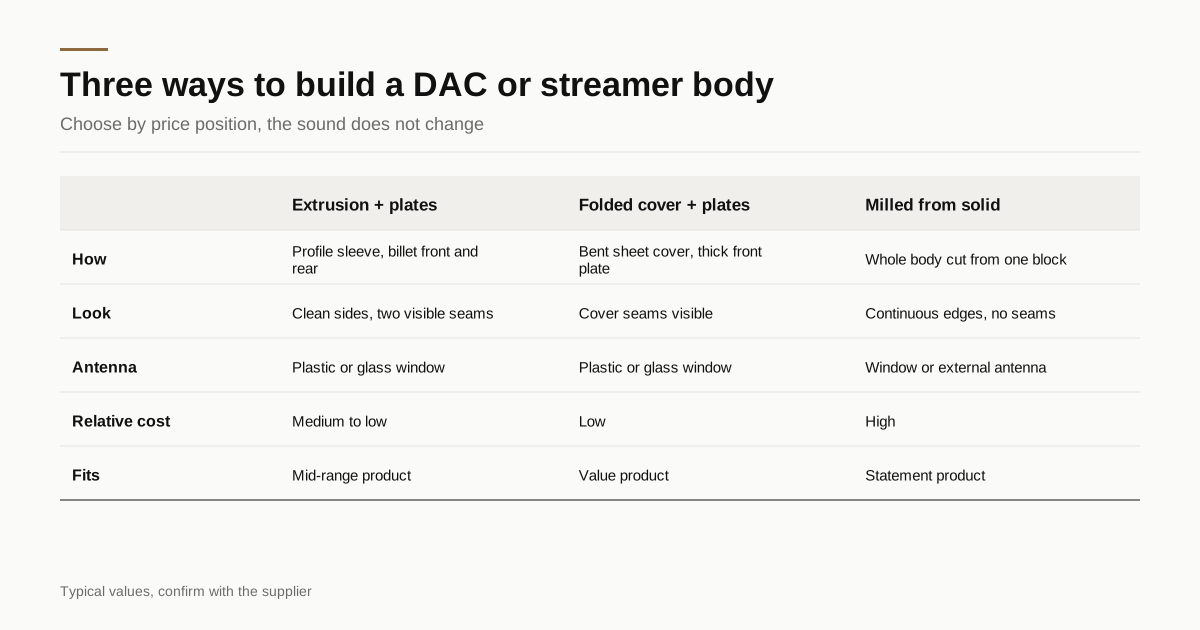
Extruded sleeve with machined end plates. The most common route. An aluminum profile forms the top, bottom and sides in one length, cut to the box depth. Billet front and rear plates close the ends. It is economical, since the extrusion does most of the shaping. Alloy differences between the extrusion and the plates affect anodize colour, as described in aluminium alloys for anodized audio parts, and the comparison of routes is in billet, extrusion and sheet chassis.
Folded sheet cover with machined front. A bent sheet forms the cover, a thick plate forms the front and a thinner plate forms the rear. It is the cheapest build and suits products where the cover is not a feature. Sheet covers are covered in sheet metal covers for audio, design for manufacture.
Milled from solid. The body is cut out of a single block, giving continuous edges with no seams on the visible faces. It looks outstanding and uses a lot of material and machine time. It suits limited editions and price points where the enclosure is the main selling point.
Choose by price positioning. A mid-range DAC fits the extrusion route. A statement product justifies the solid body.
The antenna problem for streamers
A streamer with Wi-Fi and Bluetooth needs a path for radio waves. An aluminum box is a shield, which is good for noise and bad for wireless.
Four solutions are common.
- Plastic or glass window. A section of the rear or top panel is non-metal, with the antenna behind it. A window in a front panel doubles as a display window, as described in acrylic and polycarbonate windows for audio panels.
- External antenna. A connector on the rear takes a screw-on antenna. It costs a connector hole and an accessory.
- Slot or gap antenna. The design uses a deliberate slot as part of the antenna. This needs electronic design input and testing.
- Wired only. Many high-end streamers use Ethernet only, which removes the problem.
Tell the shop which route applies before the chassis is designed, since the opening affects the stiffness of the cover and the cosmetic gap.
Shielding and grounding
A DAC has analogue and digital circuits close together, so shielding and grounding matter. The enclosure acts as a shield, and joints between parts need electrical contact where the design depends on it.
Anodized surfaces insulate. Grounding contacts between the cover and the chassis need bare metal, a conductive gasket or a masked area. The design rules are in EMI shielding for audio enclosures. Tell the shop which faces and screw points must be bare, so masking is done before anodizing.
Rear panel: where fit shows
The rear panel carries the connectors: USB, optical, coaxial, balanced outputs, Ethernet and power. It is a hidden face in daily use but it must fit well.
- Cutouts need ±0.1 to ±0.15 mm so connector bodies seat and nuts sit square.
- Connector cutouts for round jacks need clean edges, since a burr can scratch the connector.
- Legends are printed or engraved. The comparison is in engraving vs silkscreen on audio panels.
- Many connector shapes are standard, so ask the shop if it has the tooling or a punch for them. Connector panel cutouts for audio shows the common shapes and tolerances.
Feet, base plate and the underside
The underside is the part most often forgotten at the drawing stage. A DAC sits on a shelf, and the base plate, feet and ventilation slots decide whether the unit slides, rocks or marks the furniture.
Feet should be a repeatable height, so the box sits level on four points. Machined aluminum or stainless feet with a soft pad are common, and the geometry is covered in isolation feet and spikes. Screw positions for the feet should be counterbored in the base plate so heads sit below the surface, and the base should be flat to about 0.2 mm so the box does not rock.
If the box needs ventilation, slots in the base and cover are cheap to cut and hide well. Keep slot edges deburred, since a burr on the inside can touch a wire, and a sharp edge on the outside can cut a hand.
A dry fit before finishing
Fit problems on small boxes appear only when the parts meet. Ask the shop for a dry fit of all machined parts before anodizing, with the rear plate, front plate and sleeve assembled and the gaps measured. It takes a few minutes and finds errors at the stage where a fix costs little.
Check three things: the gap around each plate, the alignment of the front chamfer with the sleeve edge, and whether the screws pull the plates square. Anodize adds a small thickness, so allow for it in the gap, and re-check after finishing on the first article, as described in first article inspection for cosmetic parts.
Finish demands
On a small box, the finish dominates cost. Three points are specific to DACs.
Close inspection. A DAC sits close to the viewer, so scratches and colour differences show more than on an amplifier on a rack. Set the viewing distance and zones in the specification, as in cosmetic inspection lighting and viewing distance.
Edge definition. Narrow chamfers must be consistent. A bright diamond cut edge works on small boxes, with limits on corner radius, as covered in diamond cut chamfers on audio panels.
Colour match. The plates and the sleeve should match, or be designed to contrast. A black anodize on both is the least forgiving combination, and the control steps are in anodize colour matching for hi-fi.
Parts are small, so batch size in the anodize line is often the limit. Combine parts for several products into one finishing lot where colours match.
Cost and quantity
Small boxes still carry full setup costs. A DAC enclosure may have four or five parts: front plate, rear plate, sleeve or cover, feet and small hardware. Each has its own setup, program and first article. At 30 sets the setup per piece is high. At 300 sets it falls sharply.
Finishing is a large share, because the area to inspect and handle is the same whatever the weight. See what an amplifier chassis costs to manufacture for the cost structure and MOQ and lead time for audio parts for planning.
What to put on the drawing and in the RFQ
- Construction route: extrusion with plates, folded cover or milled from solid
- Alloys for each part and the colour match requirement
- Gap target between parts and tolerance
- Antenna route and the location of non-metal windows
- Bare-metal areas for grounding and shielding
- Rear cutouts with connector part numbers
- Finish, chamfer, legend method and viewing distance
- Quantity, yearly volume and packing for single units
Send the drawings through the RFQ form and we match them with up to 3 shops that build small audio enclosures, with a reply within 24 business hours.
Frequently asked questions
Why do small DAC enclosures cost more per kilogram than large amplifier chassis?
Because the finish is the same size as on a large chassis but the part count and handling are not. A small box still needs a front plate, rear plate, cover, feet and a bright chamfer, each with its own setup and inspection. The visible area per gram of metal is higher, so finishing dominates.
Can a streamer have a fully metal enclosure?
Only if the antenna is outside the metal or the enclosure has a non-metal window or panel. Aluminum blocks radio signals. Streamers with Wi-Fi or Bluetooth usually use a plastic or glass panel at the rear or top, or an external antenna.
Is an extruded body or a milled-from-solid body better for a DAC?
An extruded sleeve with machined end plates is cheaper and perfectly good. A body milled from solid gives crisp, continuous edges and a premium look at several times the cost. The choice follows price positioning, not sound.
Need a quote for this part?
Send the drawing. We match you with up to 3 shops and reply within 24 business hours.
Get matched with an audio parts shop