Guides / Cost
What Each Finish Adds to a Faceplate: Anodize, Blast, PVD and Powder Coat
November 21, 2026
A finish adds cost through five things: the texture step, the coating and its thickness, the colour, rack fill and masking, and the allowance for rejects. We found no public price list for audio faceplates, so this post uses the one public data set we could open, Get It Made’s simulated prices, plus vendor pages marked as directional. The aim is to show what drives a quote and which lines to ask for. This post is part of our guide to audio panel finishes.
We set no network price. Figures below were read in October 2026.
The drivers at a glance
| Driver | Direction | Magnitude | Who controls it |
|---|---|---|---|
| Texture (brush, blast, polish) | Up with effort | Bead blast about +10%, mirror polish about +67% on one large part | Buyer, by the choice of texture |
| Coating type and thickness | Up for hard coat and thick film | One vendor list: Type II about 0.50 to 2.00 USD and Type III about 2.00 to 5.00 USD per square foot | Buyer, by the drawing |
| Colour (dye) | Up for some dyes | One vendor page: standard dyes add 2 to 5 USD a part, red and black more | Buyer and finisher |
| Lot minimum and rack fill | Down per part as the lot fills | Shop-specific, we found no public figure | Buyer, by batching |
| Masking | Up with area and complexity | One vendor page: 0.25 to 1.00 USD per square inch | Buyer, by the drawing |
| Cosmetic grade | Up | Around +10% on one vendor page | Buyer |
| Rejects and sample rounds | Up | We found no public yield figure | Shop and buyer |
| Alloy grade | Up if a better grade is needed | Mirror polish needed Al7075 on one page | Buyer |
Caption: texture and grade from Get It Made (simulated prices, 25 August 2026). Cosmetic grade from a Protolabs Network page. Coating, dye and masking from a Richconn page, whose worked example does not add up, so use those lines for direction only. We found no public per-part price for decorative PVD or for powder coat on audio panels.
Texture is the visible step
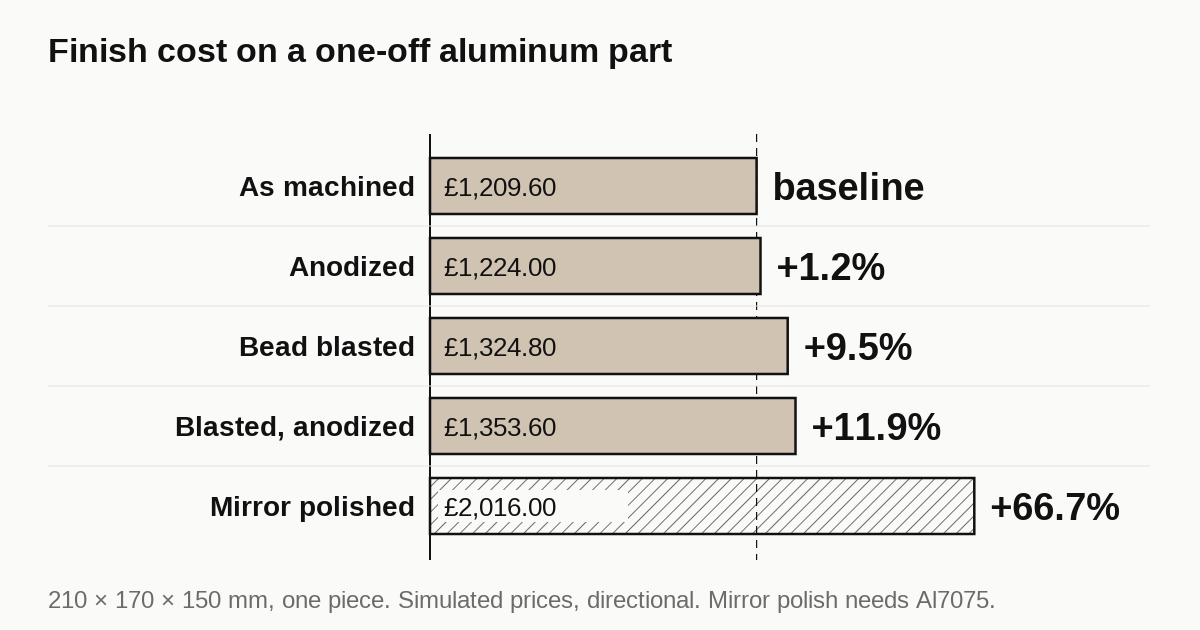
For one 3-axis aluminum part of 210 x 170 x 150 mm, the simulation gave:
| Finish | Price for one | Added to as machined | Lead time |
|---|---|---|---|
| As machined | £1,209.60 | none | 8 days |
| Anodized | £1,224.00 | £14.40, 1.2% | 9 days |
| Bead blasted | £1,324.80 | £115.20, 9.5% | 9 days |
| Bead blasted and anodized | £1,353.60 | £144.00, 11.9% | 9 days |
| Mirror polished | £2,016.00 | £806.40, 66.7% | 10 days |
Caption: Get It Made, page updated 25 August 2026. The differences and percentages are our calculation from the listed prices, since the page’s own percentages differ slightly. Simulated, directional, and not a quote for an audio panel. Brushing and powder coat are not on the page.
The page says the mirror polish needs a higher grade such as Al7075, so part of that jump is the alloy, not only the polishing time. It also says anodising is relatively cheap because parts can be finished in large batches with other projects. For a faceplate this suggests the coating is a small line on a large part and the texture is a larger one, but only on a one-piece broker price. We found no public price for brushing, so ask for it as a separate line.
Coating, thickness and colour
Wikipedia gives Type II anodize as 1.8 to 25 micrometres and Type III as thicker than 25 micrometres. Our hard anodizing post says Type III runs in a bath near freezing at a higher current, needs a tighter process window and often costs 1.5 to 3 times Type II per part. That multiple comes from the older post and we did not re-source it, so treat it as a direction. A Richconn page lists Type II at about 0.50 to 2.00 USD and Type III at about 2.00 to 5.00 USD per square foot, and says thicker coatings or complex shapes raise the cost. That is a vendor’s list, not a quote, and the same page’s worked example does not add up, so read the two ranges as directional only.
Colour adds cost in two ways. A vendor page says dyeing standard colours adds 2 to 5 USD a part and that red and black cost more, without giving a number. And a non-standard colour may need a dedicated bath, which our low volume post lists as a setup cost. A standard colour is the cheaper choice for a small run.
PVD and powder coat are priced differently from anodize. We found no public per-part price for decorative PVD or for powder coat on audio parts, so ask each kind of shop for a per-part price and a minimum.
Rack fill, lot minimums and masking
Most of the cost of a small anodizing order is not the part. It is the rack cycle, the racking labour, the dye bath setup and the minimum charge, which are spread over however many parts you send. Filling the rack with parts of the same family costs almost nothing in finishing, and that is the main saving in our low volume anodizing post.
Masking adds hand time. Threads, bores and an earth point are masked before anodizing. One vendor page lists complex masking at 0.25 to 1.00 USD per square inch. Treat that as a direction, and draw masked areas as named zones with dimensions so each one can be priced.
Rack contact also leaves marks. A Fictiv article says each part needs electrical contact with a conductive rack, that larger parts may need several contact points and that marks show most on dark-dyed parts. Specifying a hidden location on the drawing costs nothing and avoids a rework.
Need a quote for this part? Get a quote for your audio parts
Cosmetic grade and rejects
A tighter cosmetic standard raises the price, because it needs more handling care and more inspection. A Protolabs Network page says its cosmetic finishes carry around a 10% increase, guarantees its A-side surfaces defect-free and allows minor hang marks and up to 2 minor defects on B-side surfaces. It inspects at about 50 cm, 45 degrees and 500 to 1000 lux, with batch inspection at AQL level II. That is one vendor’s scheme, not a standard.
Rejects are the cost buyers cannot see. We found no public first-pass yield figure for black anodize, so ask each shop how it allows for rejects. One way shops cover them is a small overage on the lot. Our re-anodizing post calls an extra 5 to 10 percent a judgement call and not a standard. HM suggests witness coupons and boundary samples kept by both parties, which cost little and shorten disputes.
A worked example
This is an example with assumed numbers, not a quote. Suppose a finisher charges a lot minimum of 200 and 2 per part for dyed anodize, in any currency.
| Parts in the lot | Lot minimum per part | Variable | Cost per part |
|---|---|---|---|
| 20 | 10.00 | 2.00 | 12.00 |
| 50 | 4.00 | 2.00 | 6.00 |
| 100 | 2.00 | 2.00 | 4.00 |
| 300 | 0.67 | 2.00 | 2.67 |
The same finish costs three times as much per part at 20 as at 100, with no change in the work done on each part. That is why a family of parts anodized in one load is cheaper than four small lots a year, and why the first line to ask for is the lot minimum.
Lines to ask for in the quote
- Machining price per part, separate from finishing.
- Texture: brushing or blasting, as its own line, with the media or grit.
- Coating: type, thickness range and colour, as its own line.
- Lot minimum, rack or setup charge and the quantity it assumes.
- Masking charge, with the masked zones listed.
- Inspection: the cosmetic standard priced, and the sample round.
- Reject allowance or overage, stated as a percentage.
- Quantity steps, so the break points are visible.
Send the drawing through the RFQ form and we reply within 24 business hours with one itemised quote for the finished parts. Work goes to partner shops that finish audio parts. To compare textures before you price them, read brushed or bead blasted. The full decision order is in the guide to audio panel finishes.
Sources
- How much does CNC machining cost, Get It Made (simulated prices, directional)
- CNC surface finishing service, Protolabs Network (vendor page)
- How much does anodizing cost, Richconn (vendor page, directional; worked example does not add up)
- What are rack marks in anodizing, Fictiv
- Bead blasting finish guidance, HM (vendor page, directional)
- Anodizing, Wikipedia
Frequently asked questions
How much does anodizing add to the cost of a faceplate?
We found no public price list for audio faceplates, only a vendor's per-square-foot ranges that are directional. Get It Made's simulation put anodize at about 1% above as machined for one large aluminum part, because anodizing is run in large batches with other work. A real small-lot job can cost far more per part, since a lot minimum and rack fill decide the price, so ask each shop for its minimum.
Which finish costs the most per part?
In the one public data set we found, a mirror polish added about 67% to a single large aluminum part, against about 10% for bead blasting and 1% for anodize. The polish line also needed a higher alloy grade. We found no public figures for brushing, PVD or powder coat on audio panels, so compare quotes on one drawing.
Why is a small anodizing order expensive per part?
Rack time, racking labour, masking and a lot minimum are spread over fewer parts. Filling the rack with parts from the same family is the main saving. Our low volume post lists ways to do it, such as batching a year of parts into one load, picking a standard colour and designing parts that rack easily.
Does a tighter cosmetic standard raise the price?
Yes, by an amount that depends on the shop. A Protolabs Network page says its cosmetic finishes carry around a 10% price increase and guarantees its A-side surfaces defect-free. A vendor figure is directional. Ask what the shop allows for rejects, because a cosmetic reject is built into the price of every part.
Need a quote for this part?
Send the drawing. We quote the finished parts, place the work with a partner shop and reply within 24 business hours.
Get a quote for your audio parts