Guides / Finishing
Brushed or Bead Blasted: Choosing a Panel Texture for Hi-Fi Gear
November 21, 2026
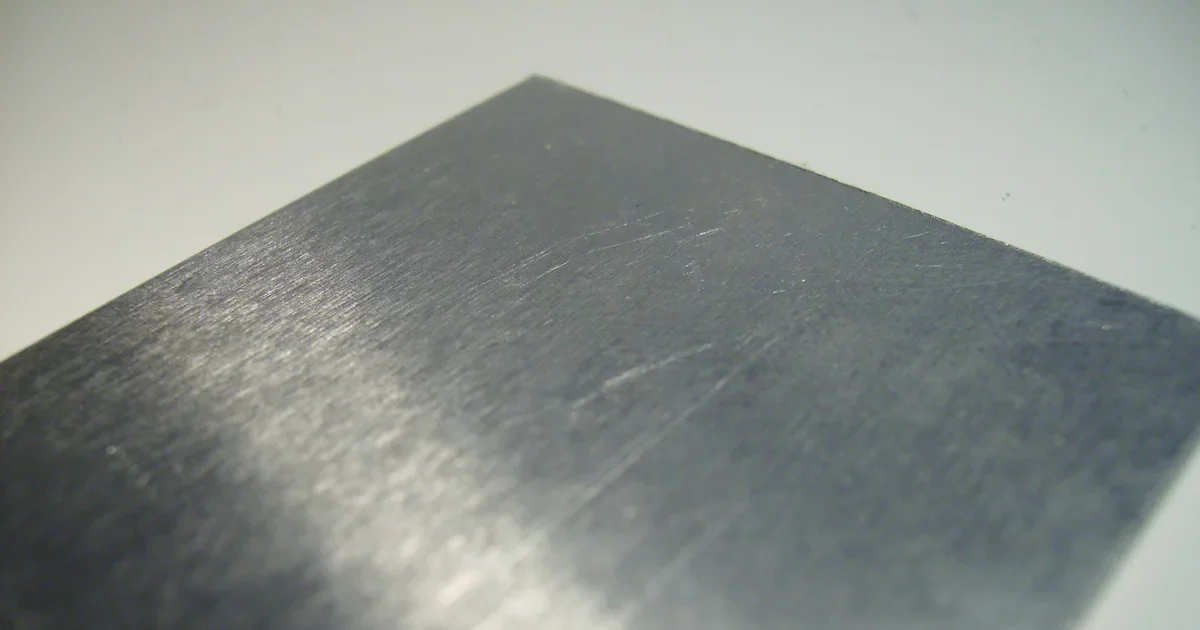
Choose brushed when the panel is one large visible face and you can control the grain, and choose bead blasted when several parts or alloys must read as one finish. Brushed gives a directional satin whose look changes with the angle of the light. Bead blasting gives a nondirectional matte with no grain to align, and it narrows colour differences between alloys. This post is part of our guide to audio panel finishes and compares the two on grain, matching, wear, edges and cost.
Figures below come from sources we opened in October 2026, and vendor pages are marked as directional. Where we found no public figure, we say so.
The decision table
| Criterion | Brushed | Bead blasted |
|---|---|---|
| Direction | Yes, parallel grain | None |
| Aluminum Association code | M35 brushed, or M31 to M33 satin | M45 to M47 shot blast, or M41 to M44 matte |
| Typical roughness | 0.5 to 1.5 micrometres Ra | 1.5 to 3.5 micrometres Ra (vendor figure) |
| Mixed alloys | Grain adds shading on top of any colour difference | Scatters light, narrows differences |
| Scratches | Rated low visibility, grain disguises light marks (vendor view) | Rated low visibility, texture absorbs minor damage (vendor view); gouges and steps remain |
| Fingerprints | Rated low to moderate (vendor view) | Rated low (vendor view); described as fingerprint-resistant on stainless |
| Price for one large part | We found no public figure | About 10% above as machined (Get It Made simulation) |
| Order of work | Before anodize | Before anodize |
Caption: codes from the designation list on anodizing.org. Roughness for brushed from Wikipedia’s brushed metal article and for blasted from a fabricator’s guide (HM). Scratch and fingerprint ratings from one comparison table by Yijin and a Richconn page. Both textures get the same scratch rating there, so the vendor view does not separate them. Price from Get It Made, simulated, August 2026. Everything marked vendor is directional.
Grain and direction
A brushed face has a direction, and that is both its appeal and its risk. Wikipedia, in an article written mainly about stainless steel, describes brushed metal as a unidirectional satin with very fine lines parallel to the brushing direction, made by polishing with a 120 to 180 grit belt or wheel and softening with an 80 to 120 grit compound or non-woven pad. Vendor guidance adds two rules that matter on a product: state the grain direction against a datum or an edge, and match it on adjacent visible panels, because a grain mismatch shows from across the room (the same page says reversing direction mid-pass gives cross-hatching).
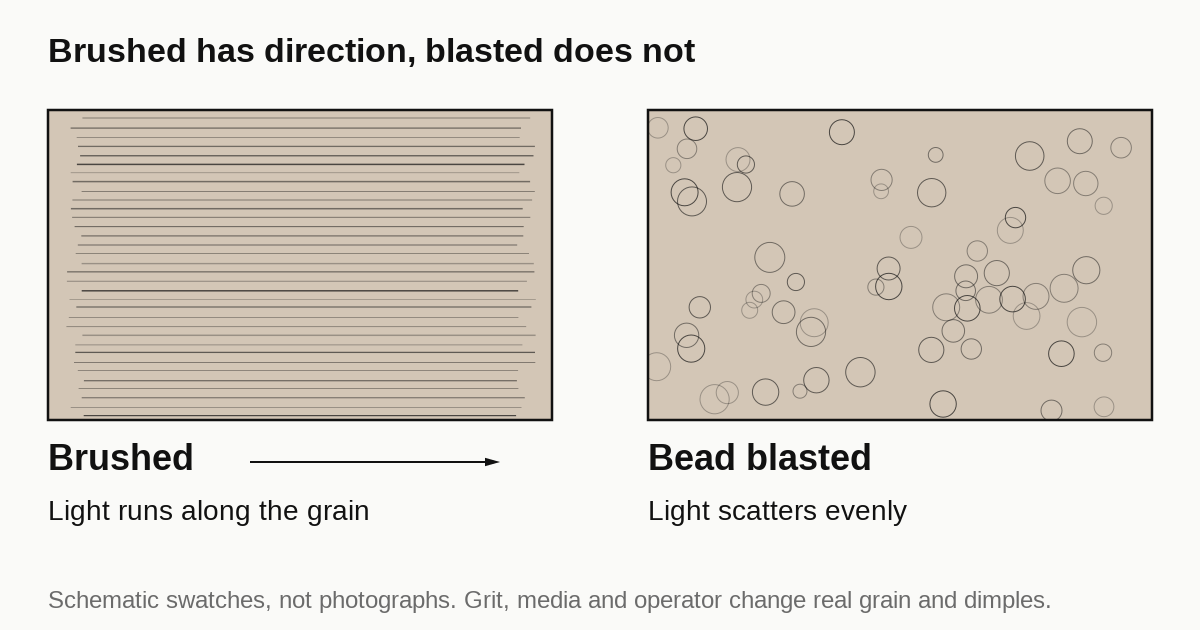
That makes brushing a good choice when one panel carries the look, and a harder one when a faceplate, a side cheek and a knob all show grain. Our brushed finish post covers the grain-continuity options and suggests 180 to 320 grit for a front panel. That does not conflict with Wikipedia’s 120 to 180 grit belt: the first describes how the grain is cut and softened, the second the finish a panel is judged on, and a grit number alone does not give the appearance, so a sample decides. Bead blasting has no direction to line up, which is the main reason many brands choose it for sets of parts.
Matching mixed alloys
Most amplifiers mix a billet panel, an extruded sleeve and a folded cover. Under a dye each alloy reads a little differently. A bead blasted surface scatters light diffusely, and a vendor page says blasting before anodizing evens out tool marks so the dye takes up uniformly. A brushed surface does the opposite: the grain adds its own directional shading on top of whatever the alloy does.
Our own alloy and colour posts reach the same view: blasting every part to one media and mesh before anodize does more for a match than anything the anodizer can add, and a dark colour hides more than a clear one. We found no published measurement of how much each texture narrows a colour difference, so this rests on practice and not on a test. The alloy side is in choosing an aluminum alloy for anodized audio parts.
Scratches, fingerprints and wear
The two textures hide different faults. Bead blasting hides fine tool paths by removing the shine that makes them visible, but it leaves a step, a gouge or chatter in place under a new matte texture. Brushing hides fine marks that run along the grain. In its comparison table, the Yijin page rates scratch visibility as low for both textures and fingerprint visibility as low to moderate for brushed and low for bead blasted, so on that vendor’s view blasting is no worse on scratches and slightly better on fingerprints. The same page says bare brushed aluminum still shows fingerprints along the grain, and that anodizing resolves it.
For blasting, a Richconn page calls the stainless steel result textured and fingerprint-resistant, and adds that regular cleaning is still needed to prevent smudges. That page is about stainless, not anodized aluminum, so we use it only as a direction. The ratings are one vendor’s judgement, and we found no controlled test comparing the two textures on anodized aluminum for fingerprints or scratches. A cross-grain scratch on a brushed face shows clearly, and a long scratch on either shows whatever the texture is. Handling controls and an inspection limit protect the panel more than the texture does.
Edges, chamfers and dimensions
Blasting rounds sharp edges by an amount the media, the pressure and the dwell time control. An HM guide says glass bead does not erode edges sharply and that blasting before Type III anodizing may round edges slightly, which affects fit-up. It also says walls under 1.5 mm can deflect at 50 psi and above, that pockets narrower than 6 mm may blast unevenly and that bores and threads need plugs or tape. Our blasting post puts glass bead removal at under 5 micrometres; we found no public measured figure to confirm it. A Protolabs Network page says tolerances are not affected by bead blasting except on specific features, and are met after brushing.
For a crisp chamfer, the safer routes are to say so on the drawing, to mask it or to machine the chamfer after blasting. A bright machined chamfer against a matte face is a deliberate look and has to be drawn. Brushing a chamfer with the face, or leaving it as machined, is the equivalent decision for a brushed panel.
Need a quote for this part? Get a quote for your audio parts
Cost and repeatability
We found no public price for brushing. Get It Made’s simulated prices for one 210 x 170 x 150 mm aluminum part, updated 25 August 2026, show bead blasting at £1,324.80 against £1,209.60 as machined, about 10% more, and bead blasting plus anodize at £1,353.60, about 12% more. A Protolabs Network page lists both bead blasting and brushing as cosmetic finishes available on request and says its cosmetic finishes carry around a 10% increase. These are one-piece broker figures. A real small-lot job depends on rack capacity, masking and the lot minimum.
Repeatability is mostly process control. HM recommends writing a Ra range instead of one value, adding a witness coupon and boundary samples kept by both parties, and recording nozzle settings for reorders. It also warns that damp media clumps and causes striping, and that an overly aggressive blast can look chalky. For a brushed face, a Yijin page recommends a reference sample approved by both parties, since results vary between shops, belt batches and operators.
Choose brushed or bead blasted
Choose brushed when the panel is the hero face, when you want a directional machined look, and when one shop can brush the parts together or you can match the grain on a drawing.
Choose bead blasted when parts of different alloys must match, when a faceplate, a cheek and a knob must look like one family, or when you want no grain to manage.
What a wrong choice costs. A brushed set whose grain does not line up reads as assembled and not designed, and the fix is a remake of the part with the wrong grain. A blasted panel that is too coarse looks chalky, and the fix is a refinish, which strips the anodize and removes metal. Ask for a sample on your own alloy in both textures before you decide, and judge them under the light and at the distance a customer will use.
What to write on the drawing
State the texture and the coating as two separate lines, so the finisher cannot merge them:
- Brushed: process, grit or equivalent, grain direction against a datum, the faces covered and the edge condition.
- Blasted: media, mesh range, automatic or manual cabinet, the faces covered, the masked features and the edge condition.
- Both: the coating, the thickness range, the dimensions that apply after coating and an approved sample.
Send the drawing and the finish fields through the RFQ form, and we reply within 24 business hours with one itemised quote for the finished parts. Work goes to partner shops that finish audio parts. The wider decision order, from alloy to defect limits, is in the guide to audio panel finishes.
Sources
- Aluminum Association designation system, anodizing.org
- Brushed metal, Wikipedia
- Bead blasting finish guidance, HM (vendor page, directional)
- Brushed finishing for CNC metal parts, Yijin Solution (vendor page, directional)
- Bead blast finish, Richconn (vendor page, directional)
- CNC surface finishing service, Protolabs Network (vendor page)
- How much does CNC machining cost, Get It Made (simulated prices, directional)
See also: audio finish comparison: wear, scratch hiding, colour repeat and minimums.
Frequently asked questions
Is brushed or bead blasted better for a hi-fi front panel?
Neither wins on every count. Brushed gives a directional satin that suits one large face and needs the grain lined up across parts. Bead blasted has no direction and suits sets of mixed alloys that must match. Choose on the product: one hero panel, or many parts that must read as one finish. Ask for a sample of each on your alloy.
Does bead blasting hide scratches better than brushing?
We found no controlled test. One vendor comparison table rates scratch visibility as low for both: brushed because the grain disguises light marks, and bead blasted because the texture absorbs minor damage. The same table rates fingerprint visibility as low for bead blasted and low to moderate for brushed. These are vendor ratings and directional, not a controlled test. A deep scratch shows on either, so handling controls and an inspection limit matter more than the choice.
Which is cheaper, brushing or bead blasting?
We found no public price for brushing. Get It Made's simulation put bead blasting at about 10% above as machined for one large aluminum part, and bead blasting plus anodize at about 12%. A Protolabs Network page puts its cosmetic finishes at around 10% extra. All are directional, so quote both on your own drawing.
Do both textures go on before anodizing?
Yes. Both remove or reshape surface metal, so they are done before the oxide layer is grown. One vendor page says blasting after anodizing destroys the film. The order on the drawing is machine, deburr, texture, clean, anodize, with the texture and the anodize written as separate lines.
Need a quote for this part?
Send the drawing. We quote the finished parts, place the work with a partner shop and reply within 24 business hours.
Get a quote for your audio parts