Guides / Finishing
Black or Silver Anodize on Audio Gear: What Shows Scratches, Drift and Fade
November 21, 2026
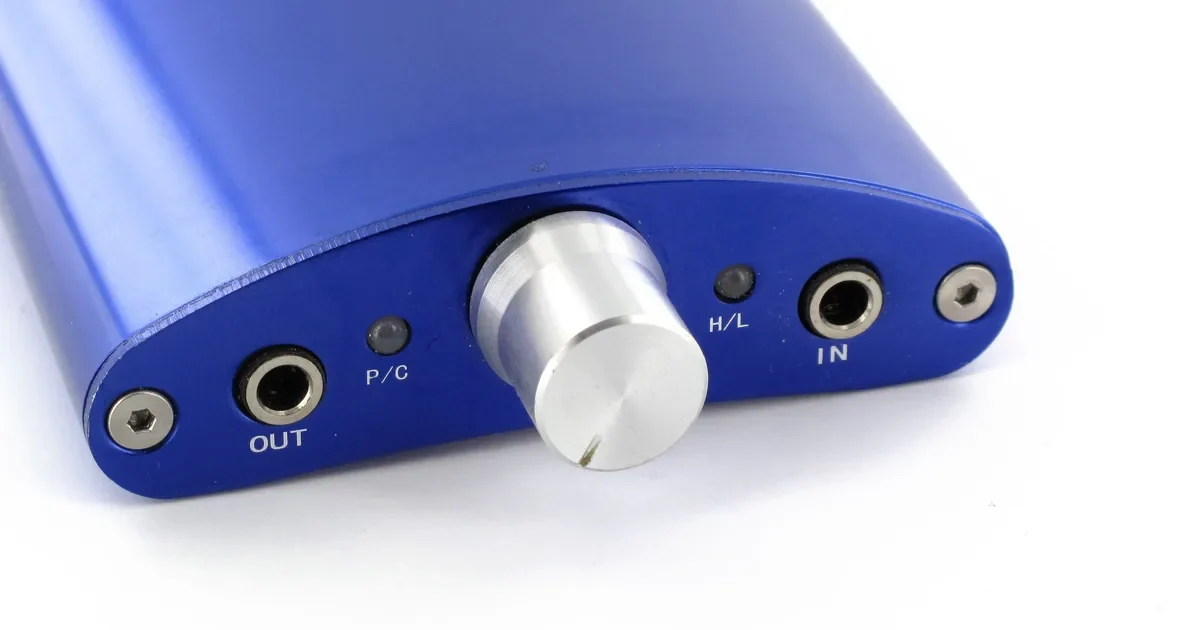
Choose black when parts of more than one alloy must match and you can control thickness and sealing, and choose silver (clear) when one alloy carries the product and you want the metal and its texture to show. Black hides alloy differences and shows a scratch that reaches the metal. Silver shows every machining mark of the texture beneath but is less contrasty when scratched, in our reading. This post is part of our guide to audio panel finishes. Here silver means clear anodize, an oxide layer with no dye.
Figures below come from sources we opened in October 2026, and forum posts are marked as directional.
The decision table
| Criterion | Black (dyed) | Silver (clear) |
|---|---|---|
| Alloy mismatch | Hides most of it (our alloy post) | Shows it, the least forgiving finish for mixed alloys |
| Scratch that reaches the metal | Light metal in a dark field | Metal beside metal (our reading) |
| Machining marks | Hidden by texture, shown if smooth | Shown unless texture hides them |
| Thickness | Needs enough for a saturated black, about 10 to 13 micrometres or more | Any class; set by wear needs |
| Fade | Dye choice and seal matter; many highly rated black dyes exist | No dye to fade |
| Cost | Dye adds a little (vendor figure) | No dye line |
| Fingerprints | We found no source by colour | We found no source by colour |
Caption: alloy and drift rows from our alloy and colour-match posts. Scratch row from a finishing.com thread, with the clear column our inference from how a dyed layer works. Thickness from finishing.com (Ted Mooney, an undated answer in a thread from June 2013). Dye cost from one Richconn page, directional. No controlled test of scratch or fingerprint visibility by colour was found.
Scratches and wear
Dyed anodize puts colour in the pores of the oxide layer, as Wikipedia explains. A scratch that cuts through the oxide removes the dye with it and exposes bare aluminum. Against a dark dye that metal reads as a light line. A finishing.com thread shows how real this is: a user asked in 2004 how to colour small scratches that expose base metal on black anodized camera housings, and the consultant answered that a permanent black marker or a commercial blackening product is a cosmetic fix, not anodizing, and that better handling is the real answer. Another respondent said touch-up anodizing and masking look poor and the original black dye is hard to match.
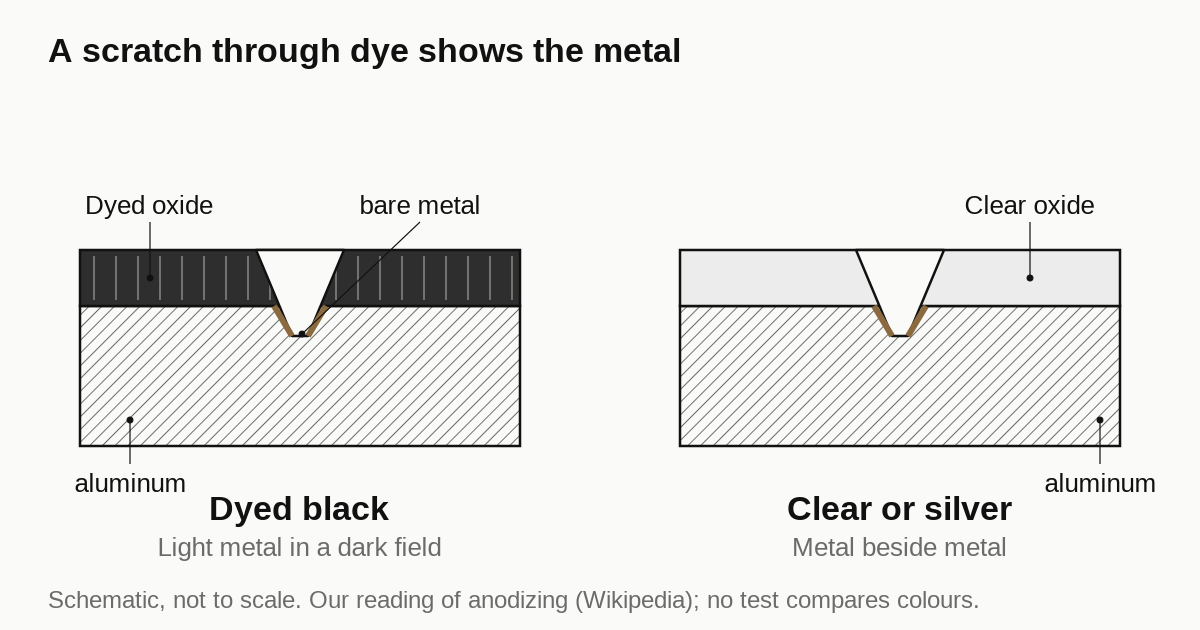
Clear anodize has no dye to remove, so a scratch through it exposes metal beside metal. That is our reading of the mechanism. We found no controlled test that compares the two, and a deep scratch shows on either. The practical protection is the same for both: protective film applied only after anodizing, gloves and no stacking face to face, as our brushed finish post sets out for handling.
Fingerprints
We found no source that compares fingerprint visibility by anodize colour, so we give no ranking. If fingerprints decide the choice, ask for the same texture in both colours and compare them under the light a customer will use.
Alloy mismatch and drift
This is where black earns its place. A faceplate, a sleeve and a cover in different alloys dye to slightly different shades, and our alloy post calls clear anodize the least forgiving finish for a mixed-alloy product and a deep black the best at hiding it. Our colour-match post says dark colours hide drift, clear and light champagne show it, a blasted surface hides more than a brushed one and rack position and dye lot add to the spread. We found no published measurement of how much each colour narrows a difference.
Clear gives away the alloy and the mill lot. If the product is one alloy, bought in one lot and finished in one load, clear is a legitimate choice, because the oxide shows the metal as it is.
Thickness and process control
Black is the colour that depends most on process control. Ted Mooney of finishing.com says saturated black needs thicker coatings, commonly 0.0004 to 0.0005 inch, which is about 10 to 13 micrometres, and that an underthick black part looks purple. On the Aluminum Association scale that sits at the lower end of Class II, which runs 0.4 to 0.7 mil (about 10 to 18 micrometres). Our own posts use 10 to 15 micrometres in their sample drawing notes, which agrees. Clear anodize has no dye to saturate, so thickness there follows the wear and corrosion need.
Rack marks matter more on black. A Fictiv article says contact marks are more noticeable on parts dyed dark. Put the mark location on the drawing, on a hidden face, whichever colour you choose.
Need a quote for this part? Get a quote for your audio parts
Fade and colour stability
All dyed anodize fades under UV. A finishing.com respondent says all colours, black included, fade, and that a good seal is imperative. Wikipedia says organic dyes fade, reds and blues in particular, and that black dyes made with ferric ammonium oxalate, an inorganic method, are more lightfast. A finisher writing in Finishing & Coating says the dye data sheet carries an ISO 2135 fade rating, generally 5 to 8, that each step up roughly doubles the exposure cycles to fade, that it is easy to find a highly rated black dye and that nickel seals are generally preferred because nickel ions bond to the dye. ISO 2135:2024 is the accelerated light-fastness test. Its catalogue entry says outdoor exposure is the only full test for exterior use, and that the accelerated test is for quality control of coatings with an established outdoor rating. We did not read the standard text.
Silver has no dye to fade. On a faceplate in a living room, UV load is lower than outdoors, but we found no public figure for indoor fade rates, so we give none. A planned post on anodized colour fade covers the dye side in detail and is not published yet.
Cost
We found no public price comparison of black and clear anodize on an audio panel. One Richconn page says dyeing standard colours adds 2 to 5 USD a part and that red and black cost more, without giving a figure. That page’s worked example does not add up, so use it for direction only.
Choose black or silver
Choose black when parts of different alloys must match, when you can write and check a thickness range and a seal, when you want a deep colour and when you can accept that a scratch to the metal will show as a light line.
Choose silver when one alloy carries the product, when the texture is the design, when you do not want a dye lot to manage or when a scratch to the metal should blend in as far as possible.
What a wrong choice costs. A black panel that is too thin looks purple and has to be redone. A silver set in mixed alloys shows a shade difference that no sample round removes, and the cure is a darker colour or a powder coat. Ask for a sample of each on your own alloy and texture, and judge them under the light a customer will use.
What to write on the drawing
State the alloy, the texture, the coating type, the thickness range, the colour by physical sample, the seal and the dye rating if the finisher can give one. Add a rack-mark location and a defect limit for the visible faces.
Send the drawing and the finish fields through the RFQ form, and we reply within 24 business hours with one itemised quote for the finished parts. Work goes to partner shops that finish audio parts. The wider decision order is in the guide to audio panel finishes.
Sources
- Anodizing, Wikipedia
- Aluminum Association designation system, anodizing.org
- Steps to minimize fading of anodized colors, Finishing & Coating
- Fading of dyed anodize, finishing.com (practitioner forum, directional)
- Scratches on black anodized parts, finishing.com (practitioner forum, directional)
- What are rack marks in anodizing, Fictiv
- How much does anodizing cost, Richconn (vendor page, directional)
- ISO 2135 catalogue entry, Nimonik (standard text not read)
See also: aluminium grades for anodized audio parts, with chemistry and defects by grade.
Frequently asked questions
Does black anodize show scratches more than silver?
A scratch that cuts through the oxide removes the dye with it and exposes bare aluminum, which is lighter than a dark dye, so it contrasts. A finishing.com thread has users asking how to colour scratches that expose base metal on black anodized camera housings. We found no controlled test against silver, so this is our reading and not a measurement.
Is silver anodize just clear anodize?
In this post, yes: an undyed oxide layer over the metal. Silver is not a dye. The Aluminum Association system lists clear as its own code in each thickness group. Because nothing hides the metal, the texture and the alloy underneath show through, which is why clear is the least forgiving finish for mixed alloys.
How thick must black anodize be?
A finishing.com consultant says saturated black needs thicker coatings, commonly 0.0004 to 0.0005 inch (about 10 to 13 micrometres), and that an underthick black part looks purple. The Aluminum Association Class II range is 0.4 to 0.7 mil. Write a thickness range on the drawing and have the finisher show a sample at that thickness.
Does black anodize fade?
All dyed anodize fades with UV exposure, black included, according to a finishing.com respondent. Black is the easiest colour for which to find a highly rated dye, and Wikipedia says black dyes made with ferric ammonium oxalate are more lightfast. We found no public figure for fade indoors, so ask for the dye rating and the seal type.
Need a quote for this part?
Send the drawing. We quote the finished parts, place the work with a partner shop and reply within 24 business hours.
Get a quote for your audio parts