Guides / Cost
Prototype Amplifier Chassis Cost: What a One-Off Really Costs and Why
November 9, 2026
In a published simulation, a one-off aluminum chassis part costs about one and a half times what the same part costs in a run of ten. The reason is not that the shop wastes time on the first piece. Programming, fixturing and finishing setup are paid once whether the order is one piece or ten, so a single piece carries all of it. No public price list exists for hi-fi chassis, so this guide shows where the money goes, uses a published simulation for the shape of the curve and gives a three-stage plan so each prototype answers a question you cannot answer another way.
If you already know the line items, jump to the stages. If not, start with amplifier chassis cost, line by line, which covers the quote for a production run. For the whole path from first quote to production order, see our guide to custom amplifier chassis.
The shape of the price curve
Get It Made, a UK manufacturing broker, publishes simulated CNC prices (updated August 2026). They are not actual quotes, so use them for shape only. For a large 3-axis aluminium part of 170 × 210 × 150 mm:
| Quantity | Unit price | Change from one piece |
|---|---|---|
| 1 | £1,209.60 | |
| 10 | £817.92 | down 32% |
| 100 | £691.20 | down 43% |
| 1,000 | £662.40 | down 45% |
Two lessons. One piece costs 1,209.60 ÷ 817.92 = about 1.5 times the price at ten. And most of the drop comes in the first ten pieces. After 100 the curve is nearly flat, which is why a first run of 25 sits on the flat part of the curve while a single piece sits at the top.
The supplier states the cause directly: it takes a similar amount of work to set up a project whether one or ten parts are machined. A real amplifier chassis is larger than that sample and has more operations, a front panel, a chassis body, rear panel and brackets, so expect higher numbers with the same shape. Treat the table as arithmetic about the curve, not a budget.
What finish does to a one-off
In the same simulation, finish on a single large aluminium part moved the price like this:
| Finish | Price for one | Change vs as machined |
|---|---|---|
| As machined | £1,209.60 | |
| Anodised | £1,224.00 | about 1% |
| Bead blasted | £1,324.80 | about 10% |
| Bead blasted and anodised | £1,353.60 | about 12% |
| Mirror polished | £2,016.00 | about 67% |
The anodize figure is low because the simulation treats it as a line on a quote. A real small-lot anodizer may charge a lot minimum that dominates a one-off, see low volume anodizing minimums. The polish figure is the lesson: hand work on a large face is the most expensive line on a prototype. If production will not be mirror polished, your prototype should not be either.
What is in a one-off quote
| Line | Why it hurts on one piece |
|---|---|
| Material | You pay for the plate or bar, including the chips. A front panel can start as several times its finished weight |
| Programming and setup | Same effort at one or ten, so one piece carries all of it |
| Machining time | Constant per piece, so it matters less at one piece than setup does |
| Finishing | Rack time and lot minimums, see the anodizing guide above |
| Cosmetic inspection | Every visible face is checked, and a rejected one-off means a full re-make |
| Packing and freight | Same per shipment, so one piece carries the shipment |
Material choice moves it too. Protolabs notes that the harder the metal, the harder it is to cut. The Get It Made page notes that stainless steel roughly doubles the price of aluminium for a simple part, which is another reason to prototype in the alloy you will build.
Three prototypes, three questions
Prototype is a broad word. Wikipedia separates a proof-of-principle prototype, a working prototype and a visual prototype that shows size and appearance but not function. A chassis programme needs all three ideas, and skipping a stage is how teams end up paying for the wrong prototype twice.
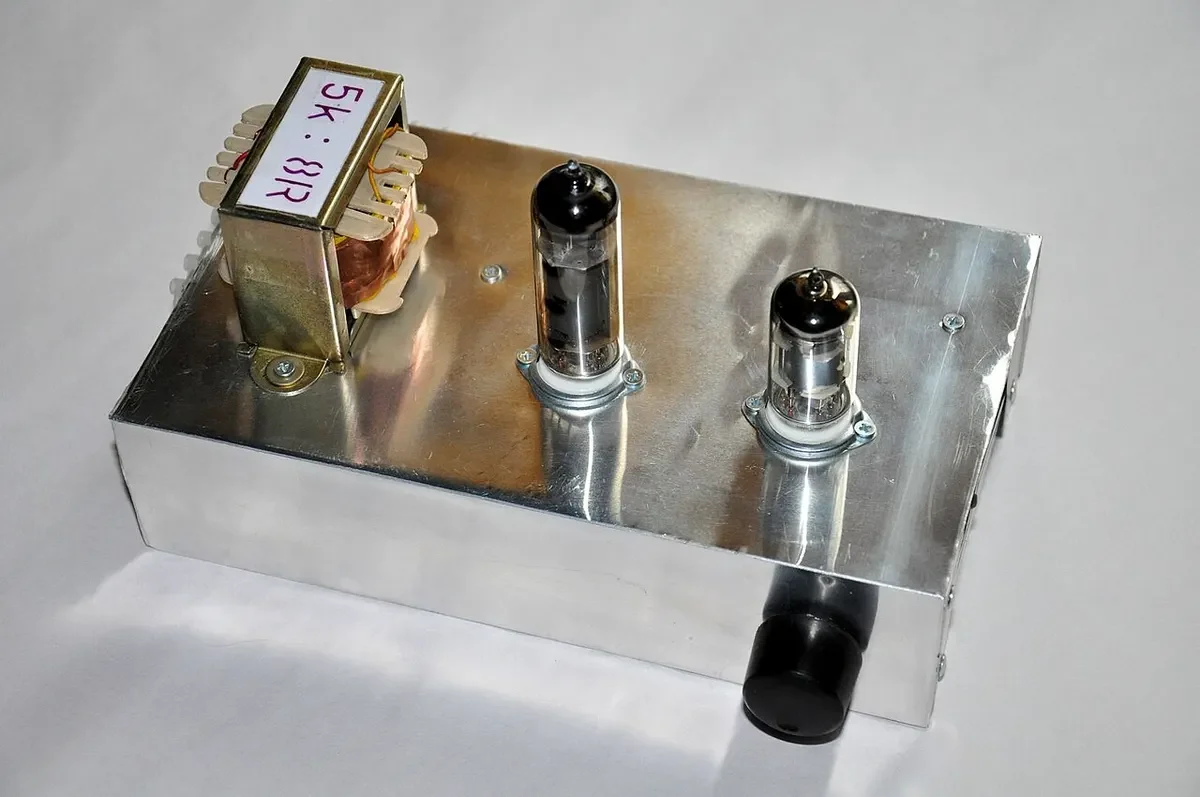
Stage 1: function. Do the transformer, board, valves and connectors fit, and does it run cool? The photo shows a hobbyist’s folded aluminum box with a transformer and two valves, which is how many first builds start. Folded sheet is the cheapest way to enclose a volume, see billet, extrusion or sheet and sheet metal covers for audio. Bare finish is fine here. Do not spend on cosmetics.
Stage 2: cosmetic. Real alloy, real process, real finish, and the real front panel. This is the prototype that goes to photographers, reviewers and the brand team. Panel gaps, knob fit and colour only show up here, see panel gaps on an audio enclosure and anodizing colour match for hi-fi parts. This stage is the expensive one, and the one teams are tempted to skip.
Stage 3: pre-production. A first article from the production route, measured and photographed, see first article inspection for cosmetic parts. If stage 2 was done properly the surprises left are small.
Need a quote for this part? Get a quote for your audio parts
Ways to lower the cost without lowering what you learn
- Order two or five, not one. The price curve falls fastest at the start, and a spare lets you test a part to destruction.
- Ask for three quantities on one drawing. Quote at 1, 5 and 25 and read the price breaks.
- Reduce the setups. Protolabs splits machining cost into cutting time with tool wear, fixtures to hold the part, and setups, which it describes as machining from multiple directions. A chassis that can be cut from two sides is cheaper than one that needs four.
- Call out cosmetic faces, not every face. See specifying cosmetic faces on a machining drawing.
- Tolerance only what matters. A general tolerance tighter than the fit needs is machine time for nothing, see tolerance stacks on an audio product.
- Do not trim the first article. A cosmetic prototype without a real finish check is a stage 1 prototype wearing a stage 2 price.
Reading a quote that looks too cheap or too dear
Protolabs advises comparing price alongside delivery speed and reliability, because a cheaper quote with a longer lead time is not the same offer. For a prototype chassis also compare these three things across quotes:
- Finish scope. One quote may include a masked and dyed anodize while another quotes the part as machined. Same drawing, different jobs.
- Inspection. Ask whether visible faces are checked under agreed lighting, see cosmetic inspection: lighting and viewing distance.
- Remake terms. A cosmetic one-off that fails inspection has to be made again. Ask who pays and how long it adds.
A shop that quotes the cosmetic prototype very low may be pricing stage 1. Compare it against the questions in how to choose the right machine shop for audio parts before you accept.
What to put in the RFQ
- STEP file and a 2D drawing with the cosmetic faces marked
- Alloy and finish, with a sample or Ra value
- Quantities 1, 5 and 25 priced separately
- Whether stage 1, 2 or 3 this is, so the shop knows what the part is for
- Delivery date, see MOQ and lead time
- Confidentiality terms for an unreleased product, see protecting your drawings when sourcing overseas
Send the drawing through the RFQ form and we reply within 24 business hours with one itemised quote for the finished parts. Work goes to partner shops that make audio chassis prototypes.
Sources
- How much does CNC machining cost, Get It Made (simulated prices, directional)
- Understanding CNC manufacturing costs, Protolabs (vendor content, directional)
- Prototype, Wikipedia
Frequently asked questions
How much does a prototype amplifier chassis cost?
No public price list exists. A UK supplier's simulation, not actual quotes, puts a large 3-axis aluminium part of 170 × 210 × 150 mm at £1,209.60 for one piece and £817.92 each at ten. A full-size amplifier chassis with a machined front panel is bigger and has more operations, so get quotes on your drawing at one, five and ten.
Why is one prototype so much more expensive per piece than ten?
Setup and programming cost about the same for one piece or ten, so a single piece carries all of it. The supplier's own note says it takes a similar amount of work to set up a project whether one or ten parts are machined. In its large 3-axis aluminium example the price fell 32% from one to ten pieces.
Should I prototype an amplifier chassis in sheet metal or billet?
Use both, for different questions. Folded sheet is the cheapest way to enclose a volume and tests fit and heat. A billet or extruded prototype in the real alloy and finish tests the look, the panel gaps and the feel. Sheet cannot answer the cosmetic questions, so do not skip the second step.
Is it worth mirror polishing a prototype chassis?
Only if production will be mirror polished. In the supplier's simulation mirror polishing added about 66% to the as-machined price, bead blasting about 10% and anodizing about 1%. A prototype must show the final finish or it proves nothing, but do not buy a finish more expensive than the one you will build.
Need a quote for this part?
Send the drawing. We quote the finished parts, place the work with a partner shop and reply within 24 business hours.
Get a quote for your audio parts