Guides / Design for Manufacture
Wood and Aluminium Hybrid Enclosures for Amps and Speakers
October 28, 2026
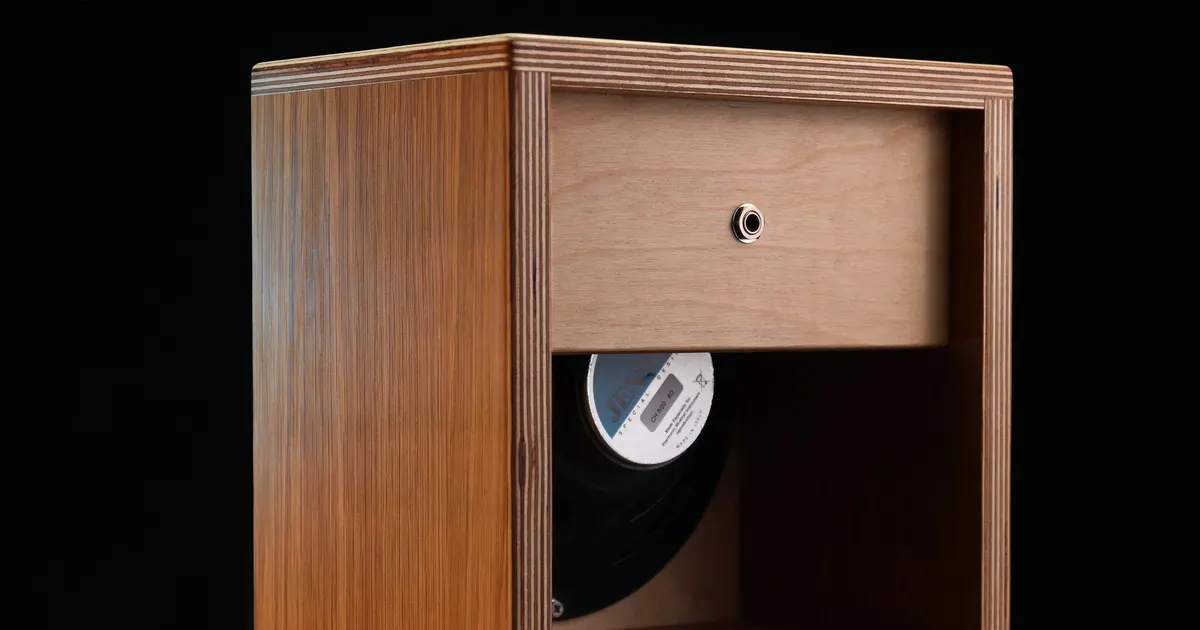
Wood and aluminum together are one of the most common combinations in premium audio: a warm veneer cabinet with a cold machined front, or a metal chassis in a wooden shell. The look is attractive. The engineering is difficult, because the two materials respond to the world in different ways and the seam between them is exactly where a buyer looks.
Two materials, two kinds of movement
Aluminum moves with temperature. Its thermal expansion is about 23 µm per metre per degree Kelvin, so a 430 mm panel grows about 0.2 mm over a 20 degree change. In a living room that range is rare, and the movement is small.
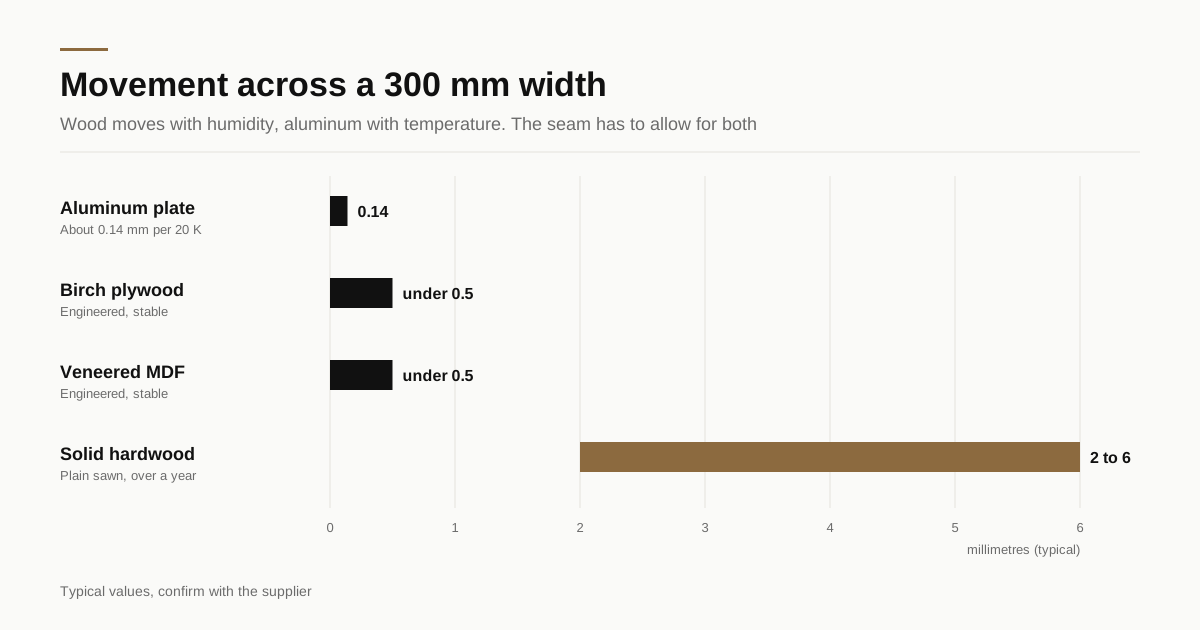
Wood moves with moisture. Fibres take up water and swell across the grain, and give it up and shrink. Along the grain the movement is tiny. Across the grain, in plain-sawn hardwood, a 300 mm wide board can change width by several millimetres between a dry winter and a humid summer. That is ten to twenty times the movement of the aluminum next to it, and it follows the season, not the temperature.
A tight, rigid joint between the two cannot survive that difference without a crack, a gap or a bowed panel. The design has to expect the movement and give it somewhere to go.
Typical figures
These are typical values, not promises. Confirm with the shop quoting your part.
| Material | Movement driver | Typical movement across a 300 mm width | Stability |
|---|---|---|---|
| Aluminum plate | Temperature | About 0.14 mm per 20 K | Very high |
| Solid hardwood, plain sawn | Humidity | 2 to 6 mm over a year | Low |
| Birch plywood | Humidity | Under 0.5 mm | High |
| Veneered MDF | Humidity | Under 0.5 mm | High |
| Bamboo panel | Humidity | 0.5 to 1.5 mm | Medium |
Engineered panels are far more stable than solid boards. A hybrid design that wants a flat, tight seam usually uses plywood or veneered MDF, not solid timber.
Choosing the wood
Pick the wood for the job, not just the look.
- Veneered MDF is flat, stable and cheap. It gives a uniform surface for veneer and machines cleanly. It is heavy, swells badly if water gets into the edges and holds screws poorly, so it needs inserts at fixing points.
- Birch plywood is stable, strong and holds screws better than MDF. The layered edge can be left exposed as a design feature or covered by veneer.
- Solid hardwood such as walnut or oak has the best grain and the most movement. Use it where it can float, for example as a side panel held by slotted fixings.
- Bamboo panels are stable and hard but have a distinct look.
Moisture content at manufacture matters. Wood should be conditioned to about the humidity of its final home, typically 8 to 10 percent for an indoor product, before it is machined. Wood cut from damp stock keeps drying after assembly and cracks or gaps.
Joint design: the part that decides everything
A hybrid enclosure has three kinds of joint. Each needs a different approach.
Aluminum front baffle to wood box. The front is machined plate, often 10 to 20 mm thick, bolted to the wooden box behind it. If the box is plywood or MDF, movement is small and a tight gasketed joint works. A thin foam or rubber gasket seals the air path, damps vibration and absorbs small differences. If the box is solid wood, use slotted holes in the wood or oversized clearance holes so the box can move behind the fixed front.
Aluminum chassis inside a wood shell. The chassis is the rigid datum. The shell wraps it and should be fixed at one point, such as the rear, and free to move elsewhere. Rubber grommets or slotted brackets let it float.
Aluminum trim set into a wood panel. An aluminum strip or ring let into a wooden surface is fixed along only one edge and floats along the other, with a small gap that the design treats as a shadow line. The related issue of visible gaps and shadow lines is in panel gaps in audio enclosures.
For all three, think about which part is the datum and which part floats. The fixed part defines the position. The floating part has clearance.
Fasteners and inserts
Screws in aluminum use threads or inserts, as covered in threads in anodized chassis. Screws in wood need a different approach.
- Threaded inserts for wood are sleeves with an outer coarse thread that bite into the wood and an inner machine thread for a bolt. They give a repeatable fixing that survives repeated assembly.
- T-nuts are installed from the back of a board and give a strong thread in plywood.
- Wood screws straight into MDF edges loosen with time and are poor for a part that is opened for service.
Use machine screws with inserts at every point that carries load or that service staff open. Use plain screws only at hidden, rarely opened points.
Finishing order
Finish the two materials separately, then assemble.
- Machine the aluminum, then finish and anodize it.
- Cut and shape the wood, sand, then veneer and finish it with oil or lacquer.
- Check both finished parts against each other for colour and gap.
- Assemble with clean gloves, soft supports and no sliding contact between metal and fresh wood finish.
Never anodize after assembly, since the acid destroys wood and glue. Never apply wood finish to an assembled aluminum part, since the solvents and sprays mark the anodize and are hard to clean from the metal. A cured lacquer can also soften under some solvent cleaners, so keep cleaning agents away from the seam.
Seam geometry: three ways to meet
The shape of the seam decides how forgiving it is.
- Flush butt joint. The aluminum and wood faces sit in one plane with a hairline gap. It looks the cleanest and forgives nothing: any movement shows. Use it only with stable engineered wood.
- Shadow gap. A deliberate groove of 1 to 2 mm between the two parts, often with the aluminum edge chamfered. The gap hides movement because the eye reads it as a design line. This is the most common premium solution.
- Overlap or rabbet. One part laps over the other, so a small amount of movement slides behind the visible edge. It suits solid wood best, and it adds machining on both parts.
Whichever you choose, put the gap dimension and the tolerance on the drawing. The way tolerances add up across a seam is covered in tolerance stack basics for audio enclosures. A 0.1 mm error on each of three parts produces a seam that looks wrong, even when every part is within tolerance on its own.
Colour and tone matching
Wood and anodize rarely match, and they are not meant to. The design question is contrast. Black anodize against walnut is a classic pairing. Natural silver against oak looks lighter and more modern. Bronze anodize against dark wood can look cohesive, though the exact shade depends on the dye lot. The colour control side is covered in anodize colour matching for hi-fi.
Wood changes colour with light: walnut lightens and cherry darkens. A showroom sample ages differently from the one in a customer’s living room, so avoid designs that depend on an exact match at launch.
Weight, resonance and damping
Wood and aluminum differ in sound as well as in movement. A cabinet is a resonant structure. Wood and MDF damp vibration by internal friction, while aluminum rings. A hybrid design lets the wood absorb energy and the aluminum provide stiffness. A gasket between the two adds a damping layer. The principles are described in chassis resonance and damping, and a thick aluminum front baffle on a damped wooden box is a common pairing for speakers.
What to put on the drawing and in the RFQ
- Wood species or panel type, thickness, veneer and finish, with moisture content at assembly
- Which part is the datum and which part floats
- Nominal gap along each seam and its tolerance
- Fastener type (inserts, T-nuts or screws) and where slotted holes are needed
- Gasket material and thickness
- Finishing order: each part finished before assembly
- A sample board of the wood with the aluminum colour beside it
- Packing, with edge protection and separation between metal and fresh finish
Send the drawing and a reference sample through the RFQ form. We match the machined aluminum parts with up to 3 shops, with a reply within 24 business hours. Say in the RFQ if the wood is supplied separately.
Frequently asked questions
Why does the seam between wood and aluminum open up over time?
Wood swells and shrinks with humidity, mostly across the grain, while aluminum moves with temperature. The two respond to different causes by different amounts, so a joint that is tight in a dry shop can gap or bind in a humid room. Stable engineered wood, a floating joint and a deliberate gap reduce the problem.
Should wood and aluminum be finished before or after assembly?
Before. Anodize and wood finishing use chemicals and cure cycles that damage each other, and both are difficult to repair once assembled. Finish each part, then assemble with protective gloves and soft fixtures.
What wood is best for a hybrid enclosure?
For stability, veneered MDF or birch plywood. For a solid wood look, hardwood with a designed floating joint. The wood that looks best on a sample board may be the one that moves most, so choose with the joint in mind.
Need a quote for this part?
Send the drawing. We match you with up to 3 shops and reply within 24 business hours.
Get matched with an audio parts shop