Guides / For Shops
Handling a Cosmetic Complaint From an Audio Brand: A Routine for Machine Shops
November 21, 2026
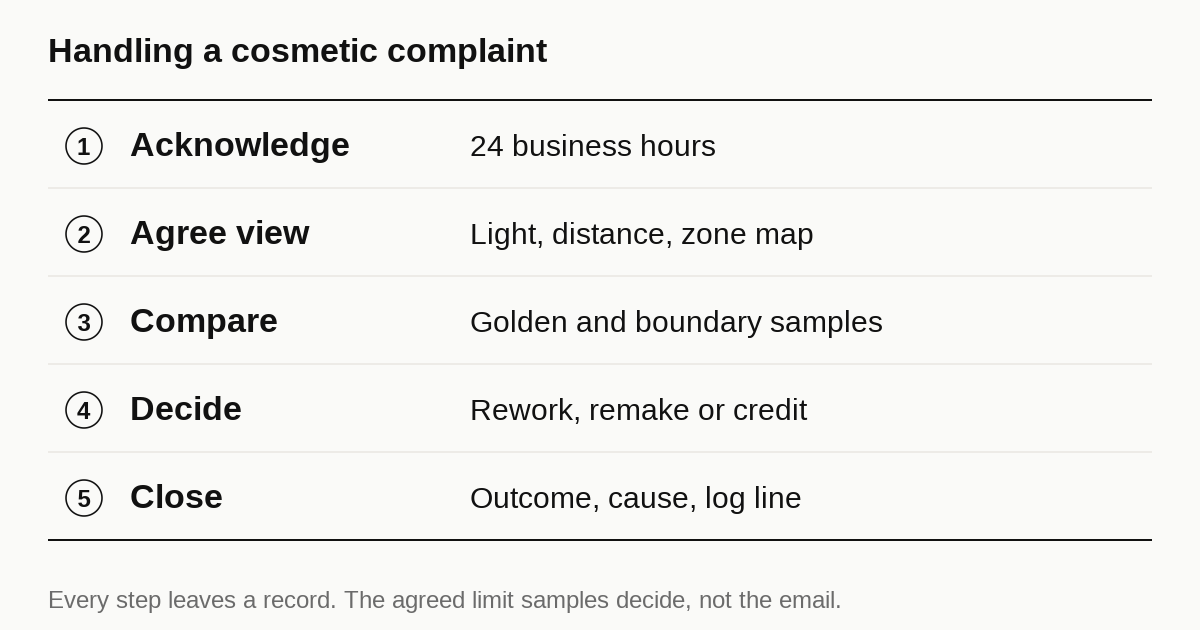
A cosmetic complaint is different from a dimensional one. A dimension can be measured by either side and the number settles it. A cosmetic fault is seen, and two people looking at the same panel under two lamps may disagree honestly. Shops that handle these by instinct lose time and sometimes the customer. Shops that handle them by routine close most of them in a few exchanges. This guide sets out a routine for a shop that makes finished audio parts.
Why cosmetic complaints escalate
Three things push a complaint up the ladder.
- Nobody agreed what was being judged. A brand writes “scratched” and the shop sees a mark inside the allowed zone limit. Without agreed definitions both sides are right. See cosmetic defect definitions for machined parts for a shared vocabulary.
- The conditions differ. A scratch visible under a raking lamp can vanish under a diffuse one. Our guide to cosmetic inspection lighting and viewing distance shows why the rule has to state light, distance and time.
- The shop goes quiet. A brand that waits a week for an answer fills the silence with the worst case.
The routine below deals with each: a fast acknowledgement, agreed conditions and a physical reference.
First reply within 24 business hours
The first reply is not a verdict. It does three jobs:
- confirm you have read it and who owns it
- ask for what you need to judge it: photographs, part number, revision, lot label and quantity affected
- say when the next message comes
A reply template to copy and edit:
Subject: [Order no.] [Part no.] cosmetic report received

Hello [name],

We have your report on [part no.], rev [x], lot [y]. [Owner name] is handling it.

To judge it we need:
1. Photos of the marked faces, taken in daylight or under a diffuse lamp, with a scale in frame
2. The lot label or packing slip, in frame
3. The number of parts affected out of the number received
4. If possible, one affected part and one part you consider good, kept in the packing they arrived in

We will reply by [date] with what we found, using the golden and boundary samples
we both signed. If you can set aside the affected parts, please do not rework them.

Regards,
[Name]
Put the 24 business hours in your own terms of business so the brand knows what to expect. A reply within that time that names the date of the next one does more than a long reply a week later.
Viewing conditions and the defect definitions
Before you open the box, agree how the part will be viewed. Write it down in the thread, even if the purchase order already has it.
Viewing-condition checklist:
- Zone of the part: A (front and knob faces), B (sides, top, bottom) or C (hidden), as marked on the drawing
- Viewing distance for that zone, for example 400 to 500 mm for a front face
- Viewing time per face, for example a few seconds, not a loupe inspection
- Light: diffuse, bright bench light, the same on both sides, and a lux level if you have a meter
- Angle: straight on and tilted, not only raking light
- Reference: golden sample and boundary samples named by label and revision
- Defect type named from the agreed list: scratch, dent, pit, streak, colour variation, haze
The distances, times and lux figures above are the examples from our lighting and viewing guide, not standards. Use the values in your own contract, and where there are none, propose them and get a reply in writing. A buyer who does not reply may still accept the conditions, but a written yes is better.
Comparing returned parts with the golden sample
Compare in the agreed conditions, the returned part beside the golden sample and the boundary samples, as set out in golden and boundary samples for cosmetic audio parts.
- Put the returned part, the golden sample and the light and dark boundary samples side by side.
- Look at the zone from the agreed distance and for the agreed time. Do not start with a loupe.
- Say which category the defect belongs to and which limit applies.
- Photograph the result in the same frame: returned part, golden sample, label.
- Check the lot record for the finish: metal lot, finisher, rack point, preparation setup. A colour difference is often a lot difference, see when the finish drifts.
Three outcomes:
- Inside the limit. Explain with the photo. Keep it short and polite. Offer to send a boundary sample if the buyer has not got one.
- Outside the limit. Accept it, and move to the remedy.
- Not covered. The defect is not in the agreed definitions. Do not argue. Treat it as a gap in the specification, decide the remedy case by case and add the defect to the list after the case is closed.
Need a quote for this part? Get a quote for your audio parts
Rework, remake or accept
The remedy follows the terms in the order. If there are none, propose one and put it in writing.
| Finding | Typical remedy | Check first |
|---|---|---|
| Surface mark that does not touch size | Rework | Anodize grows into and out of the surface in about equal amounts, so a strip changes size, see re-anodizing rework cost |
| Dent, wrong size or colour out of range | Remake | The remake lead time and the buyer’s deadline |
| Inside the limit | No action, explain | Send the comparison photo |
| Buyer wants to keep it | Written concession, part by part | Do not set a precedent for the next lot |
Do not rework a part before the buyer has agreed to the rework. A stripped panel is not evidence any more.
What the standards say
Two documents are worth knowing. They do not turn a routine into a requirement for a small shop, but they give you the headings.
- ISO 10002:2018 is titled quality management, customer satisfaction, guidelines for complaints handling in organizations. ISO describes it as guidance, usable as one process in a quality management system, for organizations of any size, and it includes an annex for small businesses. ISO confirmed it in 2023. Its themes include an open and easy complaints process, understanding what the complainant expects, analysing complaints to improve and reviewing the process.
- ISO 9001:2015 has three places that touch a complaint. Clause 8.2.1 covers customer communication, which includes customer feedback and complaints. Clause 9.1.2 asks the organisation to monitor how customers see the performance. Clause 10.2 covers nonconformity and corrective action: record it, decide whether action is needed, correct it, find the cause where needed and keep a record. ISO 9001:2026 was published on 16 September 2026. Advisera lists 8.2.1 and 9.1.2 as moderately changed, with a note under 9.1.2 naming complaints as an information source, and 10.2 as lightly restructured, so check the numbering if you quote it.
You do not need either document to keep a log. The log below is the practical half of both.
Complaint log
One row per complaint. Keep it in a spreadsheet and review it once a month.
| Field | What to write |
|---|---|
| ID and date received | Running number, date and time of the first message |
| Order, part, revision, lot | From the traveller |
| Defect as reported | The buyer’s words, with photos attached |
| Zone and defect type | A, B or C, and the type from the agreed list |
| Conditions agreed | Light, distance, time, reference samples |
| Finding | Inside the limit, outside, or not covered |
| Cause | From the lot record: handling, preparation, finish, packing, other |
| Remedy | Explained, reworked, remade, conceded, credited |
| Dates | First reply, finding sent, closed |
| Fix made | A change to a work sheet, tray, packing or the specification |
The fix column is the one that matters. A complaint that ends with a changed work sheet will not come back. For the causes that repeat, a reject tally and a Pareto chart will rank them, see cutting cosmetic scrap with a Pareto-led kaizen.
Closing the case
Send a short closing note: what was found, what was done, what has changed. Attach the final photo. Ask the buyer to confirm in writing. Then close the row.
If you machine and finish cosmetic parts and want requests from audio brands that fit your finish route, talk to us on the supplier page.
Sources
- ISO 10002:2018 Quality management, customer satisfaction, guidelines for complaints handling in organizations, ISO
- Customer communication, ISO 9001:2015 clause 8.2.1, The 9000 Store
- ISO 9001:2015 clause 10.2 nonconformity and corrective action explained, The Core Solution
- ISO 9001:2015 vs ISO 9001:2026 main differences, Advisera
- ISO 9001:2026 is live, transition period has begun, LRQA
- Anodizing, Wikipedia
Frequently asked questions
How fast should a shop reply to a cosmetic complaint?
Reply within 24 business hours with an acknowledgement that names what you need: photographs, the part number, the lot and the packing slip. You do not need a decision in that reply. A reply that says what happens next and by when stops most escalation, because the brand knows the complaint was read and who owns it.
How do I stop a cosmetic complaint turning into an argument about taste?
Move the discussion from opinions to conditions. Agree the light, the viewing distance and time, and the zone of the part, then compare the returned part with the golden and boundary samples. If the buyer approved a limit sample, the question becomes whether the part is inside or outside it.
Is there a standard for complaint handling?
ISO 10002:2018 gives guidelines for complaints handling in organizations of any size and has an annex for small businesses. It is guidance, not a certification requirement. ISO 9001 also asks a shop to handle customer feedback including complaints in its customer communication, clause 8.2.1 in the 2015 numbering.
Should I rework, remake or accept a part the brand rejects?
Decide from the evidence and the agreed terms. If the part is inside the approved limit, explain with the samples and keep it. If it is outside, rework only when the defect can be fixed without changing size or colour, otherwise remake. Anodize grows and strips in about equal amounts, so a strip changes size.
Need a quote for this part?
Send the drawing. We quote the finished parts, place the work with a partner shop and reply within 24 business hours.
Get a quote for your audio parts