Guides / Choosing a Supplier
When the Finish Drifts: Change Notification for Anodizer, Media and Brushing
November 21, 2026
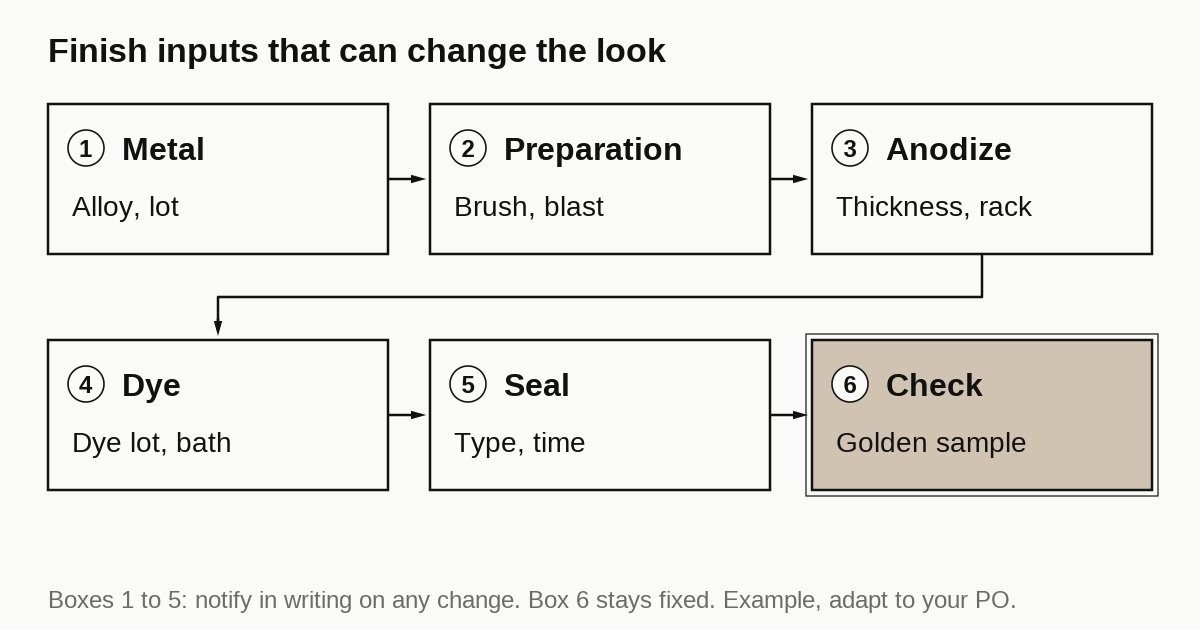
You approve a golden sample. The first batch matches it. The second batch arrives with the same drawing, the same part number and a front panel that is slightly warmer next to the first. Nobody broke the drawing. Somewhere in the finishing chain one input changed: a new anodizer, a different bag of blast media, a belt of another grit. If the shop did not tell you, you learn about it when two panels sit side by side on a bench. This guide lists the changes to ask for notice of and how to write that into the order.
The wording below is a starting point for your own contract, and a lawyer should read it.
Why identical drawings give different finishes
A drawing fixes size, a finish note and often a reference sample. It does not fix everything that goes into the look. SAF’s guide to anodized finishes lists the sources of colour variation: alloy and temper, the metal lot, coating thickness, etch, process timing, load size, racking, current density and dye time, among others. The Aluminum Anodizers Council says appearance depends on alloy, temper, gloss, surface structure and the colouring process, and that buyer and anodizer should agree an acceptable range for each project.
So a part can meet every number on the drawing and still look different from the approved one. The cure is not a stricter drawing alone. It is a rule that the shop tells you before any input changes, so you can ask for a new sample while the cost is a sample, not a batch.
The finish inputs that change the look
The table lists the inputs for a brushed or blasted, anodized and marked panel. It builds on the colour inputs in our guide to anodizing colour match for hi-fi parts.
| Input | What can change | Why it shows |
|---|---|---|
| Alloy and temper | Another alloy, another temper, another supplier | SAF notes that alloys anodize differently and that different tempers anodize at different rates |
| Metal lot | A new plate or extrusion lot | SAF says mill, production date and rolling affect the metal even within one alloy |
| Preparation: brush | Grit, belt or wheel type, direction, pressure, a new operator | The grain scatters light, see brushed finish on audio panels |
| Preparation: blast | Media type, mesh, pressure, nozzle distance, tired media | A different texture reads as a different shade, see bead blasting audio enclosures |
| Anodizer and line | A different finisher, tank or rectifier | Process chemistry, temperature and timing differ between lines |
| Thickness range | A new target or tolerance | Thickness affects how much dye the coating holds |
| Rack point and racking | A new contact point or rack type | SAF lists racking and current density among the variables |
| Dye | Dye lot, dye supplier, bath age, dye time | Dye time changes the shade, per SAF |
| Seal | A different seal type, time or temperature | The seal shifts the final look a little |
| Marking | Laser settings, engraving depth, fill | The mark and its surroundings can change locally |
| Inspection | Light, distance, lamp | The same part looks different under another light |
You do not control any of these. You ask the shop to tell you about them.
What the shop must tell you before the next batch
Keep the rule short enough that the shop will follow it. Three parts:
- What counts as a change. Anything in the table above, whether the shop made the change or its finisher did.
- When to tell you. Before the batch is released to finishing, not after it ships. A notice period in working days that both sides can keep.
- What follows. The shop makes a sample on the new input and sends it with a photo set. You approve it against the golden sample before the batch goes on.
A shop that works to ISO 9001 already has a duty to control its own changes. Clause 8.5.6 in the 2015 numbering is titled control of changes, and the commentary pages describe it as review of the change before it takes effect, authorisation by the right people and records of the outcome. That is the shop’s internal control. It does not oblige the shop to tell you, so the notice has to come from your purchase order. ISO 9001:2026 was published on 16 September 2026 and, per Advisera, clause 8.5.6 is unchanged while the planning of changes in clause 6.3 grew. Check the numbering with the shop if you refer to it.
Re-approval against the golden sample
A change notice is only useful if there is a fixed reference to compare with. Keep the golden sample and the boundary samples as described in golden and boundary samples for cosmetic audio parts, with the metal lot, the finish route and the date on the label. After a change:
- The shop makes parts on the new input, ideally from the same metal lot as the golden sample.
- You compare them with the golden sample in the agreed light and at the agreed distance.
- You approve, reject or ask for a second sample, in writing, with the revision.
- If you approve the new route, you decide whether it becomes the new reference. A signed update of the golden sample should name what changed.
Colour can be measured as well as judged by eye. A colour difference is a distance between two points in the CIE 1976 Lab* space, a space the CIE defined in 1976. Wikipedia notes that the original formula overstates differences in saturated regions and that later formulas refine it. ASTM D2244, a practice for calculating colour tolerances and small colour differences from instrumentally measured coordinates, is shown as active in its D2244-25 revision on the ASTM store. It says buyer and seller should agree on the permitted tolerance and on the calculation procedure. If you use a number, write the formula, the instrument, the light and the geometry as well, and keep the physical sample as the final reference. We found no public Delta E limit written for hi-fi front panels, so any figure is yours to agree.
Need a quote for this part? Get a quote for your audio parts
Writing the change rule into the PO
An example clause, to adapt. The brackets are for you to fill in.
CHANGE NOTIFICATION (FINISH)
1. The supplier shall notify the buyer in writing at least [N] working days before
   releasing a batch to finishing if any of the following change from the approved route:
   (a) alloy, temper or metal lot supplier;
   (b) brushing: grit, belt or wheel, direction, machine;
   (c) blasting: media, mesh, pressure, cabinet;
   (d) anodizer, line, thickness range, rack point, dye lot or supplier, seal;
   (e) marking method or settings.
2. The supplier shall provide parts made on the changed route and a photo set, and shall
   not ship production until the buyer approves them in writing against the golden sample.
3. A change made by the supplier's subcontractor is a change of the supplier.
4. Approval of a changed route applies to that route and that revision only.
Point 3 matters most. Most finishing changes start at the finisher, and the shop only hears of them when a batch comes back looking different. Say in the clause that the shop is responsible for passing the duty down.
Two cautions. First, do not pick the notice period by copying a number from a blog. Ask the shop how long its finisher takes to confirm a slot and set a period that can be met. Second, do not make the clause so long that the shop ignores it. Six or seven inputs you can verify are better than twenty you cannot.
Checklist
Before you place the order:
- Golden sample approved and labelled with revision, metal lot, finish route and date
- Boundary samples made for colour or grain, if the finish varies
- List of finish inputs written into the order, including the finisher by name
- Notice period agreed with the shop, in working days
- Duty to pass the clause down to the finisher stated
- A sample and photo set required after any change, before production ships
- Approval in writing, naming the revision
- Inspection light and viewing distance agreed, see cosmetic inspection lighting
For each batch:
- Shop confirms in the update that no input has changed, or lists what has
- Batch checked against the golden sample on arrival, in the agreed light
Put the change rule and the sample requirement in the description of your RFQ so we can confirm what the shop accepts before you order. We reply within 24 business hours with one itemised quote for the finished parts.
Sources
- Appearance and color variation, SAF (supplier content, directional)
- Anodic coating specifications, Aluminum Anodizers Council
- ISO 9001:2015 clause 8.5.6 control of changes explained, The Core Solution
- ISO 9001:2015 vs ISO 9001:2026 main differences, Advisera
- ASTM D2244, practice for calculating color tolerances and color differences, ASTM
- Color difference, Wikipedia
- CIELAB color space, Wikipedia
Frequently asked questions
Why do identical drawings give different finishes?
Because the drawing fixes size and a note, not every input of the finish. SAF lists alloy, temper, metal lot, etch, thickness, dye time, racking and current density among the causes of anodize colour variation. If the shop changes one of them, the part still meets the drawing but can look different.
Which changes should a shop announce before the next batch?
Any change to the metal lot or alloy supplier, the anodizer, the line or rack point, the thickness range, the dye lot or supplier, the seal, the blast media or mesh, the brush grit or belt, and the person or machine that does the preparation. Write the list into the purchase order, with a notice period you can keep.
Does ISO 9001 stop a shop changing its process without telling me?
Not by itself. ISO 9001:2015 clause 8.5.6 on control of changes expects changes to be reviewed, authorised and recorded, but those records belong to the shop. The standard does not oblige the shop to tell you. A notification duty has to be in your contract or purchase order.
Can a colour difference be measured instead of judged by eye?
Yes. A colour difference can be expressed as Delta E in CIELAB, and ASTM D2244 is a practice for calculating colour tolerances and small differences from instrument readings. It says buyer and seller should agree the tolerance and the calculation method. Agree the formula as well as the number, and keep the golden sample as the physical reference.
Need a quote for this part?
Send the drawing. We quote the finished parts, place the work with a partner shop and reply within 24 business hours.
Get a quote for your audio parts