Guides / Choosing a Supplier
Production Updates on an Amplifier Chassis Run: What to Ask Each Week
November 21, 2026
A chassis run rarely fails in the machine. It fails in the weeks after the cutting is done, when the parts wait for brushing, anodize or engraving, and nobody tells the brand until the ship date is close. A short weekly update, asked for in advance and written to a fixed layout, brings those delays into view while there is still time to move a launch, split a shipment or approve a change. This guide sets out what to ask for each week on an amplifier or DAC chassis run.
The routine below is a starting point for the weekly update you agree with any supplier in the purchase order. On our orders an engineer follows the run and sends you a progress update every week.
Why chassis runs slip at finishing
On a cosmetic chassis the machining is the short part of the calendar. Our guide to MOQ and lead time for audio parts lists typical ranges for a twelve week quote, and the finishing queue and the second finishing run after approval are among the longest blocks. Those ranges are typical, not promised, but the shape is the useful point: the long waits sit at the outside finisher and in your own approval rounds.
Three reasons the slip reaches you late:
- The finisher runs by rack and by colour. The low volume anodizing guide explains that anodizers price and schedule by rack cycle and tank time, and that a non-standard colour may need a dedicated bath. Your parts wait for a rack to fill or for a colour slot.
- The shop learns of the slip from the finisher, not before. A shop that has no routine to ask the finisher for a date does not know the date.
- Your approvals are on the path. A photo or a sample sent for your approval stops the line until you answer. A reply that takes a week costs a week.
An update routine does not remove these waits. It shows them, with dates.
The weekly update: steps, dates, photos
Ask for the same layout every week, so you can read it in two minutes and compare it with last week. A layout that works for a chassis run:
| Item | What to ask for |
|---|---|
| Order and lot | Order number, part numbers and revision, lot label |
| Step now | Where each part group is: material, machining, deburr, preparation, finishing, engraving, assembly, inspection, packing |
| Quantity | Made, in process, rejected and why, still to make |
| Dates | Planned date and expected date for the next step and for ship |
| Photos | The agreed shot list, named by part, revision and lot |
| Risks | Anything that could move a date, with the reason |
| Needs from you | Approvals or answers, each with a deadline |
Two rules make the layout useful. First, planned and expected are two separate columns, so a moved date is visible at once. Second, the update states what is blocked, not only what is moving. A line that reads “front panels at finisher, return date not yet confirmed” is a flag. A line that reads “front panels in finishing” is not.
Photos that show cosmetic state, not just progress
A picture of a stack of panels in a tray shows progress. It does not show whether a face is clean. Agree a shot list once, as described in our guide to product photos for client approval, and repeat it:
- the cosmetic face of one or two parts, square on, with a label in frame
- a close-up of the edge or chamfer, lit along the edge
- the golden sample next to a part from the lot, in one frame
- any mark the shop already knows about, with a pointer
That guide notes that photos approve structure and condition, but colour needs a physical sample, because the same image can look different on different devices. So treat a photo as a status check. Do not approve a colour from it.
For engraving or laser marking, ask for a close-up of one mark per part group, with a scale in frame. A mark that is too deep, too wide or off-centre is cheap to fix on part one and costly on part three hundred.
Approvals you owe the shop and their deadlines
Many slips are yours. List every decision the shop will need from you before the run starts, with a reply time you can keep:
- approval of the first article, see first article inspection for cosmetic parts
- approval of the colour sample and the rack point
- release to finishing after the machined parts pass your photo check
- release to ship after the final photo set
Write a reply time in the purchase order, for example two working days, and keep to it. If you will be away, name a person who can approve. An approval that sits in an inbox moves the ship date as much as a late anodizer does.
ISO 9001 and customer communication
If the shop works to ISO 9001, one clause is relevant here. In the 2015 numbering, clause 8.2.1 covers customer communication: arrangements for enquiries, contracts and orders including changes, and customer feedback including complaints. The standard does not tell a shop to send a weekly report, so you ask for it and write it into the order. ISO published ISO 9001:2026 on 16 September 2026 and a 2015 certificate stays valid during the transition, per LRQA. Advisera lists 8.2.1 as moderately changed, with new wording on contingency information, so check the numbering with the shop if it matters to you. A certificate is not required to run this routine.
Signs of a delay
Read each update for these:
- No date for the finishing step. The parts are in a queue and nobody has a slot.
- The same line two weeks running. “In finishing” twice without a return date means the shop is not asking.
- Quantity made equals quantity ordered, with no reject line. On a cosmetic run, a zero reject count in every update is unusual. Ask how the shop inspects.
- Photos taken under a different light each week. You cannot compare them. Ask for the same setup.
- A change nobody announced. A new anodizer, a different grit or a different alloy lot. See when the finish drifts.
- Needs from you with no deadline. The shop is waiting and has not said so.
When you see one, ask a specific question: “When did the parts enter the finishing queue, and what date did the finisher confirm?” A shop with a routine can answer in a line.
Need a quote for this part? Get a quote for your audio parts
An update for a 300 unit DAC chassis run
This is an illustrative update, not a real order. A DAC chassis here is a front panel, a body and a cover, 300 sets, in black anodize, with an engraved front panel.
WEEKLY UPDATE: week 5 of 11 (illustrative)
Order: DAC-300, rev C, lot L01

Step now
  Bodies: machined, deburred, 300 of 300
  Covers: machined, deburred, 300 of 300
  Front panels: brushed, 292 of 300; 8 rejected, tool marks near the edge
  Remakes of 8 panels: material cut, machining due Thursday

Dates
  Planned ship: week 11. Expected ship: week 11 if the remakes join the finishing lot.
  Finishing: lot planned for week 7. Finisher slot confirmed for week 7, not yet for the remakes.

Photos: shot list attached (face, chamfer, side by side with golden sample, label)

Risks
  If the remake panels miss the week 7 lot, the second lot adds about a week.

Needs from you
  Release brushed panels to finishing: reply by Tuesday
  Confirm black, same dye lot as the sample: reply by Tuesday
Read it as a buyer. It states a reject and its cause, names the next date, flags what would move the date and gives you two deadlines. If the remakes were left out of the finishing slot, the ship date would still say week 11 and the slip would show at the finisher in week 7. The update would have told you in week 5.
Weekly checklist
Print this and tick it each week.
- Update arrived on the agreed day, in the agreed layout
- Every part group shows a step, a quantity and an expected date
- Planned and expected dates compared with last week
- Rejects shown with a reason, or a statement that none were found
- Photos named to the shot list and taken in the same setup
- Finishing date confirmed by the finisher, not assumed
- Open approvals from you listed with a deadline, and answered in time
- Any change in material, process or finisher announced in writing
- Next update day confirmed
Put the routine, the layout and your reply times in the description of your RFQ so we can confirm what the shop accepts before you order. We reply within 24 business hours with one itemised quote for the finished parts.
Sources
- Customer communication, ISO 9001:2015 clause 8.2.1 explained, The 9000 Store
- ISO 9001:2026 is live, transition period has begun, LRQA
- ISO 9001:2015 vs ISO 9001:2026 main differences, Advisera
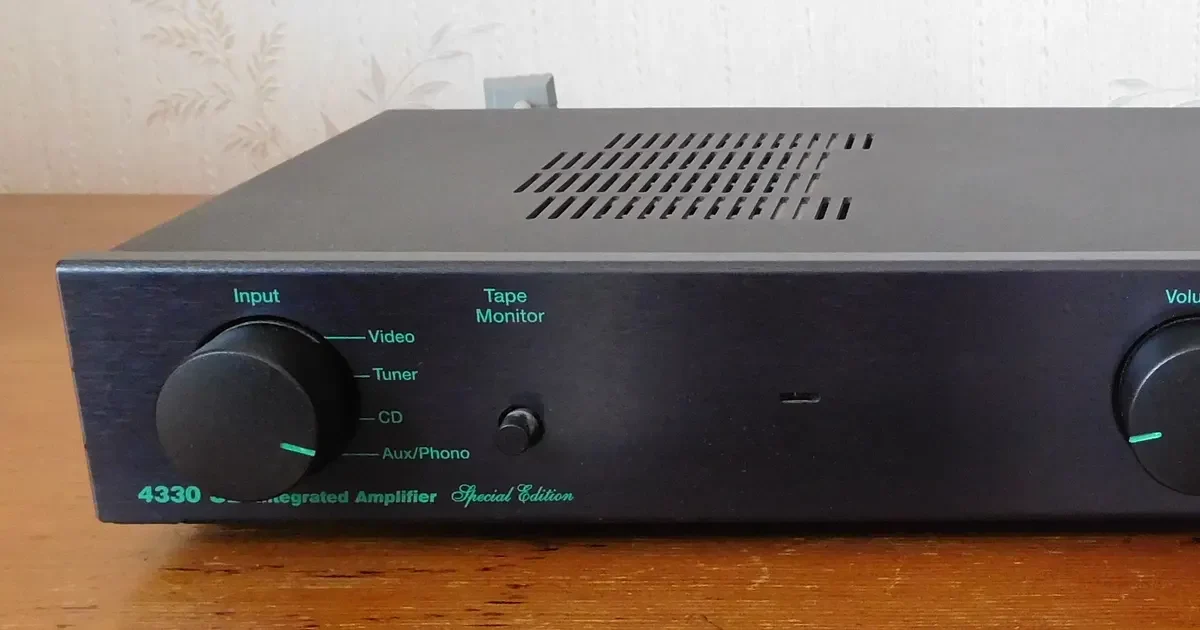
- Creek 4330 SE Integrated Amplifier, Wikimedia Commons

Frequently asked questions
How often should I ask a shop for a production update?
Weekly is a workable rhythm for a run of several weeks, because most steps on a cosmetic chassis last days, not hours, and a week is long enough to show change and short enough to act on it. Agree the day and the format in the purchase order. For a short run, ask for an update at each gate instead: after machining, after finishing and before packing.
What should a weekly update contain?
The current step for each part group, the planned and expected date of the next step, the quantity done and the quantity rejected, photographs of the cosmetic faces with a label, and a list of what the shop needs from you with a date. If a date has moved, the update says by how much and why.
Does ISO 9001 require a weekly report to the customer?
No. ISO 9001:2015 clause 8.2.1 on customer communication covers arrangements for enquiries, orders including changes and customer feedback, but it does not set a weekly report. If the shop works to ISO 9001, ask what its routine for order status is and write the weekly update into your purchase order.
What is the first sign that a finish date will slip?
A shop that stops giving a date for the finishing step. Finishing often sits in a queue at an outside anodizer, and the queue is outside the shop's control. If an update says 'with the finisher' with no return date, ask when the parts entered the queue and when the finisher confirmed the slot.
Need a quote for this part?
Send the drawing. We quote the finished parts, place the work with a partner shop and reply within 24 business hours.
Get a quote for your audio parts