Guides / Design for Manufacture
Copper Heatsinks and Busbars in Amplifiers: Machining and Plating
October 13, 2026
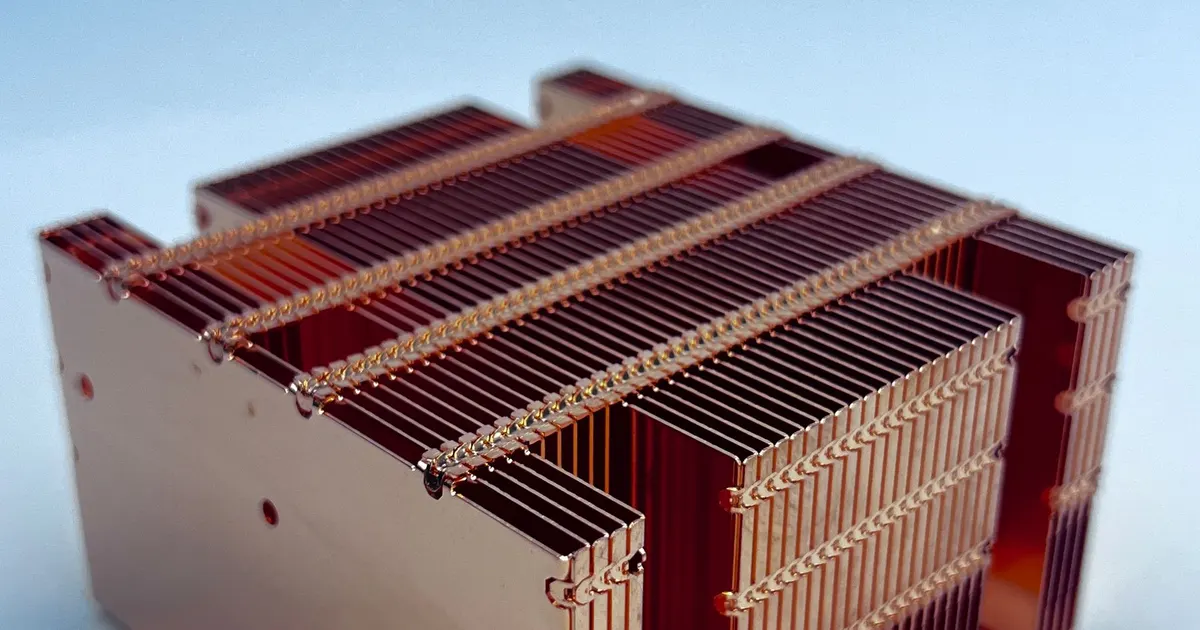
Most amplifier heatsinks are aluminum, and for good reasons: it is light, cheap and easy to extrude. Copper shows up in the parts where heat or current has to move fast through a small space: a base plate under power transistors, a spreader behind a hot output stage, a busbar carrying the supply rail. It is a good material for the job and a stubborn one to machine.
Why copper, and where
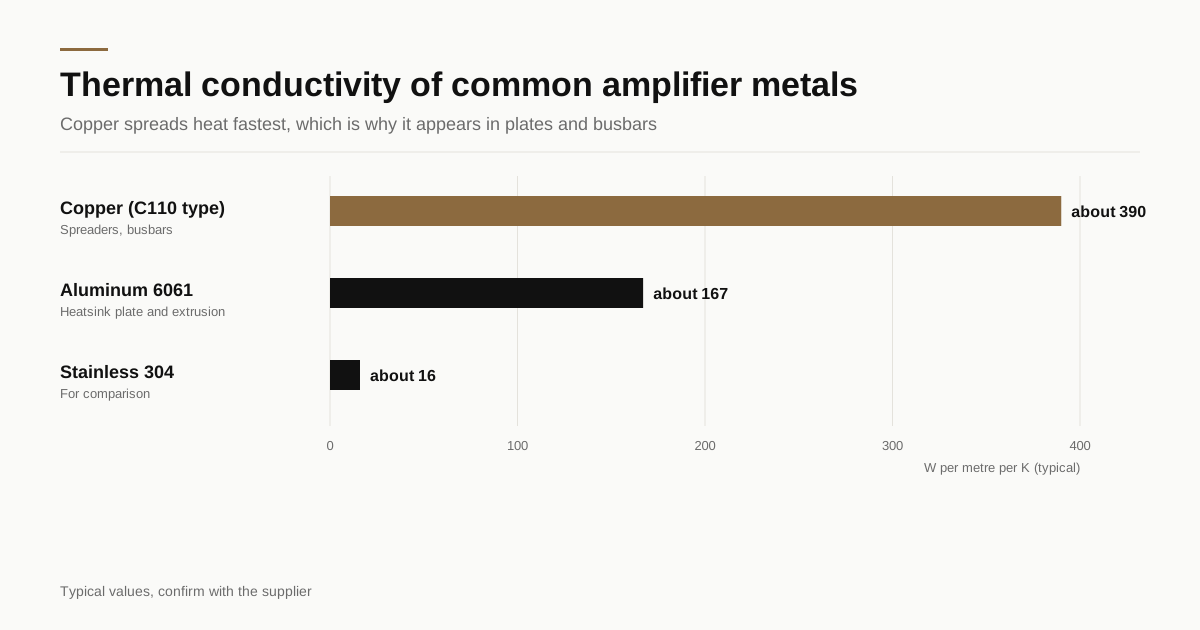
Copper conducts heat at roughly 390 W per metre per K in its common electrolytic form, against about 170 to 200 for the aluminum alloys used in extrusions and plate. Electrically, copper is the benchmark: pure grades sit near 100 percent IACS, and the common aluminum conductor grades are around 60 percent by volume.
In an amplifier this matters in three places.
Heat spreaders. A power transistor concentrates tens of watts in a few square centimetres. A copper plate between the device and a larger aluminum heatsink spreads the heat sideways before it enters the fins. The plate reduces the temperature rise at the device.
Busbars. A flat copper bar carries supply current between a power transformer, rectifier, capacitor bank and output stage. A bar has far lower resistance and inductance than wire of the same weight, and it holds its shape.
Thermal bridges and mounts. Copper blocks tie hot components to the chassis wall, so the chassis becomes part of the heatsink.
The trade-off is weight and price. Copper is about 8.9 g/cm³, over three times the density of aluminum, and it costs several times more per kilogram. Use it where its properties earn their keep, not for a whole sink.
Typical figures
These are typical values, not promises. Confirm with the shop quoting your part.
| Item | Copper (C110 type) | Aluminum (6061 type) |
|---|---|---|
| Thermal conductivity | About 390 W/m·K | About 167 W/m·K |
| Electrical conductivity | About 100 percent IACS | About 40 to 45 percent IACS |
| Density | About 8.9 g/cm³ | About 2.7 g/cm³ |
| Machinability | Poor, gummy | Good |
| Typical busbar thickness | 2 to 6 mm | Rarely used |
| Contact face flatness | 0.05 mm per 100 mm | 0.1 mm per 100 mm |
| Plating thickness, tin or nickel | 3 to 12 µm | Not applicable |
Which copper
Not all copper is the same.
- C110, electrolytic tough pitch, is the standard for busbars and plates. It is about 99.9 percent copper and the best conductor of the common grades. It is soft and sticky to machine.
- C101 and C102, oxygen-free grades, are cleaner and used where brazing or vacuum use matters. They cost more and are rarely needed in audio.
- Free-cutting copper alloys such as tellurium or sulfur copper cut far better, with chips that break, and lose a few percent of conductivity. They suit parts with many turned or drilled features.
- Brass and bronze are different materials and are described in brass and copper audio parts.
If the part is a simple flat bar or plate, C110 is the right choice and the machining is mostly cutting, drilling and bending. If it is a complex block with many features, ask the shop whether a free-cutting alloy is acceptable.
Machining copper
Copper is soft, ductile and thermally conductive. Those traits cause the usual problems.
Gummy chips. The metal tears instead of shearing cleanly. Chips wrap around the tool and the part. Sharp tools with polished flutes and high positive rake help, and so do coolant and chip breakers.
Burrs. Copper burrs are large and tough. They affect contact faces and bolted joints. Plan a deburring operation, and say on the drawing which edges must be burr-free.
Built-up edge. Copper welds to the cutting edge and then tears away, leaving a rough surface. Higher speed, sharp tools and lubrication reduce it.
Heat. Copper conducts heat away fast, which keeps the cut cool but also makes the part hot to handle and prone to expansion during measurement.
Flatness. A thin copper plate warps from residual stress and clamping. Light clamping, sharp tools and a final light facing pass keep contact faces flat. The same stress logic applies to aluminum plate, as described in machining thick front panels.
Copper insert or full copper
A common cost-saving design is a copper insert set into an aluminum heatsink, or a thin copper plate clamped between the power devices and an aluminum block. The copper handles the hot spot and the aluminum handles the bulk, so the product gains most of the benefit at a fraction of the weight and cost.
The joint between the two metals needs care. The interface should be flat and clean, with a thin layer of thermal compound, and held by enough screws to keep pressure even. Different expansion rates mean a rigid bond can loosen after many heat cycles, so mechanical clamping is more common than brazing in audio. Check the mounting hole pattern for the power devices against the plate size before cutting, since a plate that is slightly too small leaves a transistor overhanging the copper and loses most of the benefit.
Contact faces and flatness
Where a busbar or a spreader meets another part, the contact surface decides performance.
A bolted busbar joint carries current only where the surfaces touch. Two surfaces that are not flat touch at a few points, and the contact resistance rises, which creates heat. Good practice is flat faces, clean surfaces, correct bolt torque and a plated finish.
Typical requirements for a contact face are flatness of 0.05 mm per 100 mm and a roughness around Ra 0.8 µm or better. A face that is too smooth can hold less joint compound, and one that is too rough leaves gaps. For a thermal interface, where a power device or a heatsink sits on the copper, the same flatness numbers apply, with a thin layer of thermal compound filling the micro gaps.
Do not leave a burr or a raised rim around a bolt hole on a contact face. It lifts the joint and spoils the contact. Specify a light chamfer on the hole edge on the contact side.
Bending busbars
Busbars are often bent to fit around other parts. Copper bends well when annealed, but the inside radius still matters.
- A common rule is an inside bend radius of at least one to two times the thickness for soft copper, more for harder tempers.
- Bending across the grain of rolled bar is safer than bending along it.
- Holes close to a bend distort. Keep holes at least two to three times the thickness away from the bend line.
- Springback is small in soft copper but varies by temper, so first bends need a trial.
Specify the temper on the drawing, such as soft or half-hard. Hard copper cracks on a tight bend and soft copper deforms under bolt load.
Plating: tin, nickel and silver
Bare copper does not stay bright. It oxidises quickly and tarnishes in air, and the oxide film raises contact resistance at joints. Plating fixes this.
| Plating | Typical thickness | Strengths | Watch for |
|---|---|---|---|
| Tin | 5 to 10 µm | Low cost, good solderability, stable contact | Soft, can whisker in some conditions, dull grey look |
| Nickel | 5 to 12 µm | Hard, wear-resistant, stable | Slightly higher contact resistance, harder to solder |
| Silver | 3 to 8 µm | Lowest contact resistance, bright | Tarnishes with sulfur, cost |
| Clear lacquer | 10 to 25 µm | Cheap cosmetic protection | Insulating, not for contact faces |
For a hidden busbar, tin is the usual choice. For a visible copper part that should stay bright, nickel or clear coating is common. Do not coat a contact face with lacquer. Mask the bolted area if a lacquer is used on the rest of the part.
Plating adds thickness, so tight fits need allowances. A 10 µm layer on each side adds 20 µm to a plate thickness, which can matter in a stacked joint.
Anodizing is not an option for copper. The process applies to aluminum and a few other metals.
Cost
Material cost dominates small copper parts. Copper plate and bar are priced per kilogram at several times the aluminum price, and copper parts weigh more for the same volume. A busbar of 3 mm by 30 mm by 200 mm weighs about 160 g, so the material is not trivial at volume.
Machining time is longer than aluminum for the same part, because of slower speeds and finishing passes. Plating adds a batch charge. Group parts so the plater runs a full rack. The wider cost view is in what an amplifier chassis costs to manufacture, and heatsink design for aluminum is covered in heatsink extrusion for amplifier chassis.
What to put on the drawing and in the RFQ
- Material and temper, for example C110 soft or half-hard
- Flatness and roughness of contact faces, and which faces they apply to
- Burr-free edges and hole chamfers on contact sides
- Bend radii, bend positions and hole distances from bends
- Plating type, thickness and masked areas
- Current rating or heat load, so the shop understands the function
- Quantity and handling: individually wrapped, no contact between plated faces
Send the drawing through the RFQ form and we match it with up to 3 shops that machine and plate copper, with a reply within 24 business hours.
Frequently asked questions
Why use copper instead of aluminum for a heatsink or busbar?
Copper conducts heat roughly twice as well as common aluminum alloys and conducts electricity about 60 percent better by volume. It spreads heat from a small hot spot faster and carries more current in a given cross-section. The price is weight and cost, as copper is about three times as dense and several times more expensive per kilogram.
Does copper need plating?
For most amplifier uses, yes. Bare copper oxidises and tarnishes, and the oxide raises contact resistance at bolted joints. Tin or nickel plating protects the surface and keeps contacts stable. Silver plating is used where very low contact resistance matters.
Why is copper hard to machine?
Pure copper is soft and ductile, so it smears and forms long stringy chips that stick to the tool. It also work-hardens a little and leaves burrs. Sharp tools, correct speeds, good coolant and free-cutting copper alloys where allowed improve the cut.
Need a quote for this part?
Send the drawing. We match you with up to 3 shops and reply within 24 business hours.
Get matched with an audio parts shop