Guides / Design for Manufacture
Acetal and Nylon Parts in Audio Gear: Bushings, Feet, Spacers
October 8, 2026
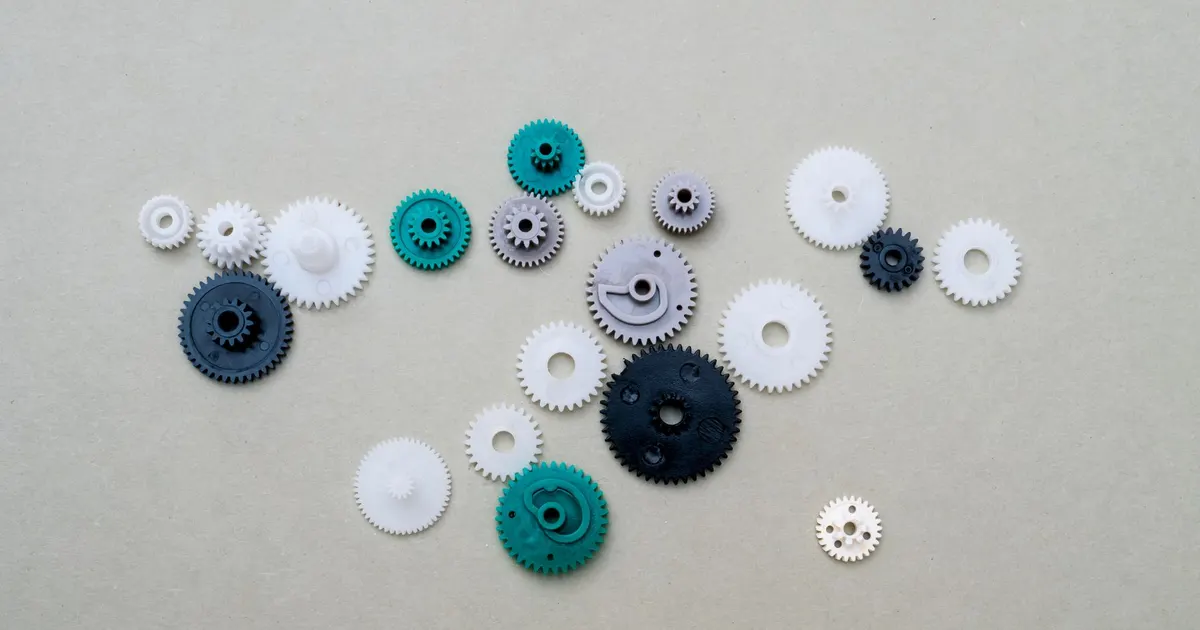
Not every part in a hi-fi product is metal. Behind the aluminum face there are plastic bushings that guide a shaft, spacers that hold a board off a chassis, feet that decouple a case from a shelf and insulators that keep a screw from touching a terminal. Two engineering plastics cover most of these jobs: acetal and nylon. They look alike on the bar and behave very differently in use.
The two plastics
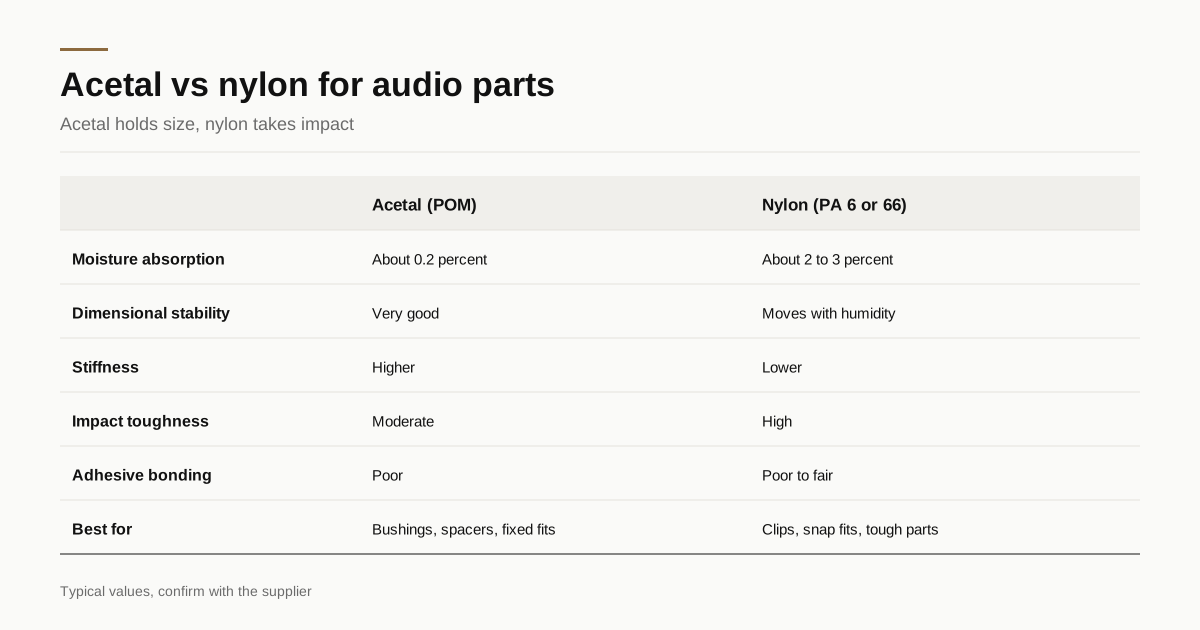
Acetal, also called POM or polyoxymethylene, is stiff, slippery and dimensionally stable. It takes up very little water, so a part cut to size stays near that size. It machines cleanly, holds tight tolerances and has low friction against metal, which is why it appears as bushings and sliding guides.
Nylon, usually PA 6 or PA 66, is tougher and more flexible. It absorbs shock and wear well. It also absorbs water from the air, swelling by a fraction of a percent at normal humidity and more in damp conditions. That makes it a poor choice where a tight, constant dimension matters.
Both are electrical insulators, both come in natural off-white or in black, and both machine on a normal lathe or mill with sharp tools. Neither is a premium look on a visible face, so they appear mainly where the part is hidden or where its function matters more than its finish.
Typical figures
These are typical values, not promises. Confirm with the shop quoting your part.
| Property | Acetal (POM) | Nylon (PA 6 / PA 66) |
|---|---|---|
| Moisture absorption at room humidity | About 0.2 percent | About 2 to 3 percent |
| Dimensional stability | Very good | Moderate, moves with humidity |
| Friction against metal | Low | Low to medium |
| Stiffness | Higher | Lower |
| Impact toughness | Moderate | High |
| Thermal expansion | About 100 to 110 µm per metre per K | About 80 to 100 µm per metre per K |
| Continuous service temperature | About 80 to 100 °C | About 80 to 100 °C dry |
| Machinability | Excellent | Good, can gum if the tool is dull |
| Adhesive bonding | Poor | Poor to fair |
The thermal expansion row is the one to remember. Both plastics expand four to five times as much as aluminum, which has a figure near 23 µm per metre per K. A plastic part inside a metal case grows faster than its housing when the unit warms up.
Where each plastic fits in an audio product
Bushings and bearings. Acetal is the usual choice for a plain bush that guides a shaft, such as the pivot for a selector or a tonearm lift. Low friction means smooth feel and no squeak. The bore must be sized for the shaft with a small running clearance, and for the growth of the plastic as it warms.
Spacers and standoffs. Acetal gives a stable height. Nylon spacers are cheaper and common in electronics, but they shift with humidity, which matters if a board must sit at a fixed distance from a panel.
Isolation feet and pads. Plastic feet are light, quiet and cheap. For heavy loads, metal feet and spikes carry more. The design logic is in isolation feet and spikes.
Insulating collars and washers. Both materials insulate. Nylon can lose some insulation value in damp air because the absorbed water conducts a little, so acetal is the safer choice around terminals. See speaker terminals and binding posts for the places insulators appear.
Knob inserts and shaft couplers. A plastic insert between a metal knob and a shaft improves grip and removes metal-on-metal rattle. Acetal holds the fit.
Cable clamps and clips. Nylon, because it flexes and springs back.
Tolerances and how plastics move
Plastics are not machined to the same tolerances as metals, for three reasons.
Thermal expansion. A 20 mm acetal bush grows about 0.04 mm over a 20 degree rise. That is the whole clearance on a tight shaft fit, so the design needs room for it.
Moisture. Nylon swells with humidity, so a nylon part cut to a dimension in a dry shop changes after it reaches a normal living room. If the fit is tight, choose acetal.
Internal stress. Plastic bar is made by extrusion or casting, and it cools unevenly, leaving stress locked inside. Machine away the outer skin and the part can move, bow or oval. Shops use annealed or stress-relieved stock for precision parts and rough the part first, let it rest, then finish.
Realistic tolerances are ±0.05 to ±0.1 mm on small machined parts. Tighter figures cost more and may not hold once the part is in a warm product. The way allowances build up across a product is covered in tolerance stack basics for audio enclosures.
Machining notes
Plastics cut like soft metals but need different handling.
- Sharp tools with positive rake. A dull tool smears and melts the surface instead of cutting.
- Light cuts and good chip clearance. Long stringy chips wrap around parts. Use air or a light coolant, and avoid oil-based cutting fluids on nylon.
- Low clamping force. A chuck that grips hard deforms a thin-walled bush, and the part springs back out of round after release.
- Deburring. Plastic burrs are fine and stringy. Deburr by hand with a sharp blade or by gentle tumbling.
For thin-walled bushes, the shop may machine the bore and the outside in a single set-up to keep them concentric.
Vibration and noise
Plastic parts often appear in audio gear because they change how vibration travels. A plastic spacer between a transformer and a chassis plate adds a small damping layer and cuts rattle. A plastic bush stops two metal parts ringing against each other. Nylon damps more than acetal, since it is softer and more lossy, and acetal gives a stiffer, more precise support.
Do not expect a plastic part to behave like rubber. Both materials are hard compared with an elastomer, so they are poor choices for true isolation of low-frequency vibration. Use them to separate metal from metal and to set position, and use soft materials where real isolation is the goal. The transmission paths in a chassis are discussed in chassis resonance and damping.
Fixings: how to hold a plastic part
Because adhesives do not stick well to these plastics, design the fixing into the part.
- Press fit. An interference fit into a metal bore holds a bush in place. The interference must be modest, since plastic creeps and a tight fit loosens over time.
- Snap fit. A flexing tab clicks into a groove. Nylon is better than acetal for this.
- Threaded inserts. A metal insert pressed or heat-staked into a plastic boss gives a durable thread for a screw.
- Self-tapping screws. Fine for a few assembly cycles. For service parts, use inserts.
- Retaining ring or clip. A groove for a circlip holds a bush on a shaft without adhesive.
The thread issues on the aluminum side of a joint are explained in threads in anodized chassis.
Appearance and finish
Machined plastic has a visible tool mark, a slightly waxy surface and a tendency to attract dust through static. For a hidden part this is irrelevant. For a visible part, such as a white acetal collar around a knob, three decisions matter.
Colour. Natural acetal is a warm white. Black acetal is common and hides marks better. Colour matching between lots can vary, so buy the stock for one run at once.
Surface. A fine finishing cut with a sharp tool gives a smooth, slightly glossy surface. Do not sand, as it leaves a hazy, scuffed look. Mass finishing is rarely used for plastics.
Marking. Plastic takes pad printing and laser marking on some grades, though acetal is hard to print on without surface treatment. Ask the shop about marking before the design is fixed.
Cost and quantity
Plastic stock is cheap and machines fast, so small plastic parts are among the cheapest in a product. Per-part cost on a run of a few hundred is often a small fraction of a metal equivalent. At very low volume the setup still dominates. The general cost structure is in what an amplifier chassis costs to manufacture.
Two choices change the price: the grade of stock and the tolerance. Standard natural or black bar is cheapest. Annealed or special-colour stock costs more. Loosening a tolerance from ±0.05 to ±0.1 mm often shortens the cycle.
What to put on the drawing and in the RFQ
- Material with grade: acetal (POM) copolymer or homopolymer, nylon 6 or 66, natural or black
- Stress-relieved or annealed stock where precision matters
- Fit information: shaft size, operating temperature range, expected humidity
- Critical dimensions, and whether they apply at room temperature
- Fixing method: press fit, insert or snap fit
- Marking and finish requirements
- Quantity and yearly volume
Send the drawing through the RFQ form and we match it with up to 3 shops that machine engineering plastics, with a reply within 24 business hours.
Frequently asked questions
Should I choose acetal or nylon?
Acetal for parts that need tight, stable dimensions and low friction, such as bushings and spacers. Nylon for parts that need toughness and some give, such as clips and snap fits, provided the part can tolerate small size changes from moisture.
Can acetal parts be glued?
Poorly. Acetal has a slick, low-energy surface that most adhesives do not hold. Use mechanical fixings, press fits, snap fits or threaded inserts, and test any adhesive on a sample if gluing cannot be avoided.
Why did my plastic spacer change size after a few weeks?
Nylon takes up moisture from the air and swells, and plastics generally expand more with heat than metals. Acetal changes much less with moisture, but both materials can also relax internal stress left from the bar. Stress-relieved stock and a design that tolerates small changes avoid most problems.
Need a quote for this part?
Send the drawing. We match you with up to 3 shops and reply within 24 business hours.
Get matched with an audio parts shop