Guides / Design for Manufacture
Wow and Flutter on a Turntable: How Pulley and Platter Runout Feed It
November 21, 2026
Wow and flutter is speed variation in a record player. Wikipedia describes wow as slow variation, historically below 4 Hz, and flutter as faster variation above 4 Hz, and says turntables mainly suffer from slow wow. A runout on a pulley or platter rim becomes a speed ripple once per turn, so a part tolerance turns directly into a wow contribution. This post is part of our guide to turntable parts manufacturing.
What the measurement says
The Wikipedia page on wow and flutter measurement says modern standards combine the two into one weighted figure. It names IEC 386, DIN 45507, BS 4847, CCIR 409-3 and AES6-2008 as sharing a common specification, with a weighting filter and a slow quasi-peak rectifier. The weighting curve peaks at about 4 Hz, where listeners find flutter most objectionable. The standard test tone is 3.15 kHz (sometimes 3 kHz). The page quotes about 0.02% weighted flutter for professional tape machines and about 0.08% for high-end cassette decks, and gives no figure for turntables. We did not read the standards themselves.
Two consequences follow for a parts drawing. The weighted figure and the peak ripple of a part are different numbers: a weighted figure depends on how far each component sits from 4 Hz. And a lab measures wow and flutter on the whole deck, not on a pulley.
Where the repeat rate comes from
Each rotating part repeats its error once per revolution. Records are commonly played at 33 and 45 rpm according to the Wikipedia page on phonographs; the exact speeds are 33⅓ and 45. The repeat rate is the rotation speed divided by 60:
| Part | Repeats | Rate (Hz) | Example input |
|---|---|---|---|
| Platter or sub-platter, 33⅓ rpm | once per platter turn | 0.56 | 33.33 / 60 |
| Platter or sub-platter, 45 rpm | once per platter turn | 0.75 | 45 / 60 |
| Motor pulley, example 300 rpm | once per pulley turn | 5 | 300 / 60 |
Caption: arithmetic. The 300 rpm pulley speed is an example, the designer’s motor sets the real number.
A platter error at 0.56 or 0.75 Hz is deep in the wow range. A pulley error at 5 Hz lands near the 4 Hz peak of the weighting curve, so equal peak ripples count differently. That is why pulley runout deserves the tightest drawing callout.
Runout becomes speed ripple
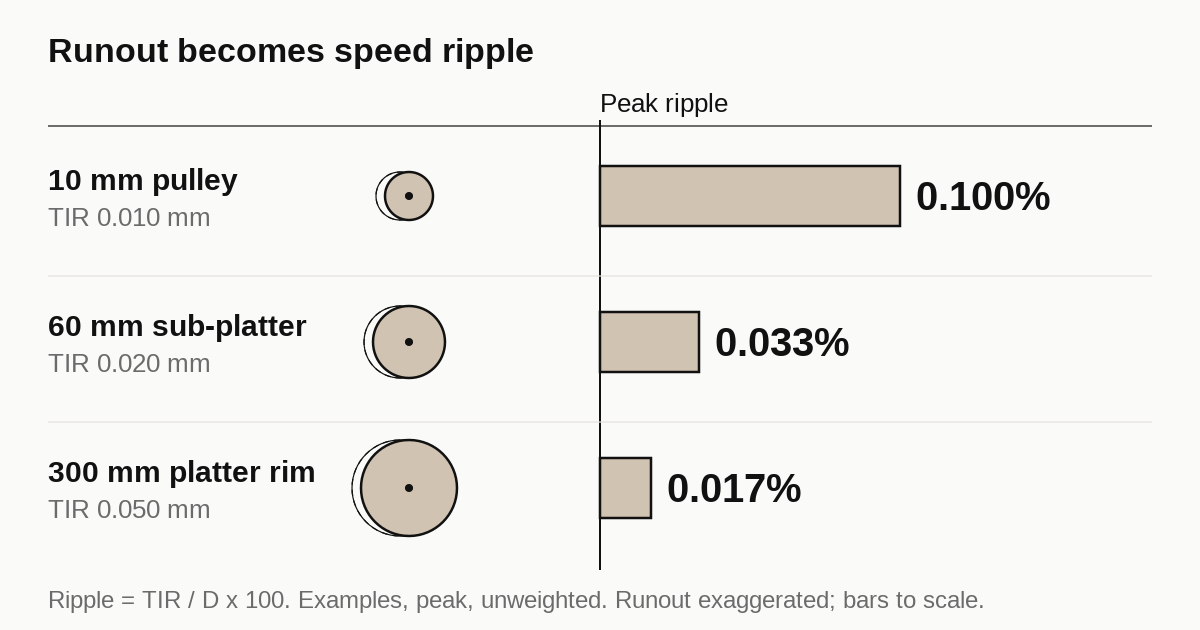
Run-out is a deviation in spinning machinery where a shaft or tool does not turn precisely along its main axis, and the total indicator reading (TIR) is the measured run-out, typically with a dial indicator against the rotating part (Wikipedia). If a belt grips a diameter D that is off-centre, the contact radius changes by plus and minus the eccentricity once per revolution. The peak speed ripple is about the eccentricity divided by the radius, which equals TIR divided by D. The same relation is derived in turntable motor pulley machining.
| Contact diameter D (mm) | TIR (mm) | Peak speed ripple (%) | Where the belt runs |
|---|---|---|---|
| 10 | 0.010 | 0.100 | Motor pulley groove |
| 60 | 0.020 | 0.033 | Sub-platter groove |
| 300 | 0.050 | 0.017 | Outer rim of a platter |
Caption: ripple = TIR / D × 100. Example sizes and TIR values, not measurements of any product. Peak and unweighted, so not comparable to the weighted figures above.
The smaller the contact diameter, the more a given runout costs. A pulley is the highest-leverage part on a belt drive, and the groove runout relative to the shaft bore is the number to protect. Bore fit adds to it, because a loose pulley lets the groove sit off the shaft axis.
Need a quote for this part? Get a quote for your audio parts
What the drawing should say
- Groove diameter with a tolerance derived from the target speed, because the diameter is a speed ratio
- Groove TIR relative to the bore, as a datum callout
- Platter bore as datum A, with TIR on the outer diameter and top face relative to it, see turntable platter machining
- Mass distribution and balance, because inertia smooths speed changes but does not remove runout
- The measuring method: dial indicator on a mandrel or on the shaft, and the report format
The designer converts a wow and flutter goal into a runout figure with the table method. The shop reports what it holds. Both numbers are then in the first article record.
Not on the part
Speed variation can also come from the belt, the motor, the bearing and the supply frequency, and the sources we opened do not say how much each contributes. A pulley cut for one mains frequency runs at a different speed on the other, which is a speed error, not wow. Do not ask a shop to guarantee a wow and flutter figure from a part, because the part is only one input. Ask it to hold runout, to report the reading with the method used and to keep the record with the lot.
To get a turned pulley or platter quoted, send the drawing with datum, runout and finish through the RFQ form and we reply within 24 business hours with one itemised quote for the finished parts. A partner shop makes them and an engineer follows the order. The parts around the pulley are in the turntable parts guide.
Sources
Frequently asked questions
What is the difference between wow and flutter?
Both are speed variation. Wikipedia describes wow as slow variation, historically below 4 Hz, and flutter as faster variation above 4 Hz. Modern standards combine them into one weighted figure, with a weighting curve that peaks at about 4 Hz because listeners find flutter most objectionable there. Turntables mainly suffer from slow wow.
How does pulley runout cause wow?
A pulley groove that runs off-centre changes the radius where the belt grips once per revolution, so the platter speed rises and falls at the pulley's rotation rate. The peak ripple is roughly the total indicator reading divided by the groove diameter. A smaller pulley turns the same runout into a larger percentage.
Is there a standard limit for runout on turntable parts?
We found no public standard that gives a runout limit for a pulley or platter. Standards named for the measurement itself, such as IEC 386 and DIN 45507, concern the weighted wow and flutter of the whole system. The designer sets a speed budget and converts it to a runout figure for the drawing.
Need a quote for this part?
Send the drawing. We quote the finished parts, place the work with a partner shop and reply within 24 business hours.
Get a quote for your audio parts