Guides / Design for Manufacture
Class A vs Class AB Amplifiers: Why the Heat Sets the Chassis Size
November 21, 2026
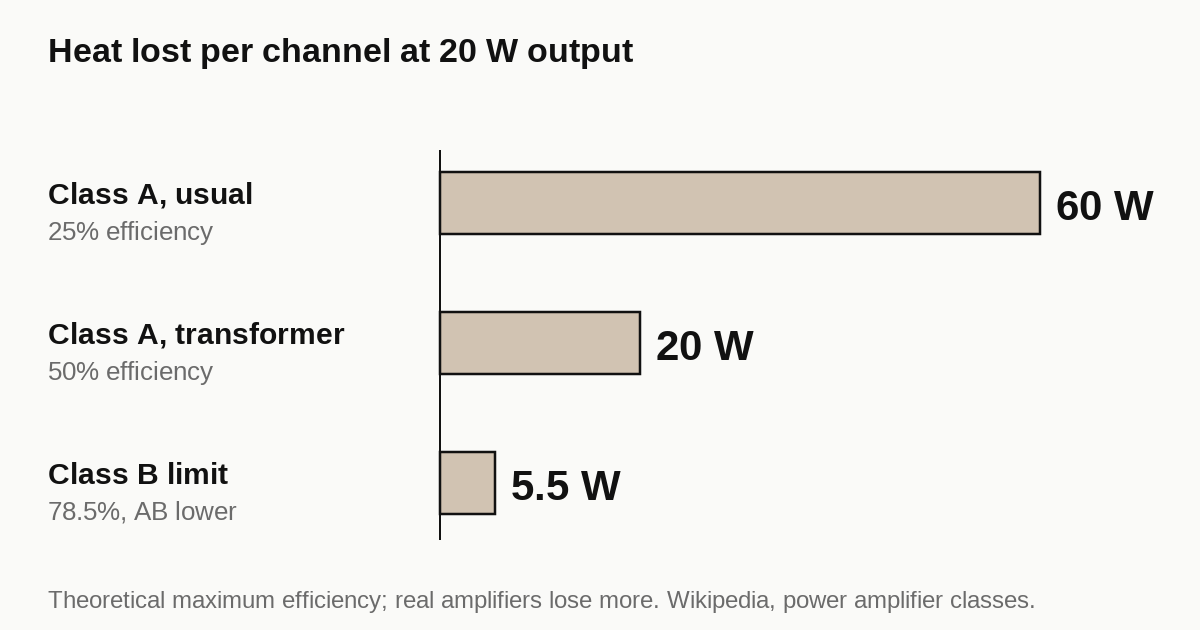
At the usual class A efficiency of 25%, an amplifier turns three watts into heat for every watt it delivers to the speaker. Near the class B limit of 78.5% it turns less than 0.3 W. That gap is why heat, more than anything inside the box, sets the size of many amplifier chassis. This post is part of our guide to custom amplifier chassis, and shows the arithmetic a designer uses before the drawing reaches a shop.
What the classes say about efficiency
The Wikipedia page on power amplifier classes gives these figures. Class A conducts for the full cycle and has a maximum theoretical efficiency of 25% for usual configurations, and 50% for a transformer or inductively coupled one. Its power draw does not follow the output, so idle consumption is about the same as at high volume. For high-power units the page says this means very large and expensive power supplies and heat sinks.
Class B has a maximum theoretical efficiency of π/4, about 78.5%. Class AB sits between: the page says its efficiency is below 78.5% for full-amplitude sine waves in transistor amplifiers, typically, and typically much more efficient than class A. Class AB keeps devices from switching fully off, which reduces crossover distortion, and its idle current affects both distortion and the risk of thermal runaway. The page adds that class D amplifiers permit smaller heat sinks than an equivalent class AB design, and the page on audio power amplifiers says class D is much lighter and produces much less heat, but may introduce some noise.
These are theoretical maxima for full-amplitude signals. Real amplifiers are less efficient, so the heat below is a floor, not a forecast.
From efficiency to watts of heat
Whatever the supply delivers and the speaker does not receive is heat. For output power P and efficiency η, the heat is P × (1/η − 1). The sink to air resistance the chassis must deliver is the allowed rise divided by the heat: R = ΔT / Q. With a 25 °C room and a sink that may reach 65 °C, ΔT is 40 K. Take 20 W per channel, two channels, a 40 K allowed temperature rise of the heatsink above room air, and the lowest efficiency in each case:
| Case | Efficiency (%) | Heat per channel (W) | Heat, two channels (W) | Sink to air needed (°C/W) |
|---|---|---|---|---|
| Class A, usual configuration | 25 | 60 | 120 | 0.33 |
| Class A, transformer coupled | 50 | 20 | 40 | 1.0 |
| Class B limit (AB is lower) | 78.5 | 5.5 | 11 | 3.6 |
Caption: arithmetic from the efficiencies on the Wikipedia power amplifier classes page. The 20 W, two channels and 40 K are example inputs. The last column is 40 K divided by the heat in watts.
The Wikipedia page on heat sinks lists commercial extruded aluminum heat sinks from 0.4 °C/W for large sinks to 85 °C/W for clip-on types. The first row asks for 0.33 °C/W, below the largest commercial sink on that list, so the designer would use several sinks, a larger custom profile or forced air. The third row asks for 3.6 °C/W, which a moderate finned sink can meet. The same page treats the heat path as resistances in series, from die to case, case to sink and sink to air. The case-to-sink step adds about 0.5 to 1.7 °C/W depending on case size and whether grease or a mica washer is used, so the sink to air figure must be lower than the total budget. At idle a class A stage delivers nothing, so all the power it draws is heat, which is why such amplifiers are warm even when silent.
The heat sink page describes its model as an approximation that assumes thermal equilibrium, so a designer adds margin and the final check is a temperature test on the real product, not a table.
What it does to the chassis
- Heatsink area. More heat means larger or more numerous fins, and a longer extrusion. The profile sets the die and the width of the amplifier.
- Vent area. Openings above the hot devices help convection but cost shielding and safety margin, see EMI shielding for audio enclosures.
- Orientation. The Wikipedia heat sink page says natural convection needs free airflow, and fins that are not vertical or are packed too tightly reduce efficiency. Fin direction and spacing are drawing items.
- Finish. The same page says matte black radiates better than bare shiny metal, but at roughly 0 to 100 °C radiation is small compared with convection for finned sinks, so colour is a minor lever. Choose the finish for looks and cosmetic limits.
- Alloy. Alloy 6060 is listed at 166 W/(m·K) and 6063 at 201 W/(m·K); copper is about 400 but costlier and heavier. For copper parts see copper heatsinks and busbars.
Need a quote for this part? Get a quote for your audio parts
What to give the shop
- The thermal resistance target in °C/W per heatsink, and the heat in watts it was calculated from
- Whether the sinks are side walls or separate blocks
- Fin direction in use, spacing and the cosmetic faces
- Vent area and slot pattern, with the shielding rule they must meet
- Flatness of the device mounting face, as thermal contact depends on it
Class names alone do not size a chassis. Send the numbers with the drawing through the RFQ form and we reply within 24 business hours with one itemised quote for the finished parts. A partner shop makes them and an engineer follows the order. Sizing from the extrusion side is in heatsink extrusion for amplifier chassis, and the whole decision order is in the custom amplifier chassis guide.
Sources
Frequently asked questions
Why does a class A amplifier run so hot?
A class A output stage conducts for the whole cycle on a standing current, so it draws almost the same power at idle as at full volume. Wikipedia gives a maximum theoretical efficiency of 25% for usual configurations and 50% for a transformer coupled one. Everything not delivered to the speaker becomes heat in the chassis.
Is class AB cooler than class A?
Usually yes. Wikipedia says class AB efficiency is typically below the class B limit of 78.5% for full-amplitude sine waves, and typically much higher than class A. Less of the supply power is lost as heat, so the same output needs a smaller heatsink. Real figures depend on bias setting and design.
How does heat change the chassis RFQ?
It sets the heatsink size, the fin profile, the vent area and the alloy. Give the shop a thermal resistance target in degrees C per watt from the designer, the vent pattern and whether the sinks are the side walls. Do not ask the shop to guess cooling from a class name.
Need a quote for this part?
Send the drawing. We quote the finished parts, place the work with a partner shop and reply within 24 business hours.
Get a quote for your audio parts