Guides / Design for Manufacture
Dual Mono vs Monoblock Amplifiers: What Each Means for the Chassis
November 21, 2026
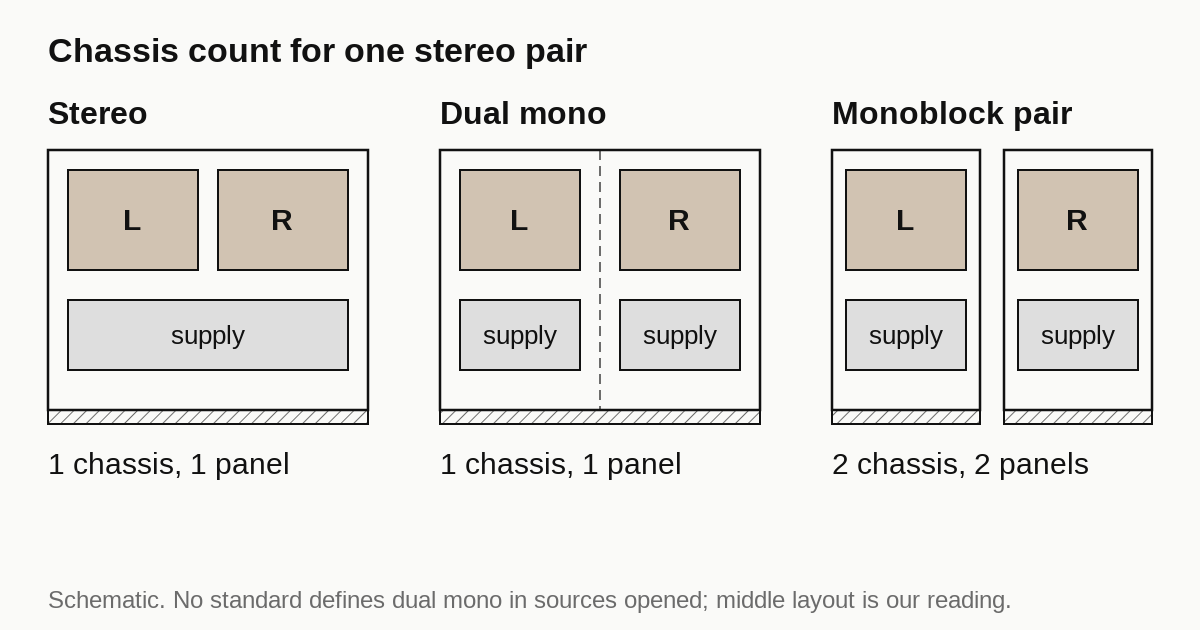
A monoblock is one power amplifier for one channel in its own chassis. A dual mono amplifier puts two separate channels in one chassis. For the chassis maker the difference is the number of boxes, front panels and finish lots, and whether the two channels are separated inside one case. This post is part of our guide to custom amplifier chassis.
Three layouts, defined
Retailer explainers agree on the basics. One page from an audio retailer says a stereo amplifier puts two independent channels in one housing, usually with one power supply shared between them, and that a monoblock is a single unit for one channel with a dedicated power supply. A hi-fi maker’s page says monoblocks have independent circuitry and a power supply for each channel.
“Dual mono” is the loose term. We found no standard or neutral reference that defines it, and the two pages we opened define monoblock and stereo, not dual mono. Our reading is that it names a single-chassis stereo amplifier built as two separate channel blocks, but whether each block has its own transformer, its own rectifier or only its own regulation is a design fact, not a word. That is why the first question to a designer is the power supply layout.
| Layout | Chassis per stereo pair | Front panels | Supply per channel | Source of the definition |
|---|---|---|---|---|
| Stereo, shared supply | 1 | 1 | Usually shared | Retailer explainer |
| Dual mono | 1 | 1 | Varies by design | Not defined in sources we opened |
| Monoblock pair | 2 | 2 | Dedicated | Retailer and maker pages |
Caption: counts are for one stereo pair. The first and third rows follow the pages we opened. The middle row is our reading, marked as such above.
What the vendor claims say, and what they do not
The same pages credit monoblocks with less crosstalk and better imaging, with better grounding and heat dissipation when each unit works alone, and with a shorter speaker cable when the unit sits near the speaker. They also say monoblocks take more space, need more cabling, generate more heat in total and cost more per channel. The pages give no measurements, so treat the benefits as vendor claims. The cost side is plain arithmetic: two boxes are more metal than one.
What changes for the chassis maker
Quantity. A pair of monoblocks is two of everything: two front panels, two covers, two sets of heatsinks and rear panels. A quote that was for one chassis per product becomes two, and the price break moves with it.
Matching. Two units sit side by side in a customer’s room, so the colour and texture of the two front panels has to match. Parts for a pair should come from one anodize lot and one batch of material, see anodizing colour match for hi-fi. If one unit is returned and re-made later, it is a new lot.
Heat. Each channel has its own heat load in its own box, so each box needs its own heatsink area, sized for one channel. One retailer page says monoblocks generate more heat in total, which we did not see measured. Either way the heat is spread over twice the surface. Heat and class of operation are covered in amplifier class and heat.
Separation inside one chassis. A dual mono build keeps both channels in one box, so the maker may ask for a divider plate or a split layout. That is an internal part with its own drawing and its own flatness and bare-contact needs.
Rack fit. The Wikipedia page on the 19-inch rack gives a panel width of 482.6 mm and a rack unit of 44.45 mm. Half of 482.6 mm is 241.3 mm, an upper limit for two units side by side before rails and clearance. Rack monoblocks are therefore usually stacked, not paired across. Panel and ear dimensions are in 19 inch rack panel dimensions.
Need a quote for this part? Get a quote for your audio parts
Cost and weight, as ratios only
We found no public price for a dual mono or monoblock chassis, so we give ratios from the part counts above, not money. A monoblock pair needs two of every part, so the metal and machining for a pair is about twice that of one unit before any saving from a larger run. A dual mono box needs one set of outer parts but is wider or deeper to hold two channel blocks, and may add a divider. The retailer page quoted above calls monoblocks larger, heavier and more expensive per channel; read that as a direction, not a number. Freight follows weight and box count, so ask each shop to quote the pair and the single unit on the same drawing.
Questions to settle before the drawing
- Is the product one box or a pair, and how many sets per order?
- Does each channel have its own transformer, or only its own regulation?
- Are the two channels divided inside the box by a plate?
- Are the front panels a matched set, and from which finish lot?
- Does the unit go in a rack, and is the width fixed by it?
Send the drawings, with the quantity per pair, through the RFQ form and we reply within 24 business hours with one itemised quote for the finished parts. A partner shop makes them and an engineer follows the order. The decision order for the whole box is in the custom amplifier chassis guide.
Sources
- Regular amplifier and monoblock, Ooberpad (retailer, directional)
- Mono block vs stereo amplifier systems, Roksan (maker, directional)
- 19-inch rack, Wikipedia
- Audio power amplifier, Wikipedia
Frequently asked questions
What is the difference between a monoblock and a dual mono amplifier?
A monoblock is one amplifier for one channel in its own chassis, with its own power supply. A dual mono amplifier puts two separate channels in one chassis. The term is not defined by a standard we found, so some makers give each channel its own transformer and others share one. Ask for the power supply layout.
Does a monoblock need a bigger chassis?
Per amplifier, not necessarily, but a pair needs two chassis, two front panels and two covers. One retailer page describes monoblocks as larger, heavier and more expensive per channel than a stereo amplifier. For the chassis maker that means double the parts and a second finish run to match to the first.
Can two monoblocks fit in a 19 inch rack?
A 19 inch panel is 482.6 mm wide, so two units side by side would each have to be narrower than 241.3 mm before rails and clearance. Most rack monoblocks are instead stacked in height, using rack units of 44.45 mm each. Tell the shop which arrangement the product uses.
Need a quote for this part?
Send the drawing. We quote the finished parts, place the work with a partner shop and reply within 24 business hours.
Get a quote for your audio parts