Guides / Choosing a Supplier
How to Judge a Machine Shop's Cosmetic Sample Parts Before You Order
November 21, 2026
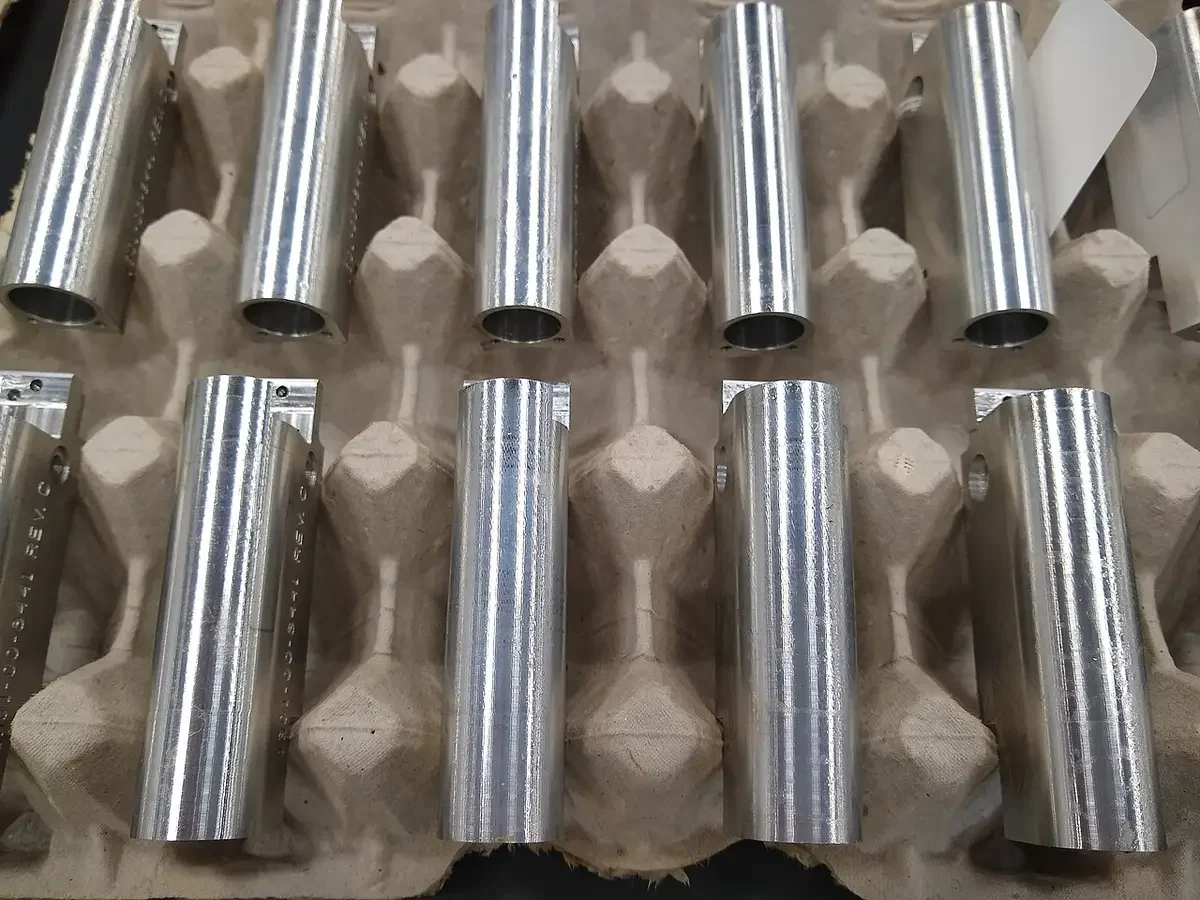
A shop’s cosmetic sample shows what the shop can do on its best day. It does not show what your order will look like. To judge it, answer three questions: was it made the way your order will be made, does it show your finish route and can you see the spread and not only one piece?
This post is for brands choosing between shops. It follows how to choose the right machine shop for audio parts and goes deeper on the one item buyers rely on most, the sample in the post.
What a sample can and cannot prove
A sample proves capability. It does not prove repeatability or your colour.
SAF, an aluminium supplier, makes the point about anodizing. Different alloys anodize different colours, so sheet in 5005 and extrusion in 6063 will look different even though both suit anodizing. Metal made on different days differs too. And SAF says anodizing range samples are not meant to be a specimen of an actual colour: they show the potential amount of variation, are usually made months ahead from different metal and do not reflect your job’s lot.
The Aluminum Anodizers Council adds that appearance depends on alloy, temper, gloss, surface structure and the colouring process, and that colour disparities arise when people interpret a named colour differently. It says the acceptable range should be agreed on a per-project basis between the buyer and the anodizer. Wikipedia notes that dye colours tend to vary with the base alloy and that red and blue organic dyes are particularly prone to fading.
Read a sample as an answer to one question: can this shop and this finisher produce this kind of surface? Your own question, will batch two match batch one, needs more than one piece.
Ask these questions before you look at it
| Ask | Why it matters | Good answer |
|---|---|---|
| Which alloy and temper? | Alloy changes anodize colour | A named grade, for example 6061-T6, and a note if your alloy differs |
| Which finish route? | Brushed, bead blast and polish give different looks | The process steps in order, with the faces they cover |
| Who did the finishing? | One anodizer for all the work is SAF’s way to minimize colour variation | A named in-house line or a named partner |
| When was it made? | An old sample may not reflect today’s process | A date and, if possible, a lot reference |
| Is it from a production run or a one-off? | A one-off can be set up by hand and run with extra care | “Off the line, third piece of the lot” |
| What did the shop change to make it? | Silent changes are the main risk in a repeat order | A written note, even a short one |
If the shop cannot say who finished the sample, you have learned something already. See anodizing in house or outsourced: a shop decision guide.
How to inspect it
Do this in the same order every time, with the part in your hand.
- Fix the light and the angle. Anodized coatings are translucent, so appearance varies with viewing angle, per SAF. Use a neutral light, tilt the part through a few angles and keep the same setup for every shop. Cosmetic inspection: lighting and viewing distance gives a routine.
- Look at the faces your customer sees first. Then the edges, the corners and the thread entries. Edges show deburring and chamfer control.
- Find the process marks. Tool lines, rack contact points and blast pattern tell you how the part was made. A shop that can tell you where the rack points are has thought about them. The photo at the top shows lengthwise tool marks on a machined surface: the question is whether such marks are acceptable on your seen face and in what direction.
- Check grain direction on brushed faces. It should run the way your drawing says, and the same on matched parts. See brushed aluminum panels: grain, grit and direction.
- Compare two pieces side by side. A difference you can see between two pieces from the same shop is the spread you should expect in a run.
- Test one fit if the sample has one. A knob on its shaft, a panel against a cover. A cosmetic sample with a bad fit tells you about tolerance control. See panel gaps on an audio enclosure.
- Write down what you see. Photograph under your agreed light and write one line per face. Memory is a poor record.
Need a quote for this part? Get a quote for your audio parts
Ask for the spread, not the best piece
A single piece shows the best case. Ask for two or three pieces from different days or lots, or from the start and end of a run. SAF says to order from a single lot where possible and, where more than one finisher is involved, to share samples between them. If a shop sends one piece and says it is typical, ask for a second.
When you commit to a project, ask for a target sample made from the actual lot. SAF recommends requesting a target from each finisher anytime a large quantity of anodized aluminium is used. That target becomes the start of your reference set, see golden and boundary samples for cosmetic audio parts.
Make the sample test yours
A generic sample narrows down shops. A sample on your own geometry decides between them.
- Send the cosmetic zones and the finish note from your drawing, and ask for a piece with your finish on your alloy before the full run.
- Agree in writing what happens next: approval, correction or a second sample.
- Ask what records the finisher keeps. The Aluminum Anodizers Council says the anodizer is responsible for quality control records, available to the customer on request.
The RFQ form has a tick box for a finish sample approved before the full run. We reply within 24 business hours with one itemised quote for the finished parts. The first article shows you the finish before the full run.
Red flags
- Photographs only, with no physical part offered.
- A sample that is “like yours” with no alloy, process or finisher named.
- Only one piece, always the same piece.
- Sample colour approved from a swatch card or a screen.
- No answer when you ask what the shop changed to make it.
What to do with what you see
Rank the shops on three things: whether the sample matches your finish route, whether the pieces agree with each other and whether the answers are specific. Price comes after those. A lower quote on a shop whose pieces disagree is the cost of a rejected batch later, see first article inspection for cosmetic audio components for the next gate.
Sources
- Appearance and color variation, SAF (supplier content, directional)
- Anodic coating specifications, Aluminum Anodizers Council
- Anodizing, Wikipedia
Frequently asked questions
What does a shop's sample part prove?
It proves the shop can make that surface on that day, from that material, by that route. It does not prove your colour or your lot. SAF says range samples are not meant to be a specimen of an actual colour and are usually made months ahead from different metal. Ask which alloy, finish route and finisher the sample used.
How many sample pieces should I ask for?
Ask for at least two pieces from different days or lots, plus a photograph of the lot label. SAF notes that metal produced under identical conditions on different days is nearly impossible, so lots differ. Two pieces side by side show the spread. One piece shows only the best case.
Should I judge a sample from a photograph?
Not for a finish. Anodized coatings are translucent and appear different at different viewing angles, according to SAF. A photograph fixes one angle and one light. Use photographs to narrow the field and a physical part, handled in the agreed light, to decide.
Is a sample from an unrelated job useful?
Yes, as proof of capability on the same process, such as bead blast then anodize. It is weak proof for your alloy, colour or tolerance. Ask for a sample on your drawing's cosmetic zone before the full run, and treat an unrelated sample as a way to narrow down shops.
Need a quote for this part?
Send the drawing. We quote the finished parts, place the work with a partner shop and reply within 24 business hours.
Get a quote for your audio parts