Guides / Design for Manufacture
What Is an Audio Chassis? Frame, Panels, Cover and Heatsink in Plain Terms
November 21, 2026
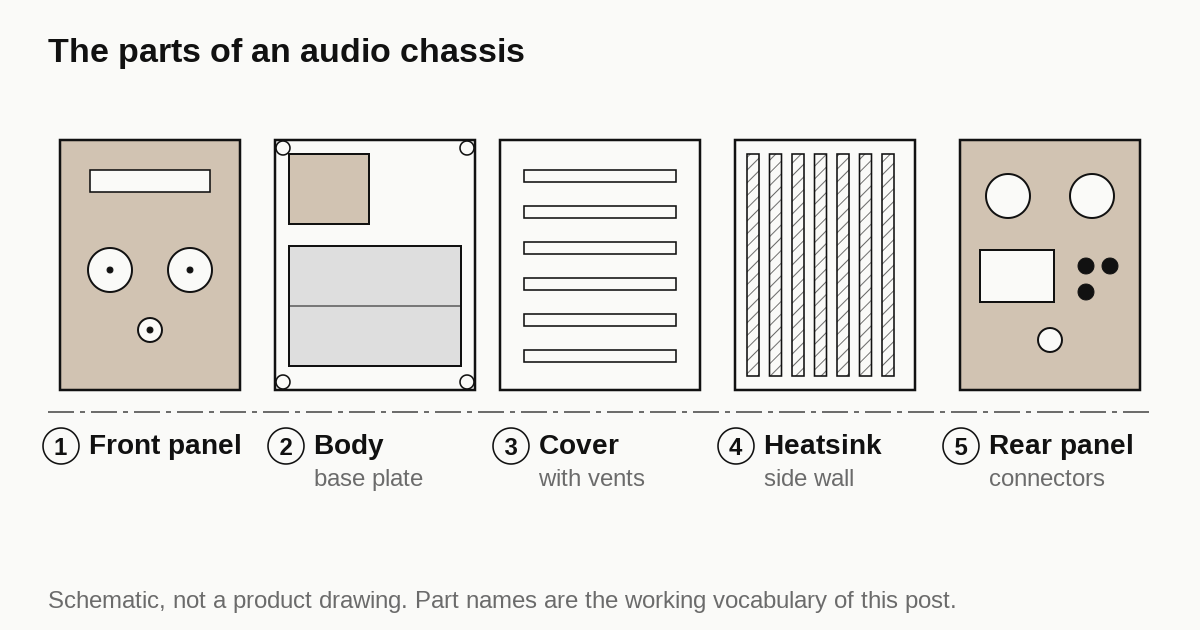
An audio chassis is the metal frame and panels that hold the circuit boards, transformer, connectors and controls of an amplifier, DAC, preamp or similar product. In general electronics a chassis is the internal frame that carries the boards, and the chassis together with its outer covering is sometimes called the enclosure. Hi-fi makers use both words for the whole metal box, so a drawing must name each part. This post is part of our guide to custom amplifier chassis.
Chassis, enclosure, case and cabinet
The reference definition is narrow. The Wikipedia page on chassis describes it as the internal frame or support structure that holds circuit boards and other components, and says that in modern computer cases the chassis is covered by lightweight covers or panels. In older equipment the chassis sat inside a heavy cabinet. The chassis plus the covering is sometimes called an enclosure.
Audio trade usage is looser. A hi-fi brand often says “chassis” for everything a customer sees and touches, and “case” or “cover” for the lid. We found no standard that fixes these words for hi-fi, so treat the table below as our working vocabulary and write it into the RFQ.
The parts of a typical amplifier chassis
| Part | Job | What the drawing gives | Unit |
|---|---|---|---|
| Front panel (faceplate) | Visible face; holds knobs, display, switches | Thickness, cutouts, finish, cosmetic zones | mm |
| Body, base or bottom plate | Carries transformer, boards and feet | Thickness, hole pattern, flatness | mm |
| Cover or top plate | Closes the box; often carries vents | Thickness, vent pattern, fastener spacing | mm |
| Side panels or side heatsinks | Walls; often the cooling surface | Profile, length, finish on fins | mm |
| Rear panel | Connectors, inlet, terminals | Cutout sizes, bare earth areas | mm |
| Heatsink | Moves heat from output devices to air | Thermal resistance target, fin size | °C/W |
| Mounting ears (rack products) | Fix the panel into a 19 inch rack | Hole positions, panel height | mm |
Caption: parts and drawing items are our working list for an RFQ, not a standard.
Not every product has all seven. A small DAC may be one folded shell with a machined front plate. A power amplifier may use two extruded side heatsinks, a thick front panel and a sheet metal cover. Billet, extrusion and sheet are the three usual ways to make them.
Materials and what they do
Aluminum is the usual choice for the visible parts. The Wikipedia page on heat sinks lists the thermal conductivity of aluminum alloy 6060 at 166 W/(m·K) and 6063 at 201 W/(m·K), and copper at about 400 W/(m·K), roughly twice aluminum, but about three times as dense and more expensive. That page gives no figure for 6061 and notes that values depend on temper. Steel is used where a chassis must carry a heavy transformer or shield a magnetic field.
The same page puts commercial extruded aluminum heat sinks at a range from 0.4 °C/W for large sinks to 85 °C/W for clip-on types. A smaller number means the sink moves more heat for each degree of temperature rise, which is why a power amplifier carries large finned profiles and a small DAC needs none.
Sizes: when the chassis follows the rack
Some audio products are made to fit a 19 inch rack. The Wikipedia page on the 19 inch rack gives a unit height of 44.45 mm (1.75 in) and a panel width of 482.6 mm (19 in), and names EIA-310 and the IEC 60297 series as the dimensional standards. The Wikipedia page on audio power amplifiers notes that standalone amplifiers are sometimes mounted in a 19 inch rack, and that consumer products often put a preamplifier and a power amplifier in a single chassis. Most hi-fi components are not rack products, so their width is a brand decision, set with the front panel, not by a standard.
Need a quote for this part? Get a quote for your audio parts
Where the safety standard touches the chassis
IEC 62368-1 is the product safety standard for audio, video, information and communication technology equipment rated up to 600 V. Its abstract on the IEC webstore says it classifies energy sources and prescribes safeguards against them, and that it sets no performance requirements. The same page lists the 2018 edition as withdrawn on 2023-05-26, with a 2023 version available. We did not read the standard text. It applies to the finished product, so which clauses reach the chassis is a question for the brand and its test lab. What the shop controls is what the drawing says about openings and bare earth areas, covered in IEC 62368-1 audio enclosure requirements.
Words to use in an RFQ
- Name every part from the table, with its own quantity, material and finish
- Say whether the heatsink is part of the wall or a separate block
- Mark which faces are visible and which are hidden, using cosmetic zones
- State the rack size if there is one, or the exact width and height if not
- Mark the earth point and any area that must stay bare
- Ask for the price of each part and of the set, so quotes compare
The full vocabulary of this site is in the glossary, and what each part costs is in audio chassis cost. When the parts are named, send the drawing through the RFQ form and we reply within 24 business hours with one itemised quote for the finished parts. A partner shop makes them and an engineer follows the order. The same decision order, from build route to checklist, is in the custom amplifier chassis guide.
Sources
- Chassis, Wikipedia
- Heat sink, Wikipedia
- 19-inch rack, Wikipedia
- Audio power amplifier, Wikipedia
- IEC 62368-1:2018, IEC webstore
Frequently asked questions
What is the difference between a chassis and an enclosure?
In general electronics a chassis is the internal frame that holds the circuit boards and parts. The chassis plus its outer covering is sometimes called the enclosure. Hi-fi makers use both words for the whole metal box, so a drawing should name each part (front panel, body, cover) instead of relying on either word.
Is a heatsink part of the chassis?
It can be. On many amplifiers the side heatsinks are extrusions that also form the walls, so they are structure and cooling in one part. On others the heatsink is a separate block bolted to the frame. Say which on the drawing, because it changes the material, the finish and who machines it.
What material is an audio chassis usually made of?
Aluminum for the visible panels, because it is light, machines quickly and anodizes. Steel appears where a heavy transformer needs a stiff plate. Thermal conductivity for aluminum alloys 6060 and 6063 is listed at 166 and 201 W/(m·K), copper at about 400, so copper is rare outside heat spreaders.
Need a quote for this part?
Send the drawing. We quote the finished parts, place the work with a partner shop and reply within 24 business hours.
Get a quote for your audio parts