Guides / Design for Manufacture
Star Ground and Chassis Ground: What the Audio Enclosure Must Allow
November 21, 2026
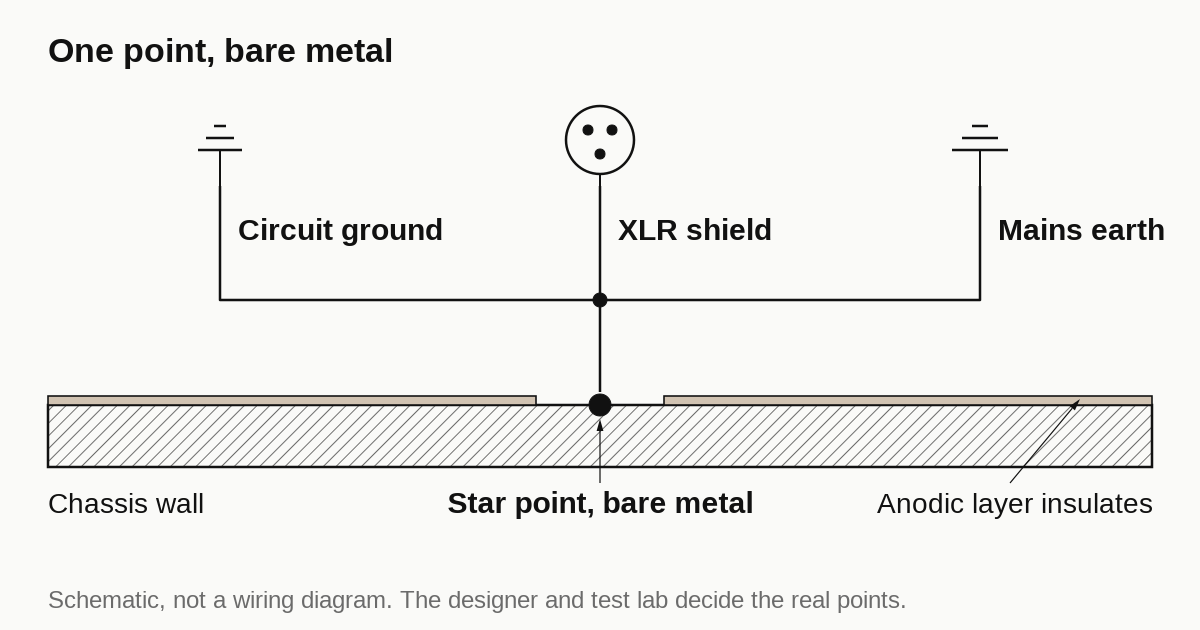
A chassis ground is the connection between the circuit and the metal case, and a star ground is a layout where several ground paths meet at one point instead of being chained. For the chassis maker the useful part is simpler: the case must give bare metal at the points the designer names, and the finish must not cover them. This post defines the terms and is part of our guide to custom amplifier chassis. It does not cover wiring or masking checklists.
The terms, in one table
| Term | Meaning (source) | What it asks of the case |
|---|---|---|
| Ground loop | More than one ground path between devices; hum at line frequency, 50 or 60 Hz, is the typical symptom (Wikipedia) | Nothing by itself; layout and cabling decide |
| Star (single-point) ground | Ground paths meet at one point; studios tie chassis together and connect to building ground at a single point (Wikipedia) | One designated bare point |
| Chassis ground | If the supply is not isolated, the external chassis ground meets the PCB ground plane at a single point (Wikipedia) | A bare stud or boss for that point |
| Isolated supply | Chassis joins circuit ground through a high-voltage capacitor, for example 2200 pF at 2 kV (Wikipedia) | The same bare point, with the part fixed to it |
| Safety ground | In large installations, a safety ground for exposed metal and a technical ground for cable screens (Wikipedia) | Conductive path from every exposed metal part |
Caption: wording follows the Wikipedia page on ground loops. The page gives these as examples and not as requirements for any product.
The page also notes that ground potential at different outlets may differ by 10 to 20 volts, and that ground loop conductors often have a resistance below 1 ohm, so a weak magnetic field can induce significant current. That is why the point where the circuit meets the case is chosen once and kept short.
Pin 1 and the XLR panel
Connector shields are a common source of the problem. In an article on the pin-1 problem, a broadcast technology writer describes noise on a cable shield reaching the signal reference through pin 1 of the connector. The article says AES48-2005 covers shields of connectors in audio equipment with active circuitry, and that following it correctly should eliminate pin-1 problems. As the article describes it, designated shield contacts connect to the chassis by the lowest-impedance path, using a star point to equipment ground, the internal circuit reference and the chassis. We did not read the AES48 text; this is the article’s account. The article also says XLR shells often do not mate solidly with their receptacles.
For the chassis this means the rear panel around an XLR is a ground part, not only a cosmetic one. The cutout, the shell contact and the bare metal behind the connector flange all affect the path. The cutout dimensions themselves are in connector panel cutouts for audio.
How the problem shows up, and what sits outside the case
The pin-1 article describes a bench test: inject a 60 Hz signal into the ground system, and any rise in the output noise indicates the problem. That is a test for the brand, not the shop. The same article says pin-1 problems can also appear at radio frequencies and in unbalanced and digital equipment. The Wikipedia ground loop page lists remedies that live outside the case: an isolation transformer, balanced interconnection, a ground lift at the load end, a resistor of about 10 ohms in the shield, battery power or optical isolation for digital data. It warns that removing the safety ground creates a shock hazard. None of these is a chassis feature. They explain why a chassis that gives a clean, bare, single bond point leaves the designer more options.
Need a quote for this part? Get a quote for your audio parts
What the case must allow
Bare metal at named points. The Wikipedia page on anodizing says the anodic layer is insulative, and gives Type II as 1.8 to 25 μm thick per MIL-A-8625. A ring terminal on an anodized face may sit on oxide and not on metal. The earth point, the connector flange where the designer wants a bond, and any seam that must conduct are marked as bare. The same page notes that chromate conversion coating has a greatly increased electrical conductivity, so a conductive coating is the other route. Why anodize breaks an earth point is covered in IEC 62368-1 audio enclosure requirements.
One point, not several. If a cover is bolted to the base through bare screws on several faces, the case is a conductor with many paths. The designer decides which faces are bare so that the case does not add its own loops.
A fixing that stays tight. A stud or boss for the earth lug has a thread, a flat landing and a locking part. The case must hold it flat.
An example of a drawing note, for the designer to set the dimensions: “Earth boss, bare metal within an agreed diameter, no anodize, no paint, deburred.” The size is the designer’s number, not ours.
Questions for the designer
- Which points are bare, and how large?
- Is the supply isolated, and is the capacitor fixed to the case?
- Do the XLR flanges bond to the panel, and with what contact?
- Does any cover seam need to conduct?
- Which test confirms the bond, and who runs it?
The brand and its test lab answer for the finished product. The chassis maker answers for what the drawing shows. Send the drawing with the bare areas marked through the RFQ form and we reply within 24 business hours with one itemised quote for the finished parts. A partner shop makes them and an engineer follows the order. The decision order for the whole case is in the custom amplifier chassis guide.
Sources
- Ground loop (electricity), Wikipedia
- Resolving Pin-1 Problems, TV Technology (trade article, directional)
- Anodizing, Wikipedia
Frequently asked questions
What is a star ground?
A star ground ties several ground paths together at one point instead of daisy-chaining them. Wikipedia describes studios that tie all metal chassis together with heavy conductors and connect them to the building ground at a single point. Inside a product the same idea keeps shield currents and circuit return currents on separate paths until they meet.
Is chassis ground the same as safety earth?
Not necessarily. Wikipedia describes large installations that use a safety ground for exposed metal and a separate technical ground for cable screens. Where the circuit meets the case, and how the case reaches mains earth, are decisions for the designer and the test lab. The shop supplies bare metal at the points the drawing names.
Why does anodize matter for the earth point?
The anodic layer is an electrical insulator. A screw or ring terminal pressed onto an anodized face may not make a metal-to-metal contact. The earth point, and any face that must carry current, needs to be bare, masked before anodizing, or cleaned back to metal. The designer names the faces, the shop keeps them bare.
Need a quote for this part?
Send the drawing. We quote the finished parts, place the work with a partner shop and reply within 24 business hours.
Get a quote for your audio parts