Guides / Design for Manufacture
Aluminum or Steel for an Amplifier Chassis: Stiffness, Weight, Heat, Shielding and Finish
November 18, 2026
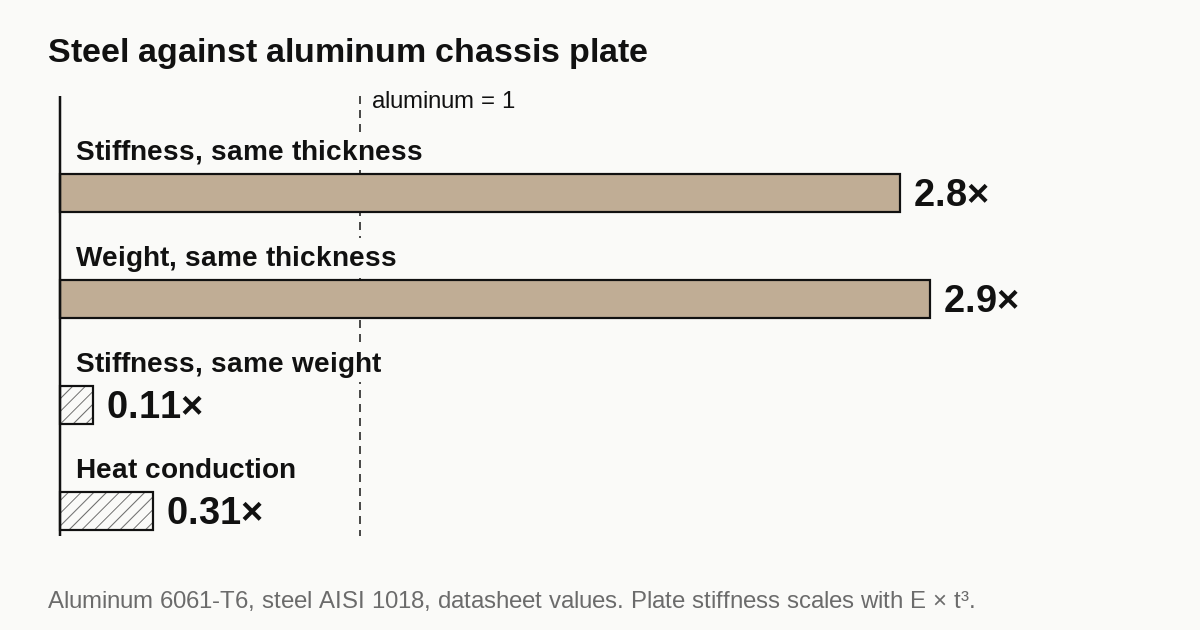
Choose aluminum for the visible parts of a hi-fi chassis and consider steel only where a heavy mains transformer needs a stiff, magnetic plate. In the datasheet values we used, steel is 2.8 times stiffer at the same thickness but 2.9 times heavier, and aluminum conducts heat about three times better. At equal weight aluminum is far stiffer, which is why a common build is an aluminum chassis with a thicker top plate. This post is part of our guide to custom amplifier chassis.
The numbers below are typical datasheet values for 6061 aluminum and AISI 1018 steel, worked out for a flat plate. We did not look for listening tests and make no claim about sound.
The decision table
| Criterion | Aluminum 6061 | Low-carbon steel | Matters most for |
|---|---|---|---|
| Density | 2.70 g/cm³ | 7.9 g/cm³ | Shipping, handling, mounting points |
| Modulus of elasticity | 68.3 GPa | 190 GPa | Top plate sag under transformers |
| Thermal conductivity | 167 W/m-K | 52 W/m-K | Spreading heat through a plate |
| Magnetic behaviour | Not ferromagnetic | Ferromagnetic, permeability of several thousand | Mains transformer field |
| Finish route | Anodize, blast, brush, powder coat | Paint, powder coat, galvanize | Look of visible faces |
| Machining price | Lower than stainless in broker data | We found no public mild steel figure | Cost at one-off and at volume |
Caption: aluminum values from the Protolabs 6061-T651/T6 datasheet (2026). Steel values from the MakeItFrom AISI 1018 page, where the modulus is 190 GPa and conductivity 52 W/m-K. Permeability from Wikipedia’s mu-metal page. Typical values, not design values.
Stiffness and weight
The deflection of a flat plate under a load scales with its modulus times its thickness cubed. That gives three useful comparisons, all calculated from the table above.
| Comparison | Result |
|---|---|
| Same thickness | Steel plate is 190 ÷ 68.3 = 2.8 times stiffer and 7.9 ÷ 2.70 = 2.9 times heavier |
| Same stiffness | Steel needs (68.3 ÷ 190) to the power one third = 0.71 of the aluminum thickness |
| Same weight | Steel thickness is 2.70 ÷ 7.9 = 0.34 of the aluminum thickness, which makes the steel plate about 0.11 times as stiff |
Caption: arithmetic from typical datasheet values, an example and not a measurement of any product.
A worked example, labelled as an example: a 3 mm aluminum top plate has the stiffness of about 2.1 mm of steel. The steel plate weighs about 2.1 times as much per square metre, 16.8 kg against 8.1 kg. Steel gives a thinner plate and a heavier chassis. Aluminum gives a lighter chassis and a thicker one. Which matters depends on whether the product is carried, shipped by the pallet or judged by weight in the showroom.
The tube amplifier chassis guide gives practical thicknesses for both materials. That guide lists 3 to 5 mm in aluminum and 1.5 to 2 mm in steel. The ratio here gives roughly 2.1 to 3.6 mm of steel for the same plate stiffness, which is thicker than the guide’s steel range. A steel plate that only needs strength, and not equal stiffness, can be thinner, so treat both as starting points and ask the supplier to check your load.
Heat
Low-carbon steel conducts 52 W/m-K against 167 for 6061, about 0.31 times. A plate that must spread heat from a transformer or a regulator to a larger area does that better in aluminum. For heatsinks, the choice is usually already made: extruded aluminum, because the extrusion route is an aluminum process.
Heat spreading does not require the whole chassis to be aluminum. A steel top plate over an aluminum heatsink is one possible mix, and the joint between them is a design question for the amplifier maker.
Magnetic fields and shielding
This is where steel earns its place. A Wikipedia article on magnetic shielding says Faraday-style shielding is ineffective for static or slowly varying magnetic fields, below about 100 kHz, and that high-permeability alloys such as mu-metal are used because they draw the field into themselves. Mains hum from a transformer sits at 50 or 60 Hz and its harmonics, well below that. Aluminum is not ferromagnetic and offers no low-reluctance path for it.
Steel does. Wikipedia’s mu-metal page gives a relative permeability of 80,000 to 100,000 for mu-metal against several thousand for ordinary steel. So a steel plate or can around a transformer helps, a mu-metal can helps more, and the mu-metal page notes that bending or shock after annealing can disrupt the grain alignment that gives it that permeability. A formed and drilled mu-metal part has to be annealed in its final shape.
Two honest limits. First, we found no public figure for how much a steel chassis reduces transformer hum compared with an aluminum one, so any number you hear needs a measurement on your layout. Second, distance, orientation and the transformer type can move the result more than the chassis material, see EMI shielding an audio enclosure. High-frequency shielding depends on seams and openings more than on the metal.
Need a quote for this part? Get a quote for your audio parts
Finish and corrosion
Anodizing is an aluminum process. Steel chassis are painted or galvanized: Wikipedia’s electrical enclosure page says steel cabinets may be painted or galvanized. A powder coat is the common cosmetic route for steel, and it softens sharp detail, so it suits a cover better than a front panel. The powder coating post covers when it beats anodize.
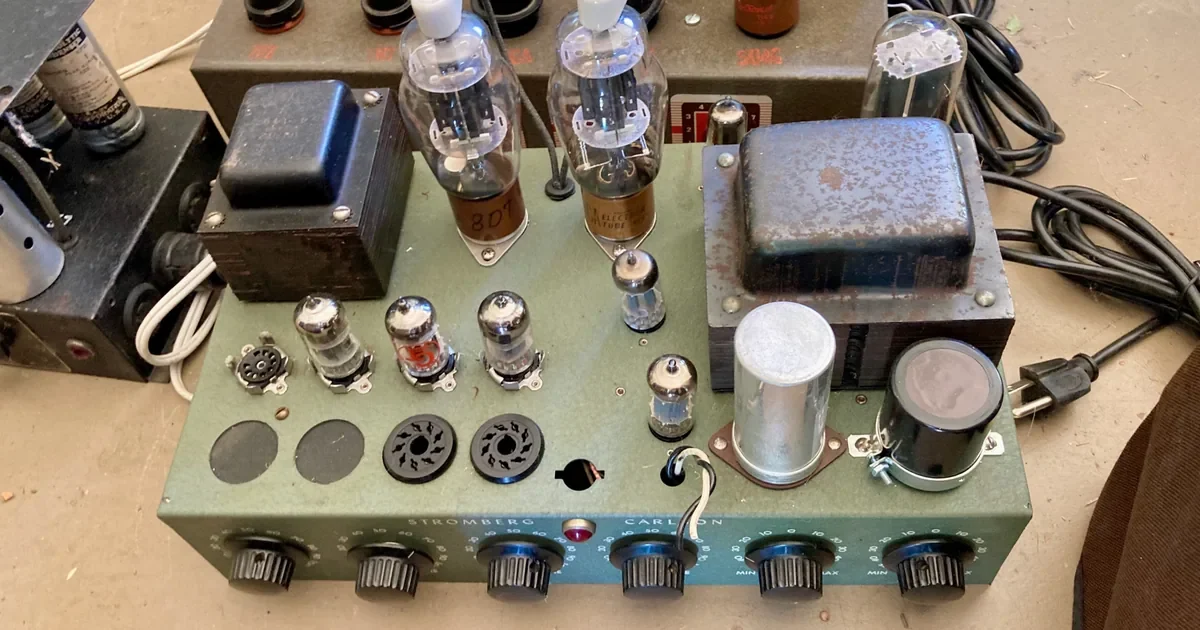
Bare steel rusts. The photograph at the top of this post shows a mottled, rusty transformer cover on a vintage amplifier, the kind of failure a coating exists to prevent. Wikipedia’s anodizing article says pure aluminum self-passivates in air with a film only a few nanometres thick, and that anodizing builds a thicker oxide layer whose pores can absorb dye.
The visible face is the deciding factor for many brands: if the front panel is brushed or bead blasted aluminum with an anodize, the rest of the chassis can be whichever material makes sense, and a matching colour is a finishing question, not a material one.
Machining and cost
We found no public price comparison of finished aluminum and steel amplifier chassis. The nearest public data is a UK broker’s simulated CNC prices (updated August 2026), which compare stainless steel and not mild steel. For a simple 3-axis part it says stainless costs roughly double the price of aluminum, and the ratios in its tables run from about 1.25 to 2.5 depending on part type and quantity. It attributes aluminum’s lower cost partly to machinability and notes harder metals wear tools. We found no mild steel figure, so treat the stainless ratios as a rough marker for steel and not as a quote.
For a short run, ask for both materials on the same drawing and compare. We found no public figure for the finishing share of a steel chassis against an aluminum one.
Choose when
Choose aluminum when the part is a front panel or any visible face, when weight matters, when heat has to spread, when the finish is anodize or when the run is short and machining dominates.
Choose steel when the part is a hidden structural plate under heavy transformers, when a steel can around a transformer is the shielding plan or when the cover is a coated sheet part.
Mix them when the amplifier has both jobs: an aluminum front panel and heatsinks, a steel top plate or transformer cover. A mixed chassis needs a conductive path between the parts, so mask the joint faces or specify a conversion coating, see the EMI post.
What a wrong choice costs. A steel front panel on a product sold on its look usually means a coating where customers expect metal. An aluminum top plate that is too thin sags under the transformers, and fixing it after tooling means a new part.
What to put in the RFQ
- The material, grade and temper for every part, for example 6061-T651 plate and a named steel grade and thickness.
- Which part carries the transformer and its weight, so the supplier can confirm the thickness.
- The finish per part: anodize on aluminum, paint or powder coat on steel, and which faces are cosmetic.
- Whether joints between aluminum and steel parts need a conductive path.
- Quotes for both materials on one part if you have not chosen.
Send the drawing through the RFQ form and we reply within 24 business hours with one itemised quote for the finished parts. Work goes to partner shops that make audio chassis. The wider decision order is in the guide to custom amplifier chassis.
Sources
- Aluminum 6061-T651/T6 data sheet, Protolabs
- SAE-AISI 1018 carbon steel properties, MakeItFrom
- Magnetic shielding, Wikipedia
- Mu-metal, Wikipedia
- Electrical enclosure, Wikipedia
- How much does CNC machining cost, Get It Made (simulated prices, directional)
- Anodizing, Wikipedia
Frequently asked questions
Is an aluminum or a steel chassis better for an amplifier?
Neither wins on every count. Aluminum is lighter, conducts heat about three times better than low-carbon steel in the datasheet values we used, machines faster and anodizes. Steel is stiffer at the same thickness and, unlike aluminum, offers some shielding against the low-frequency field of a mains transformer. A mixed build is possible, with steel where the transformer sits and aluminum for the visible panels.
How thick must a steel plate be to match an aluminum one?
For the same plate stiffness, steel needs about 71% of the aluminum thickness, from the ratio of the two moduli to the power one third. A 3 mm aluminum plate matches roughly 2.1 mm of steel. The steel plate then weighs about twice as much per square metre. These are calculated from typical datasheet values, so confirm with your supplier's grade.
Does a steel chassis shield a mains transformer?
Partly. Faraday-style shielding is ineffective for static or slowly varying magnetic fields, below about 100 kHz, and high-permeability alloys are used instead. Ordinary steel has a relative permeability of several thousand, while mu-metal is reported at 80,000 to 100,000. Distance, orientation and a local can around the transformer can matter more than the chassis material.
Can steel be anodized like aluminum?
No. Anodizing builds an oxide layer from aluminum itself. Steel cabinets may be painted or galvanized, and a powder coat is one route. That changes the look: a coated steel chassis reads as paint, while an anodized aluminum one reads as metal. If the front panel is the cosmetic face, it is usually aluminum either way.
Need a quote for this part?
Send the drawing. We quote the finished parts, place the work with a partner shop and reply within 24 business hours.
Get a quote for your audio parts